




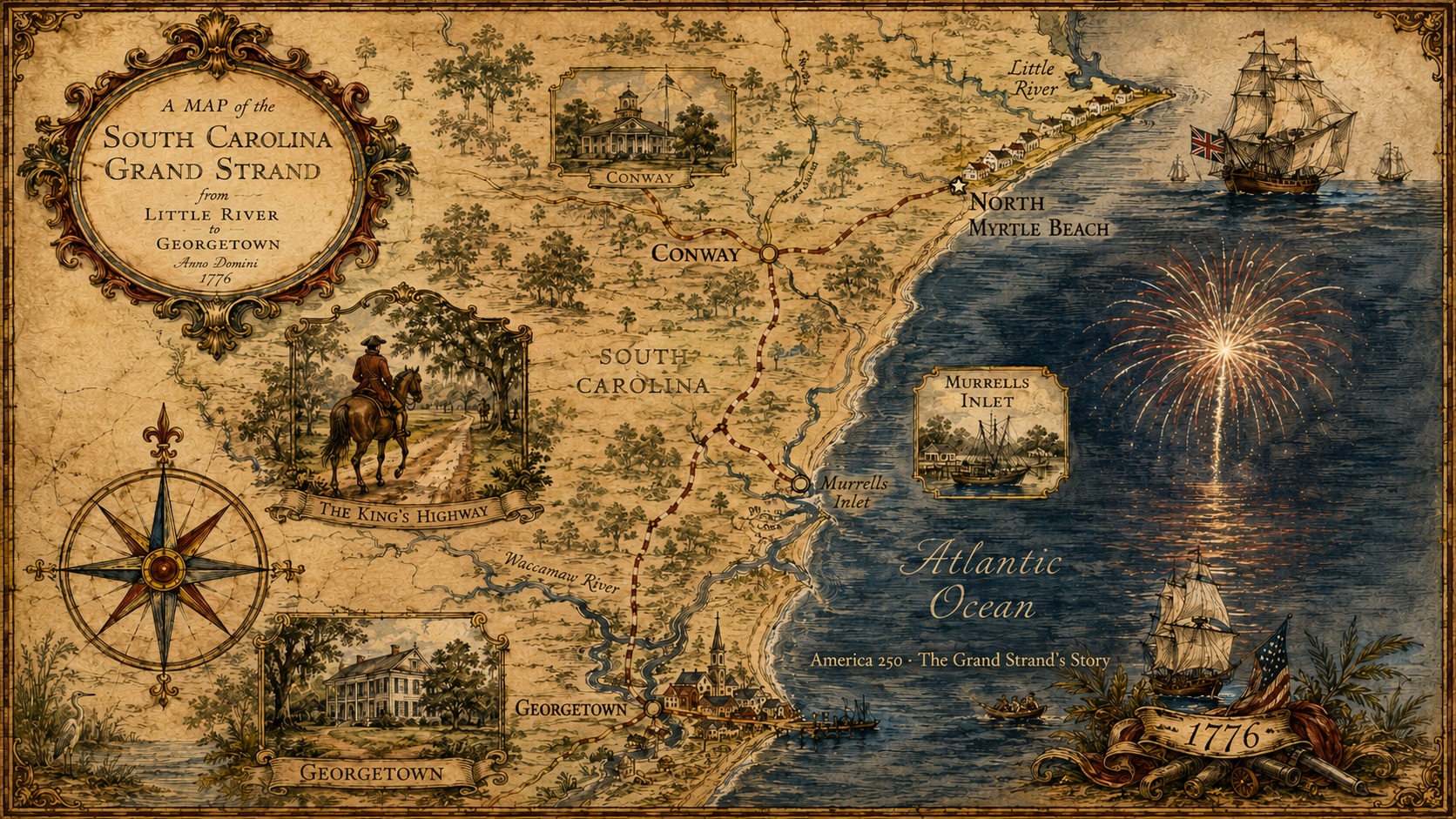
America 250 & the Grand Strand: An Epic Story Hiding in Plain Sight
Table of Contents
- The Grand Strand and America — A Connection Most Visitors Never Know
- Before the Colonies: The Waccamaw People and Spanish Arrival
- Pirates, Planters, and the Road That Connected a Nation
- The Revolution: The Swamp Fox Retreats to Little River
- The Founding Father Born Down the Road
- George Washington Rides Through Windy Hill
- Civil War: Blockade Runners and a Live Cannonball
- Reconstruction: Georgetown’s Son Who Made History in Congress
- World War II: FDR Planned D-Day Thirty Miles from Here
- Celebrating America 250 on the Grand Strand in 2026
- Historic Sites Worth Visiting Near North Myrtle Beach
- Frequently Asked Questions
There is a version of this place that most visitors know well. The one with the morning smell of sunscreen and salt air, the soft thump of waves carrying through an open balcony door before the rest of the family is awake. The pelicans working the surf line. The way late afternoon light turns the water somewhere between green and gold just south of Cherry Grove. That Grand Strand is real, and it is one of the great pleasures of the American South. But there is another version of this place — older, stranger, and far more consequential — that stretches back five centuries and touches almost every major chapter of American history. Most visitors never hear a word of it.
In the summer of 2026, the United States turns 250 years old. Across the country, communities are asking what it means to be part of that story. The Grand Strand — this 60-mile arc of coastline from Little River down through Murrells Inlet, encompassing North Myrtle Beach, Myrtle Beach, Conway, and Georgetown — does not have to look far for its answer. A signer of the Declaration of Independence was born here. The first Black man ever elected to the U.S. House of Representatives grew up here. George Washington rode a horse through what is now North Myrtle Beach and recorded every detail in his diary. Franklin Roosevelt spent four weeks nearby, quietly finalizing the invasion plans for Normandy. The road that carried the news of the first shots of the Revolution south to the colonies still runs through this town — you have almost certainly driven it.
This article is the introduction to a nine-part series. Each piece goes deep on one chapter of Grand Strand history — the pirates, the planters, the soldiers, the legislators, the presidents, and the ordinary people who shaped a republic on this particular stretch of coastline. Together, they tell a story that deserves to be told, in the year it deserves most to be heard.
The Grand Strand and America — A Connection Most Visitors Never Know
Ask most people what they associate with the Grand Strand and they will give you the honest tourist’s answer: golf, seafood, the beach, the Boardwalk, outlet shopping, maybe the Shag if they know their South Carolina. Very few people — even people who have been coming here for decades — know that more Revolutionary War battles were fought on South Carolina soil than in any other colony. Fewer still know that one of those battles happened within Horry County, or that the county itself is named for a colonel who rode alongside the most celebrated guerrilla commander in American history.
That is not a criticism. History has a way of going quiet in places that later become famous for something else. The Grand Strand became famous for its beaches and its hospitality, and that reputation crowded out the earlier story. But the earlier story is there, embedded in the place names, the county boundaries, the roads, and the land itself. Conway’s name comes from Robert Conway, a Revolutionary War militiaman who farmed and fought in the swamps of Horry County. Windy Hill — one of the four communities that merged to form North Myrtle Beach in 1968 — got its name from a future president of the United States who could not keep his hat on while riding the exposed beach strand in 1791. These are not myths or local legends. They are documented historical facts.
America’s 250th anniversary is the right moment to surface them. The national commemoration — officially called the Semiquincentennial, organized through the America250 Foundation and the state-level SC250 commission — is generating an extraordinary amount of public interest in founding-era history. Ken Burns spent nine years making a six-part documentary on the American Revolution that premiered on PBS in November 2025, broke every PBS streaming record in the network’s history, and is now streaming free through July 12, 2026. People are paying attention to this history in a way that happens once a generation. The Grand Strand has a genuine, verified, remarkable story to contribute to that conversation.
Before the Colonies: The Waccamaw People and Spanish Arrival
Long before any European gave this coastline a name, the Waccamaw people lived along the river that still carries their name, fished the creeks and bays, and understood the rhythms of this particular stretch of coast in ways that took settlers centuries to approximate. The Waccamaw were part of the broader Siouan-speaking peoples of the Carolinas and had occupied this territory for thousands of years by the time Spanish explorers arrived at Winyah Bay in 1526 — making that landfall at present-day Georgetown the first documented European contact with what would become the United States.
The Spanish settlement that followed — called San Miguel de Guadalupe — lasted less than a year before disease, starvation, and conflict forced its abandonment. The expedition sailed away. The coast returned to quiet. But that brief landing at Winyah Bay gave this stretch of South Carolina a historical claim that predates the Plymouth Colony by nearly a century. The full story of the Grand Strand’s colonial origins — the pirates who used Little River and Murrells Inlet as hiding places, the Carolina Gold rice empire that made Georgetown County the wealthiest in all thirteen colonies, and the road that would eventually connect a nation — is told in depth in the first article of this series.
Pirates, Planters, and the Road That Connected a Nation
In the early 1700s, the coves and inlets of the northern Grand Strand were not vacation destinations. They were hiding places. The shallow, labyrinthine waterways around Little River and Murrells Inlet were ideal for vessels that needed to disappear quickly, and the most notorious pirates of the Golden Age — Blackbeard, Stede Bonnet, and others whose names appear in the colonial court records of the era — used this coastline as a staging ground for raids on Atlantic shipping lanes. Georgetown, founded in 1729 and now the third oldest city in South Carolina, became the commercial center of a rice economy so productive that by the mid-1700s, Georgetown County was generating more wealth per capita than any county in any of the thirteen colonies.
Running through all of it — literally — was the King’s Highway. Ordered by King Charles II of England around 1660 and completed by 1735, this 1,300-mile road connected Boston to Charleston and served as the postal route, the military corridor, and the primary artery of colonial commerce along the Atlantic seaboard. In Horry and Georgetown counties, the King’s Highway is what we now know as U.S. Highway 17 — and in parts of Myrtle Beach and North Myrtle Beach, it still carries the name Kings Highway on local road signs. The history of that road, and of the president who rode it through Windy Hill, is told in its own dedicated article in this series.
The Revolution: The Swamp Fox Retreats to Little River
When the British captured Charleston in May 1780 — the largest surrender of American forces during the entire Revolutionary War — the Continental Army’s formal military presence in South Carolina effectively collapsed. What did not collapse was the resistance organized in the swamps and pine forests of the backcountry, and some of that resistance had its roots right here. General Francis Marion, who would earn the name “the Swamp Fox” for his elusive guerrilla tactics, retreated to his brother Isaac’s farm near Little River after the fall of Charleston. It was from this coastline that he began organizing the irregular warfare that would eventually help turn the tide of the Southern Campaign.
Marion’s troops encamped at Kingston — the settlement that would become Conway — during their movements through Horry County. The Battle of Bear Bluff, a documented skirmish on the Waccamaw River, involved local militia fighters whose family names still appear in Horry County today. And Colonel Peter Horry, for whom the county is named, served as one of Marion’s most capable commanders throughout the Southern Campaign. The Horry County Museum in Conway, which is free to visit and houses a significant new 2026 exhibition on the county’s Revolutionary War history, is the best place to see this story laid out with artifacts and primary sources. The full account of Marion, Horry, and the Revolution on Grand Strand ground is the subject of Article 3 in this series.
The Founding Father Born Down the Road
Thirty-five miles south of Crescent Beach, on a bluff above the North Santee River, stands Hopsewee Plantation — a Georgian-style house built around 1740 and listed today on the National Register of Historic Places. It is open to visitors Tuesday through Saturday. Thomas Lynch Jr. was born there in 1749, educated at Eton College and Cambridge University in England, and returned to South Carolina to take his place in the political leadership of a colony on the verge of revolution. In 1776, at the age of 26 and already suffering from the illness that would kill him three years later, he signed his name to the Declaration of Independence.
Lynch and his father Thomas Lynch Sr. were the only father-and-son pair to serve simultaneously in the Continental Congress, making their family’s contribution to the founding of the Republic unique among all the founding generation. Thomas Jr. died at sea in 1779, lost with his wife on a voyage from Charleston to the West Indies — never knowing how the Revolution would end, never seeing the Constitution he helped make possible. His autograph is today among the rarest of any of the 56 signers. And the house where his story began is a forty-minute drive from the nearest North Myrtle Beach vacation rental. Article 4 of this series tells his story in full.
George Washington Rides Through Windy Hill
In the spring of 1791, two years into his first term as the nation’s first president, George Washington set out from Philadelphia on a Southern Tour — a 1,900-mile journey through the former colonies intended to unify a fragile young republic and reassure citizens from Virginia to Georgia that their new government was real, present, and on their side. Washington traveled south along the King’s Highway, keeping the meticulous diary he maintained throughout his public life. On April 27th, he crossed the North Carolina–South Carolina border just north of Little River, dined with a local Revolutionary War veteran, and spent the night at the indigo plantation of Jeremiah Vereen. He wrote that Vereen had entertained him very kindly without accepting any payment.
The next morning, Vereen guided Washington across the swash and onto the beach strand — the same exposed oceanfront that visitors walk today between Ocean Drive and Windy Hill. The wind coming off the Atlantic was fierce. Washington’s hat blew off so many times during the ride south that the stretch of beach where it happened began to be called Windy Hill by locals — and Windy Hill is one of the four communities that merged in 1968 to form the city of North Myrtle Beach. The name on the road signs, the name on the real estate listings, the name in the vacation rental searches: all of it traces back to one gusty April morning when the first president of the United States could not keep his hat on his head. Article 2 of this series follows that ride in detail, using Washington’s own diary entries as the guide.
Civil War: Blockade Runners and a Live Cannonball
The same geographic features that made Little River and Murrells Inlet useful to pirates in the 1700s made them strategically significant during the Civil War. Confederate blockade runners used the shallow inlets of the northern Grand Strand to slip past Union naval patrols on routes to Nassau, Bermuda, and Havana, trading cotton for weapons, medicine, and goods the Confederacy could not manufacture. Admiral Dahlgren launched a six-warship assault on the Murrells Inlet position in December 1864 that was repulsed. In March 1865, the USS Harvest Moon — the Union flagship on the South Atlantic Blockading Squadron — was sunk by a Confederate torpedo in Winyah Bay near Georgetown. Georgetown itself was occupied by Union forces in February 1865, one of the last Southern port cities to fall.
And then there is the cannonball. During construction work in downtown Conway, workers excavating near City Hall found a Civil War-era cannonball buried in the root system of a live oak tree. It was still live — still capable of detonating — and military ordnance specialists had to be called in to dispose of it safely. History has a way of surfacing itself in this part of South Carolina, sometimes literally. Article 5 of this series tells the full Civil War story of the Grand Strand.
Reconstruction: Georgetown’s Son Who Made History in Congress
Joseph Hayne Rainey was born in Georgetown in 1832, the son of a man who purchased his own family’s freedom through his work as a barber. During the Civil War, Joseph was conscripted by Confederate forces to work on military fortifications; rather than submit, he and his wife escaped to Bermuda, where he worked as a barber and waited for the war to end. He returned to Georgetown in 1866 and within four years had accomplished something no American had accomplished before: in November 1870, he became the first Black man elected to the United States House of Representatives.
Rainey served five terms — the longest tenure of any Black congressman during the Reconstruction era — and used that platform to champion the 14th Amendment, to argue for federal enforcement of civil rights law, and to push for the establishment of public schools for all children regardless of race. A room in the United States Capitol, designated H-150, is named in his honor. A post office on Georgetown’s Front Street carries his name. A park on the Georgetown waterfront is named for him. He walked the same streets that visitors walk today on a Georgetown day trip — and his story is one of the most consequential stories in the constitutional history of the Republic. Article 6 of this series is dedicated entirely to him.
World War II: FDR Planned D-Day Thirty Miles from Here
Thirty miles south of Myrtle Beach, on 16,000 acres assembled from fourteen former rice plantations along the coast near Georgetown, Bernard Baruch — born in Camden, South Carolina, and one of the most influential financial and political figures of the twentieth century — built an estate he called Hobcaw Barony. Baruch served as economic adviser to Presidents Wilson, Roosevelt, and Truman, among others. His property became a place of extraordinary historical significance. Winston Churchill came to Hobcaw in 1932 to recuperate after being struck by a car in New York City. In the spring of 1944, President Franklin Roosevelt spent four consecutive weeks at Hobcaw — the longest vacation of his four-term presidency — and it was during those weeks that the Allied plans for the D-Day invasion of Normandy were finalized.
Meanwhile, Baruch’s daughter Belle — a noted equestrian, conservationist, and landowner in her own right — was patrolling the South Carolina coastline from her beach cottage, watching for German U-boats that were operating with alarming frequency in the waters off the Grand Strand. The Hobcaw Barony Discovery Center is open to visitors today, roughly thirty miles south of North Myrtle Beach oceanfront homes and oceanfront condos. Article 7 of this series tells the full Hobcaw story.
Celebrating America 250 on the Grand Strand in 2026
The national America250 Foundation — chartered by Congress to lead the Semiquincentennial commemoration — has organized the largest synchronized Fourth of July celebration in United States history for July 3–4, 2026, with simultaneous events in cities across the country. South Carolina, through the SC250 commission chartered by the state General Assembly in 2018, has organized a year-long calendar of events spanning all 46 counties. Charleston — named by Congress as one of only four national “signature cities” alongside Boston, Philadelphia, and New York — is hosting a packed calendar of events including symposia, living history demonstrations, concerts, and waterfront celebrations throughout June and July.
For visitors staying in North Myrtle Beach, the Grand Strand’s own calendar in the summer of 2026 offers a rich mix of celebration and history. The Horry County Museum in Conway — free admission, located in a beautifully converted historic building on Main Street — has launched a dedicated 2026 exhibition on Horry County’s role in the Revolution. Ken Burns’s six-part documentary series “The American Revolution” — which premiered on PBS in November 2025 and shattered the network’s streaming records — is available free on all PBS platforms from Memorial Day through July 12, 2026, making it the perfect companion viewing for any trip that includes a visit to the historic sites described in this series. And North Myrtle Beach’s own 4th of July celebrations, as always, rank among the most spectacular on the East Coast — fireworks over the ocean, live music, and a shoreline that has witnessed American history for five centuries.
Historic Sites Worth Visiting Near North Myrtle Beach
Every article in this series connects to a real, visitable place. These are not reconstructions or theme parks — they are the actual locations where the history happened, most of them within an hour’s drive of Ocean Drive or Cherry Grove Beach.
| Site | Location | Historical Connection |
|---|---|---|
| Horry County Museum | Conway | 2026 Revolution exhibit; county history from Indigenous era to present. Free admission. |
| Vereen Memorial Historical Gardens | Little River | Original King’s Highway roadbed; Washington slept at the Vereen plantation April 27, 1791. |
| Hopsewee Plantation | Near Georgetown | Birthplace of Thomas Lynch Jr., signer of the Declaration of Independence. Guided tours Tue–Sat. |
| Hobcaw Barony Discovery Center | Georgetown area | FDR finalized D-Day plans here during a four-week stay in spring 1944. Churchill visited 1932. |
| Joseph Hayne Rainey Park & Post Office | Georgetown Front Street | Named for the first Black congressman in U.S. history, born in Georgetown in 1832. |
| Rice Museum | Georgetown | Documents the Carolina Gold rice economy that made Georgetown the wealthiest colonial county. |
| Hampton Plantation State Historic Site | McClellanville | Washington visited in May 1791 and asked that the “Washington Oak” live oak be preserved — it still stands. |
Frequently Asked Questions
Make North Myrtle Beach Your Base for America 250
There has never been a better summer to dig into the history hiding right outside your door. From Cherry Grove to Windy Hill, North Myrtle Beach puts you within easy reach of Hopsewee Plantation, Hobcaw Barony, the Horry County Museum, and the stretch of beach where the first president of the United States rode in the summer of 1791. Thomas Beach Vacations has the perfect oceanfront home or condo for your group — call (843) 273-3001 or browse our full selection of oceanfront homes and oceanfront condos at northmyrtlebeachvacations.com.
This article is the hub piece of Thomas Beach Vacations’ nine-part America 250 & the Grand Strand series, published in June 2026 to mark the 250th anniversary of American independence. Historical facts have been verified against primary sources including George Washington’s published diary, the Horry County Museum, the South Carolina Encyclopedia, and the records of the SC250 commission. Thomas Beach Vacations is a locally owned vacation rental company serving North Myrtle Beach, South Carolina.