



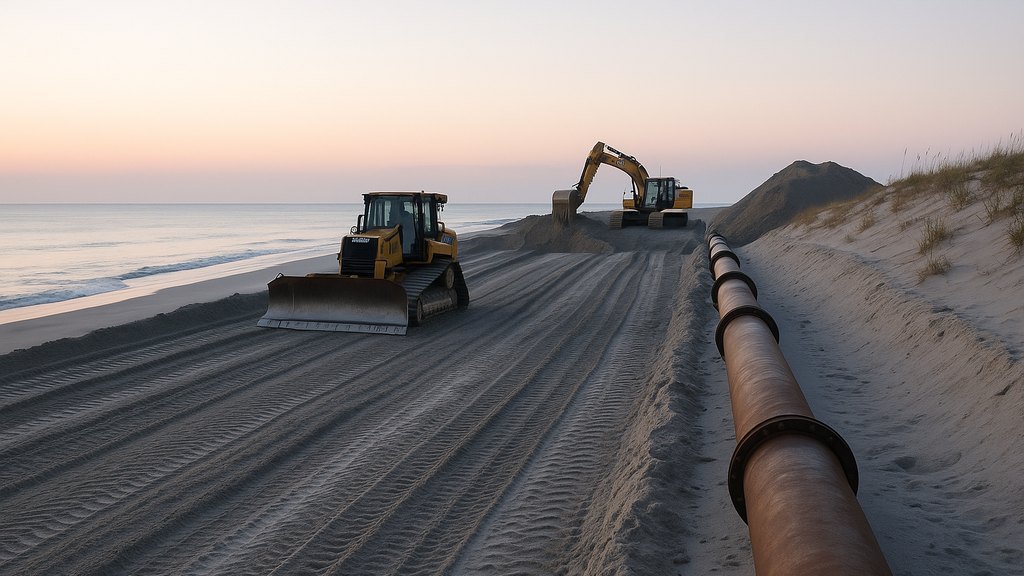
The U.S. Army Corps of Engineers, Charleston District, has finished an emergency renourishment of 28 miles of Grand Strand shoreline, placing 2.15 million cubic yards of sand at a cost of $72 million. North Myrtle Beach received 675,000 cubic yards across eight miles, completed January 31, 2026. The work was fully federally funded and repairs erosion from Hurricanes Ian and Debby.
Table of Contents
NORTH MYRTLE BEACH, S.C. — The beach in front of North Myrtle Beach is wider and higher than it was two years ago, and that is by design. The Army Corps of Engineers has completed a $72 million emergency renourishment covering 28 miles of the Grand Strand, rebuilding the engineered sand barrier that absorbs storm surge before it reaches roads, utilities and oceanfront buildings.
What the Project Covered
The Charleston District of the U.S. Army Corps of Engineers placed 2.15 million cubic yards of sand across roughly 28 miles of coastline, split into three segments. Houston-based Great Lakes Dredge & Dock Co. held the construction contract.
The work was authorized as emergency repair following erosion from Hurricane Ian in 2022 and Hurricane Debby in 2024. Both storms drew down the engineered beach profile well below its design template, which is the trigger for federal repair funding.
How the Sand Was Divided
North Myrtle Beach received 675,000 cubic yards spread over about eight miles, and that segment finished first, on January 31, 2026.
Myrtle Beach followed with 850,000 cubic yards across 7.5 miles, running from May through July 3, 2026. Surfside Beach and Garden City closed out the project with 610,000 cubic yards over 12 miles between July 3 and August 15, 2026.
Sequencing the segments this way kept active construction off any single stretch of beach for the whole season, and put the North Myrtle Beach work in the winter months, well clear of the summer visitor period.
How an Engineered Beach Actually Works
A renourished beach is not simply a cosmetic sand refill. The Corps builds a berm and dune profile to a specific width and elevation, designed so that storm waves expend their energy chewing through sand rather than reaching the infrastructure behind it.
“The sand we place isn’t just recreation; it’s engineered to take the hit so communities don’t have to,” said Sonja Carter, the project manager for the Charleston District.
That is the origin of the phrase used in the Corps’ own account of the work — sacrificial sand. The beach is expected to erode. Losing sand during a storm is the system functioning correctly, not failing, and it is why periodic renourishment cycles are built into the project from the start.
A Dredging Technique That Sped Things Up
The dredge Amelia Island used booster pumps to push sand roughly 15,000 feet down the pipeline, about triple the 5,000-foot distance typical for this kind of placement.
The practical benefit for beachgoers was less equipment parked on the sand and shorter closure windows on any given stretch, because the dredge could stay offshore longer and reach farther without repositioning the pipeline as often.
Why Local Governments Paid Nothing
The $72 million was fully federally funded. Because the work was classified as emergency repair of an authorized federal shore protection project, the usual local cost-share requirement did not apply, saving Horry County municipalities millions.
The economic argument behind that funding is straightforward: Grand Strand tourism contributes more than $12 billion a year, and nearly all of it depends on the beach itself remaining usable and on oceanfront infrastructure surviving storm seasons.
What Visitors Will Notice
The most visible change is width. On the North Myrtle Beach segments, the dry beach at mid-tide is noticeably deeper than it was before the work, which means more room at high tide and a longer walk to the water at low tide.
Newly placed sand also tends to be coarser and shell-heavier than the beach it replaces, and it settles and sorts over a season or two. Fresh dune plantings are fenced in places; those fences protect the dune system and should not be crossed.
Guests staying in Cherry Grove Beach, Ocean Drive, Crescent Beach and Windy Hill are all on segments covered by the January 2026 placement.
Frequently Asked Questions
Sources: U.S. Army Corps of Engineers, Charleston District, via DVIDS and army.mil, “Holding the Line: The Sacrificial Sands of the Grand Strand” by Dylan Burnell, published September 17, 2026, for project scope, sand volumes by segment, completion dates, contractor, dredging method, funding and the quote from project manager Sonja Carter. U.S. Army Corps of Engineers material is a work of the federal government.