




Between the Waters: Hobcaw Barony, Bernard Baruch, FDR, and Churchill on the Grand Strand
Table of Contents
- Between the Waters: The Land Before Baruch
- The Lone Wolf of Wall Street
- The Purchase: Fourteen Plantations, One Barony
- The Park Bench Statesman
- The Night Churchill Got Hit by a Car
- The President Comes to Hobcaw
- Belle: The Baroness of Hobcaw
- The Gift That Lasted
- Hobcaw Barony Today
- Frequently Asked Questions
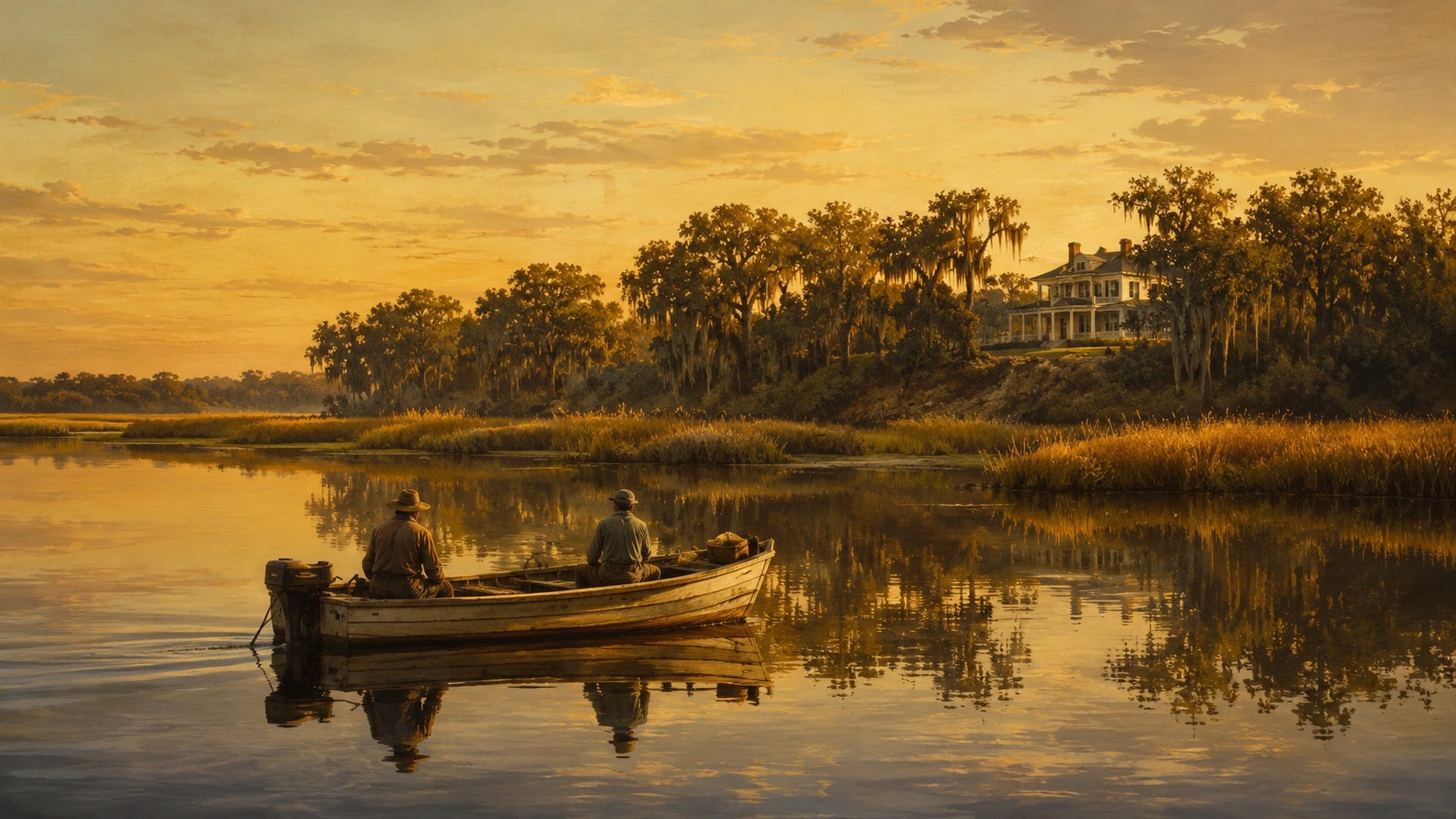
Thirty miles south of Myrtle Beach, past the long flat reach of Highway 17 where the live oaks close in over the road and the marsh opens on both sides like a held breath, there is a gate. Beyond it, 16,000 acres of South Carolina Lowcountry sit largely as they have always sat — pine forest and salt marsh, rice field canals gone back to water, cypress swamp and tidal creek, the whole ancient geography of the Waccamaw Neck doing what it does, unhurried and indifferent to the fact that human history has moved through it at a remarkable velocity. The Waccamaw people were here first. The English rice planters came and built their earthwork empire and then lost it. And then, in 1905, a self-made millionaire from a Jewish immigrant family in Camden, South Carolina, drove down and looked at what was left of fourteen ruined plantations and saw something the planters themselves had never fully understood. He saw a place worth saving.
His name was Bernard Mannes Baruch. He was thirty-five years old. He had already made more money than most men see in several lifetimes, and he would go on to serve as adviser to every American president from Woodrow Wilson to John F. Kennedy. He would chair the War Industries Board in World War I and mobilize an economy for World War II. He would stand before the United Nations in 1946 and propose a plan that, had it been accepted, might have prevented the nuclear arms race that defined the second half of the twentieth century. He would become known, for his habit of sitting on a park bench across from the White House and receiving government officials as if the bench were an office, as the Park Bench Statesman. He was one of the most influential private citizens in the history of the republic. And through all of it, through two world wars and the Depression and the atomic age, he kept coming back to a piece of South Carolina Lowcountry between the waters — the place the Waccamaw people had named long before anyone else thought to name it. He kept coming back to Hobcaw.
Presidents came to him there. Winston Churchill convalesced there after nearly being killed in a New York street. Generals and senators and financiers came, and went home changed in the way people do when they have spent time in a place that requires them to be quiet. The Lowcountry has always had that quality — the marshes and the rice creeks and the slow-turning tides that do not adjust their pace for anyone, not for power or money or the urgency of war. Hobcaw Barony absorbed all of it and remained what it was: 16,000 acres of life, going about its business, between the waters.
Between the Waters: The Land Before Baruch
The word itself is old. The Waccamaw people, who had lived along the rivers and coastlines of what is now South Carolina long before any European arrived to name things, called the peninsula at the southern end of Waccamaw Neck by the word hobcaw — between the waters. It was an apt description then and it remains one now. The land sits at a narrow junction where Winyah Bay closes in from the west and the Atlantic holds the east, a finger of earth pressed between two bodies of water, tidal rivers feeding into both sides. The Waccamaw used it seasonally — hunting deer and turkey from its pine forests, harvesting seafood from its marshes, leaving behind the shell middens that still exist today as small rising islands in the spartina grass.
In 1718, King George I of England granted the land — 12,000 acres at Hobcaw Point — to John Lord Carteret, one of the Lords Proprietors of the Carolina colony. Carteret never saw it. He sold the undeveloped land twelve years later without having set foot on it, and over the following decades the peninsula was surveyed, subdivided, and parceled into individual rice plantations. By the mid-18th century, the Waccamaw Neck was thick with them — tidal fields carved from cypress swamp by enslaved people who brought with them from the West African Rice Coast the knowledge of how to manage water in a tidal system. The rice grew. The planters prospered. The enslaved people did the work and received nothing for it but the continuation of their bondage.
After the Civil War, the system collapsed. Commercial rice production on the South Carolina coast declined steadily through the latter half of the nineteenth century, killed by the combination of labor costs, competition from rice-growing regions further west, and a series of storms and hurricanes that ravaged the tidal infrastructure. By 1905, most of the old plantations on the Waccamaw Neck were in disrepair — the rice fields reverting to marsh, the plantation houses peeling, the earthwork dikes that had held the water back for more than a century slowly dissolving back into the land. That was the moment Bernard Baruch drove down from New York and saw what the decline had left behind. He thought it was perfect.
The Lone Wolf of Wall Street
Bernard Baruch was born on August 19, 1870, in Camden, South Carolina — the second son of Dr. Simon Baruch, a German Jewish immigrant who had come to South Carolina before the war and served as a medical officer in the Confederate Army, and Isabella Wolfe, a Camden woman of Sephardic Jewish descent. After the war, Simon moved his family to New York, where he taught medicine at Columbia University and pioneered surgical techniques, including an early form of the appendectomy. His son Bernard graduated from the City College of New York in 1889, worked briefly in a linen office, and then went to Wall Street.
What happened next was the kind of rise that the Gilded Age occasionally produced and then spent the rest of the century trying to explain. Baruch started as an office boy at the brokerage house A. A. Housman & Company in 1891. He was methodical where other traders were impulsive. He studied industries the way a man studies for an exam — railway routes and business law and commodity markets and the hidden mathematics of risk. He was not reckless. He was calculating in the best possible sense, and he was right more often than he was wrong, which is all Wall Street ultimately requires. By 1897, after brilliant trading in sugar stocks, he had enough money to buy a seat on the New York Stock Exchange and to marry Annie Griffen. By 1903 he had established his own brokerage. Before he was thirty-five years old, he was a millionaire many times over.
Wall Street gave him a nickname: the Lone Wolf. He worked alone, told no one his positions, trusted his own analysis over the crowd’s noise. It was the right nickname in the right decade. The crowd, in 1929, would be spectacularly and catastrophically wrong about the stock market. Baruch had seen it coming years earlier and had already moved his money to safety. He reportedly warned friends — including Winston Churchill and humorist Will Rogers — to do the same. Some listened. The ones who didn’t lost everything along with most of the country.
The Purchase: Fourteen Plantations, One Barony
Between 1905 and 1907, Baruch bought fourteen separate plantation tracts on the Waccamaw Neck and assembled them into a single property he renamed — reclaiming the old colonial designation — Hobcaw Barony. He called it, in his own memoir, a veritable Shangri-La in his native South Carolina. He meant the place itself: the miles of longleaf pine, the tidal marshes, the duck-thick mornings when the birds rose from the old rice fields in formations so dense they blocked the sun like weather. He was a hunter and he had found one of the best places in the country to be a hunter, and he had bought it.
But Hobcaw was never only a hunting preserve. It was also a place where Baruch could think without being watched — where the men who needed his counsel could come and have a real conversation without reporters following every word into the morning papers. Washington was exhausting in this way, full of people who turned private thoughts into public currency. On the Waccamaw Neck, with the bay on one side and the ocean on the other and the marsh blocking every road, a man could talk. Baruch entertained accordingly: Generals Omar Bradley and George Marshall hunted turkey in the pines. Senators Robert Taft and Harry Byrd came. Ralph Pulitzer came. The politician and the financier and the general, all of them finding their way down Highway 17 to the gate, all of them leaving something of the city behind them when they arrived.
Baruch rebuilt the main house overlooking Winyah Bay — Hobcaw House — into something suited for hospitality on a serious scale. The property included more than seventy historic buildings and structures: the old slave cabin villages of the plantation era, which Baruch largely preserved; the cemeteries; the barns and pump houses and the old plantation infrastructure that the former owners had left to the weather. He also added what the era required: a boathouse, stables, outbuildings for staff. The place he assembled was not a museum. It was a working retreat, breathing and changing, where the past was present in the buildings and the land and the people who had always lived there.
The Park Bench Statesman
Baruch’s public life began in 1916, when President Woodrow Wilson appointed him to the Advisory Commission to the Council of National Defense. It was an unlikely fit in one sense — Baruch was a speculator, not an industrialist or an engineer — and exactly the right fit in another. The country was moving toward war and someone needed to understand how to turn the enormous, diffuse machinery of American commerce into a directed instrument of military production. That required someone who understood prices, supply chains, the hidden relationships between industries, and the way that money moved under pressure. On March 4, 1918, Wilson appointed Baruch chairman of the War Industries Board, vastly expanding the board’s authority to regulate production, set prices, allocate raw materials, and coordinate the entire industrial output of the United States for the war effort.
The press called him an industrial czar. He was never quite that — the WIB worked largely by persuasion rather than coercion, and the military retained its own contracting authority — but the result was real. American industrial production was mobilized in a way that had not been attempted before, and when Baruch accompanied Wilson to the Paris Peace Conference in 1919 as an economic adviser, he carried with him the authority of a man who had proved that he understood what industrial power actually meant. He would spend the next four decades trying to make sure the country never forgot that lesson.
In the years between the wars, Baruch cultivated his reputation for accessible wisdom in the most literal possible way: he sat on park benches. In Lafayette Park, across from the White House, he received senators and cabinet members and newspaper columnists on an outdoor bench the way other men received visitors in offices. He was so associated with this practice that the post office once delivered a letter addressed simply “Bernard Baruch, Lafayette Park, Washington, D.C.” — and it found him. The nickname stuck: the Park Bench Statesman. It was a good description of a man who had discovered that informal settings — a park bench, a duck blind, a dining room in a house on Winyah Bay — produced better conversations than formal offices ever did.
Hobcaw Barony: A Timeline of Remarkable Events
| Date | Event |
|---|---|
| 1718 | King George I grants 12,000 acres to John Lord Carteret — the original Hobcaw Barony |
| 1766–1767 | Land surveyed and divided into individual rice plantations along Waccamaw Neck |
| 1905–1907 | Bernard Baruch purchases 14 plantation tracts and assembles Hobcaw Barony, 16,000 acres |
| March 1918 | Wilson appoints Baruch chairman of the War Industries Board; mobilizes U.S. industry for WWI |
| Dec. 13, 1931 | Churchill struck by car on Fifth Avenue in New York; fractured nose and ribs, pleurisy |
| January 1932 | Churchill recuperates at Hobcaw Barony; arrives with daughter Diana |
| 1930–1931 | Belle Baruch wins President of the Republic’s Cup at the Paris Horse Show in consecutive years |
| 1935–1956 | Belle purchases Hobcaw Barony from her father piece by piece; owns it entirely by 1956 |
| April–May 1944 | FDR recuperates at Hobcaw Barony — longest vacation of his four-term presidency |
| June 6, 1944 | D-Day — one month after FDR left Hobcaw; Allied invasion of Normandy |
| June 14, 1946 | Baruch presents the Baruch Plan to the UN Atomic Energy Commission: “We are here to choose between the quick and the dead” |
| April 25, 1964 | Belle Baruch dies of brain cancer at age 64; leaves Hobcaw to the Belle W. Baruch Foundation |
| June 20, 1965 | Bernard Baruch dies in New York at age 94, having advised every president since Wilson |
The Night Churchill Got Hit by a Car
Late in the evening of December 13, 1931, Winston Churchill stepped out of a taxicab on Fifth Avenue in Manhattan, looked left — as one does in England, where traffic comes from the right — and was struck by a car coming from his right at approximately 35 miles per hour. The driver, Mario Cantasano, had no time to stop. Churchill went down on the pavement. He was fifty-seven years old, on a lecture tour of America to recover money he had lost in the 1929 crash, and on his way, of all places, to find his friend Bernard Baruch’s apartment. He had forgotten the address and thought he recognized the block. He did not.
The damage was serious: fractured nose and ribs, a three-inch gash across his forehead, severe shock. He was taken to Lenox Hill Hospital and developed pleurisy. His convalescence would stretch to nearly two months. Churchill would later write about the accident for the Daily Mail with characteristic compression: he described the moment of impact as “one moment — I cannot measure it in time — of a world aglare.” He had the fur-lined overcoat to thank for his life. Without it, the doctors said, the impact would likely have killed him. The world, in December 1931, came very close to losing the man it would desperately need by 1940.
When Baruch heard what had happened to his friend — Churchill had been looking for his apartment, of all the bitter ironies — he reached out immediately. Come to Hobcaw, he said. We will take good care of you. Churchill, who had convalesced first in Nassau with his family, took Baruch up on the offer and arrived at Hobcaw Barony in January 1932, bringing along his eldest daughter Diana. He stayed through January — resting, eating, walking the property, getting his strength back in the pine-scented air of the South Carolina Lowcountry. He remembered the people of Georgetown warmly for the rest of his life, and he later described Bernard Baruch as his finest American friend. His granddaughter Celia Sandys, visiting Hobcaw exactly 72 years after Churchill’s stay, echoed the phrase when she arrived at the front door of Hobcaw House: she said Baruch was her grandfather’s finest American friend. Baruch’s chair from that visit is still there, in the house, where it has always been.
The President Comes to Hobcaw
By the spring of 1944, Franklin Roosevelt was a man running on reserve. He had been president for eleven years. He had guided the country through the Depression and steered it into and through a world war that was, in April of that year, not yet won. He was sixty-two years old, had been polio-stricken since 1921, and was showing symptoms of congestive heart failure that his physician, Admiral Ross McIntire, could no longer manage with schedule adjustments and press management. McIntire prescribed rest. Real rest — not the kind that happened in Washington surrounded by the permanent machinery of power, but the kind that required removing the president from the capital entirely and setting him down somewhere the capital could not easily follow.
Baruch offered Hobcaw. Roosevelt accepted, and in April 1944 a presidential train rolled into Georgetown — trailing a Marine detachment, Secret Service agents, FBI agents, and a small corps of reporters who were keeping the arrangement quiet enough that Baruch later noted the visit had been simultaneously a state secret and entirely obvious to everyone in Georgetown County. The motorcade came through town, the small airport saw a steady parade of military personnel, and the local community understood, the way small towns do, that something significant was happening behind the gates on the Waccamaw Neck.
Baruch gave the president the entire Hobcaw House and moved himself to Belle’s home on the property a few miles away. The bedroom prepared for Roosevelt was on the lower floor, with large windows looking out over Winyah Bay — and because the standard beds were not suited to a man with his degree of paralysis, the Baruchs had a custom three-quarter bed built for him, positioned so he could see the water. Baruch’s wife Annie commissioned a custom ivory candlewick spread. Roosevelt pulled out a cigarette and, at some point in those weeks, burned a hole in it. The spread, with its burn hole, is still on the bed today.
What was supposed to be two weeks became a month. The president slept ten to twelve hours a day. He fished from boats on Winyah Bay with Baruch. He rode out to the nearby plantation properties and walked in the pine forest and sat in the salt air. McIntire, who had described the president on his arrival as pale, wan, and in terrible health, with a cough, described him differently when he left. He left, the admiral said, tanned and in better health than in many a year. The month on Winyah Bay gave Roosevelt what Washington had been unable to give him: actual stillness. He left Hobcaw in May 1944. D-Day — the Allied invasion of Normandy — came on June 6, one month later. He died less than a year after that, on April 12, 1945, in Warm Springs, Georgia.
The Lowcountry held him, for those four weeks, the way it holds everything — without opinion, without urgency, with that flat and patient indifference to human importance that is the particular gift of places where the tides come and go regardless. The president of the United States sat in a chair on a South Carolina bay and watched the water and slept twelve hours and ate Baruch’s food and got better, temporarily, against all the evidence of what was happening to his body. Hobcaw gave him what it had given Churchill: a month in which nothing was required but to survive it.
Belle: The Baroness of Hobcaw
Belle Wilcox Baruch was born on August 16, 1899, the eldest of Bernard and Annie Baruch’s three children, and she grew up between two worlds — the New York world of power and money and social obligation that her father navigated with such skill, and the Hobcaw world of pine and marsh and early mornings on the water, which she preferred absolutely and without apology. From the time she was a child she was at home in the Lowcountry in a way that city children rarely are — hunting and fishing and riding horses with a competence that shaded quickly into brilliance.
In the late 1920s she went to Europe, drawn to the competitive equestrian circuit that was then one of the most demanding athletic arenas on the continent. She was not doing what a wealthy American heiress was expected to do in Paris; she was winning. In 1930 and again in 1931, Belle Baruch won the President of the Republic’s Cup at the Paris Horse Show — the classic competition, the one that counted. In the 1931 competition, she was the only one of 119 contestants to post a perfect score. She won more than 300 prizes in competition across France and other countries. When the American embassy in Paris refused to issue her a competition license because she was a woman, she obtained one from the French government and kept competing.
By the mid-1930s, Europe had changed. Hitler and Mussolini had both reportedly tried to buy Belle’s prize horse, Souriant, and she had refused both of them. By 1936, Churchill wrote to Bernard Baruch with a clear message: bring your daughter home. Germany was getting dangerous, and people who had publicly defied the Fascist leaders were not safe. Belle returned, and with her she brought her horses. Her father, as persuasion, offered to build her a house at Hobcaw — which he did, along with stables, dog kennels, and an airplane hangar, because Belle was also a pilot. She built her life at Hobcaw the way her father had built his career: deliberately, on her own terms, without particular interest in what other people thought she should do.
Beginning in 1935, Belle started buying Hobcaw from her father, piece by piece. By 1956 she owned all of it. She managed 16,000 acres of South Carolina Lowcountry with a conservation sensibility that was genuinely ahead of her time — she watched the development spreading along South Carolina’s coast and understood what it meant for the estuaries, the pine forests, the fish populations, the birds. She understood that habitats had to be maintained, that land had to be managed as a system, that the market economy had no mechanism for preserving the things it found unprofitable. She decided, quietly and completely, that her land would not be sold.
The Gift That Lasted
In 1963, Belle Baruch was diagnosed with brain cancer. She was sixty-four years old. She spent her final months at Hobcaw, in the place she had loved since childhood and managed for thirty years, surrounded by the land and the staff who had been with her through all of it. She died on April 25, 1964. She had no children. Neither did her brother or sister. There was no one to leave it to in the way families leave things — as inheritance, as continuation. So she left it to the future instead.
Her will established a private foundation for the purpose of teaching and research in forestry, marine biology, and the care and propagation of wildlife and flora and fauna in South Carolina, in connection with colleges and universities in the state. She intended to name the foundation after her father — the man whose money had made Hobcaw possible, and whose public career had shaped her understanding of what real service looked like. Bernard Baruch, who was ninety-three years old and still lucid, declined the honor. This was Belle’s world, not his. The trustees named it for her: the Belle W. Baruch Foundation. He died the following year, on June 20, 1965, at ninety-four, having advised every American president from Woodrow Wilson forward.
The foundation took possession of 16,000 acres of South Carolina Lowcountry and has held them ever since — not as a park, not as a tourist attraction, but as a working research preserve. Clemson University and the University of South Carolina both maintain long-term research facilities on the property. The Belle W. Baruch Institute for Marine and Coastal Sciences and the Belle W. Baruch Institute of Coastal Ecology and Forest Science conduct ongoing research into the ecosystems of the South Carolina coast from within Hobcaw’s boundaries. The land that the rice planters cut from swamp and the Waccamaw people had called their home long before the planters arrived is, today, doing what Belle Baruch intended: teaching people what it contains, generation after generation, in perpetuity.
Hobcaw Barony Today
The Belle W. Baruch Foundation offers guided tours of Hobcaw Barony through its Discovery Center. The two-hour and three-hour bus tours move through ecosystems and history simultaneously — through the longleaf pine forest and the salt marsh and the old rice field remnants, past the slave cabin villages that were occupied from the plantation era through the 20th century, through the Bellefield Nature Center and the cemeteries and the outbuildings that have stood since the 18th century. And then to Hobcaw House itself, where Bernard Baruch’s library and furnishings are preserved as he left them, where Churchill’s chair stands where it was placed in the winter of 1932, where the custom three-quarter bed in the lower room still has the ivory candlewick spread with the burn hole that FDR put in it with a cigarette, seventy-some years ago, during the longest month of rest of his presidency.
The property sits on Highway 17, about eight miles south of Pawleys Island and about 30 miles south of Myrtle Beach. From Cherry Grove Beach in North Myrtle Beach, it is about 45 minutes down the coast — an easy morning drive that takes you through the length of the Grand Strand and deposits you at one of the most historically layered sites on the entire Eastern Seaboard. From Windy Hill south through the length of the Grand Strand, everything along this coast connects — the colonial rice history, the Civil War on the water, the Rainey house on Prince Street, and now Hobcaw Barony, where a South Carolina man who became one of the most powerful private citizens in American history bought a piece of land and kept it safe from everything the modern world would have turned it into, and then his daughter kept it safer still.
Tours at Hobcaw fill up. Reservations are recommended. Visit hobcawbarony.org for current scheduling and pricing. The Bellefield Nature Center Discovery Center is open Monday through Friday. This is one of those places that rewards slow attention — the kind of attention that is easier to give when you are not rushing back to a city, when you have a week on the coast and a beach house and mornings with nothing particular required. Oceanfront homes in North Myrtle Beach and oceanfront condos along the Grand Strand put Hobcaw Barony within easy reach of a day with real history in it.
Frequently Asked Questions
Base Camp for the Grand Strand’s Greatest History
North Myrtle Beach puts you within easy reach of Hobcaw Barony, Georgetown’s historic district, and the full sweep of coastal history that runs from the colonial era to World War II along this 60-mile stretch of coast. Thomas Beach Vacations has been placing families on this shore for decades. Call (843) 273-3001 or browse vacation rentals at northmyrtlebeachvacations.com — the beach is waiting, and so is the history.
Sources: Hobcaw Barony official history — hobcawbarony.org; SC Encyclopedia — “Baruch, Bernard Mannes”; Britannica — Bernard Baruch; Post and Courier (Georgetown) — “Friends at Hobcaw Barony: Bernie, FDR and Sir Winston” (2020); Grand Strand Magazine — “Living Laboratory: The Past and Present of Georgetown’s Hobcaw Barony”; SC Picture Project — Hobcaw Barony; Grand Strand Magazine — “The Baroness of Hobcaw”; Charleston Magazine — “The Baroness of Hobcaw” (2022); Hobcaw Barony official — “The Baroness of Hobcaw: Belle W. Baruch”; Sporting Classics Daily — “Belle Baruch: The Troublesome Child”; Horry News — “Day Trip: Hobcaw Barony” (2024); International Churchill Society — “My New York Misadventure”; Churchill History Blog — Dec. 13, 1931; Chartwell Booksellers — Churchill Fifth Avenue accident letter; Wikipedia — Hobcaw Barony, Belle W. Baruch, Edward F. Cantasano; Bernard Baruch, Park Bench Statesman — Carter Field (1944, McGraw-Hill); Baruch CUNY biography archives; U.S. Army Ordnance Corps Hall of Fame — Bernard Baruch; NPS — Bernard Baruch Bench of Inspiration, Lafayette Park; Clio — Hobcaw Barony entry; Forest History Society — “Hobcaw Barony” (Forest History Today, 2022).