



Table of Contents
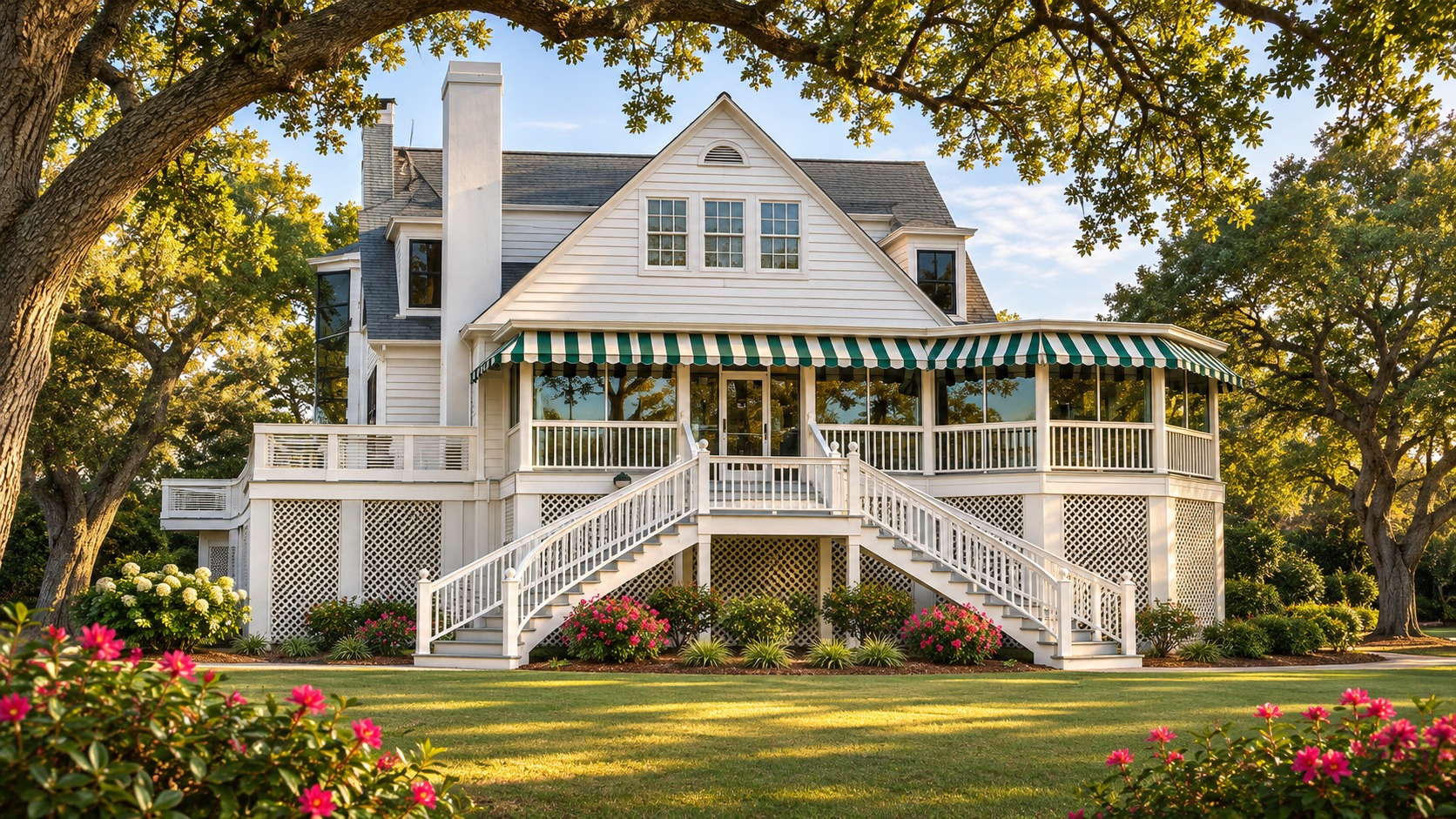
Drive south along Ocean Boulevard far enough and the high-rises thin out. Somewhere past the main stretch, set back behind a stand of live oaks that are plainly older than anything around them, there is a white clapboard house with a green striped awning and a double staircase curving up to a wraparound porch. It looks like somebody’s grandmother’s beach place, which is more or less what it was.
It is the Franklin G. Burroughs-Simeon B. Chapin Art Museum, and almost nothing about it is obvious from the road. Eleven galleries are inside. The building itself is a century old and stands eight miles from where it was built. It was three weeks from the bulldozer in 1975. And for the last twenty-four years it was run by a director whose board gave her one instruction, which she took seriously enough to bring Ansel Adams, Frida Kahlo, a LEGO exhibition and two delegations of Tibetan monks to a resort town on the Carolina coast.
Most visitors to the Grand Strand never find it. That is a shame, and it is also the appeal: on a weekday in February you can have a room of paintings to yourself, forty minutes from a beach house on the north end, for eight dollars.
The House That Was Nearly Demolished
The house went up in 1924, built by the textile executive Eugene Cannon in what was then called the Cabana Section of Myrtle Beach. It later passed to Col. Elliott White Springs, who used it for his family and for executives of Springs Industries, and under him it acquired the name it still half-carries today: Springmaid Villa. Staff and volunteers still call the building the Villa, and the museum’s newsletter is named for it.
In 1975 the property changed hands and the house was slated for demolition. What saved it was a local arts organization. Gaye Sanders Fisher of the Waccamaw Arts and Crafts Guild led the campaign to keep it standing, and Harry Charles, a Guild member who also sat on Myrtle Beach city council, worked with his wife Jane to organize what came next.
Eight Miles on Two Flatbed Trucks
Saving the house meant moving it. The structure weighed about 150 tons. Two flatbed trucks carried it roughly eight miles south over three full days, to a parcel donated by the Myrtle Beach Farms Company, and anyone who has driven Ocean Boulevard in summer can appreciate what that must have looked like.
Then came the slow part. A decade of fundraising followed before the building opened to the public as a museum in June 1997, renamed to honor Franklin G. Burroughs and Simeon B. Chapin, the two men who founded the company that gave the land. The former director, Pat Goodwin, and former staff member Karen Olson eventually wrote the whole story down in a book, The Villa: A Myrtle Beach Story.
The detail worth carrying into the galleries with you is this one: the Waccamaw Arts and Crafts Guild, the group that refused to let the house be knocked down, still hangs its annual juried exhibition inside it. The 29th edition is on the walls now. A volunteer arts guild saved a building and then spent half a century filling it.
What Is Actually Inside
Eleven galleries, rotating through the year, which is the thing people underestimate. This is not a single permanent hang you see once. Exhibitions change, so a visit in March and a visit in October are different visits.
Recent and current shows have included Uproot by the metalsmith Logan Woodle, Emerging Forms drawn from the permanent collection, and the Waccamaw Guild juried exhibition. Earlier in 2026 the museum mounted its first Impressionist exhibition in three decades, which we wrote about at the time.
There is also a working pottery studio. The Linetta Prichard Pottery Studio opened in 2018 and runs classes and workshops, and the museum programs artist receptions, tours, lectures and classes for both adults and children across the year. Because exhibitions and class schedules rotate, check what is hanging before you commit to a particular afternoon.
Twenty-Four Years of Getting People Through the Door
When Pat Goodwin took over as executive director in 2002, the board gave her a brief that was almost comically direct: bring more people through the front door. She retired in November 2026, and the twenty-four years in between explain why a town better known for mini-golf has a museum worth planning around.
Ansel Adams came in 2004 and again in 2012. Frida Kahlo in 2022. The Grand Strand Collects, in 2017, borrowed works owned by local families and put them on public walls. Lifting Black Voices and the first museum exhibition by the Gullah painter Jonathan Green both arrived in 2023. Tibetan monks came twice to build sand mandalas. Brian Rutenberg, the abstract painter who grew up here, showed solo in 1998 and 2011 and again in 2022 alongside Alice Ballard.
The other half of the strategy was less rarefied and probably did more for attendance: a LEGO exhibition in 2016, Family Days that pulled hundreds of visitors, Dia de los Muertos and Chinese New Year and Gullah Day celebrations, summer programs run jointly with the Chapin Memorial Library, and ongoing creative work with veterans. South Carolina recognized the run with its Elizabeth O’Neill Verner Award in 2013, and Myrtle Beach issued a proclamation in Goodwin’s name in October 2026. Allyson Sheumaker took over as executive director in November 2026.
Hours, Admission and the Free-Entry Routes
| Detail | Information |
|---|---|
| Address | 3100 South Ocean Boulevard, Myrtle Beach, SC 29577 |
| Tuesday–Saturday | 10 a.m. to 5 p.m. |
| Sunday | 1 to 5 p.m. |
| Monday | Closed |
| Adults | $8 |
| Seniors 65+, military, veterans | $5 with ID |
| Children 18 and under | Free |
| Phone | (843) 238-2510 |
Admission was free for most of the museum’s life; the $8 adult charge arrived in 2025. There are still several legitimate ways in at no cost, and they are not well advertised. Full-time students with valid ID get in free. So do museum members and EBT cardholders. Active-duty military and their families enter free under the Blue Star Museums program between Armed Forces Day in May and Labor Day in September. If you belong to another museum in the North American Reciprocal Museum network, your membership card works here. And Bank of America cardholders get free admission on the first full weekend of every month through the Museums on Us program.
Note the Monday closure, which catches people out, and the holiday closures around Christmas and New Year’s. Call ahead if your trip falls in that window.
Going With Children
Children under eighteen are free, which makes this one of the cheapest indoor options on the Grand Strand for a family. Eleven galleries is also a manageable size: you are not going to lose anyone, and nobody has to be marched through forty rooms.
The museum has a long record of family programming, from the LEGO show to Family Days to summer sessions with the Chapin Memorial Library, and the pottery studio runs classes for children as well as adults. If the forecast turns and you need somewhere to go, it belongs on the same shortlist as our guide to indoor things to do on a rainy day and our kid-friendly guide.
For the wider area, our pillar guide to things to do in Myrtle Beach covers the rest, and the coast’s gallery scene is in our piece on the Waccamaw Arts & Crafts Guild and Gallery 320.
Making the Drive From the North End
From North Myrtle Beach the museum is roughly thirty to forty minutes south depending on which section you start from and how Highway 17 is behaving. In winter it is an easy run. In July, allow more and go early.
That drive is worth pairing with something else on the south end rather than making the trip for one stop. The museum sits near the southern end of Ocean Boulevard, which puts it within reach of Market Common and the state park without doubling back.
On the north end, Cherry Grove is the farthest from the museum and the quietest place to come back to. Ocean Drive puts you near Main Street. Crescent Beach and Windy Hill sit farthest south and shave real minutes off every drive toward Myrtle Beach proper, which matters if museums and shows are the point of the trip.
Off-season is the argument for all of it. Rates on oceanfront homes and oceanfront condos are a fraction of summer, the galleries are quiet, and the drive takes half as long.
Frequently Asked Questions
The quiet months are the best months for this one, and they are also the best months to rent on the north end. Thomas Beach Vacations has placed families in North Myrtle Beach homes and condos since 1962, from Cherry Grove and Ocean Drive down through Crescent Beach and Windy Hill. Call (843) 273-3001 or browse our oceanfront homes and oceanfront condos.
Sources: Franklin G. Burroughs-Simeon B. Chapin Art Museum history, admission and hours pages; Roger Yale, special to the Post and Courier, November 2026. Hours, admission, exhibitions and programs are set by the museum and subject to change — confirm at (843) 238-2510 before visiting.