




How Myrtle Beach Became a Household Name 50 Years Ago — and Why It Still Is
Table of Contents
- Before the Boom: A Quiet Stretch of Carolina Coastline
- The 1970s: When Everything Changed
- The Formula That Made It Stick
- Golf Capital of the World
- Staying Relevant: The Boardwalk, the SkyWheel, and Beyond
- More Than Just a Beach Trip
- North Myrtle Beach: The Quieter, Deeper Side of the Grand Strand
- Frequently Asked Questions
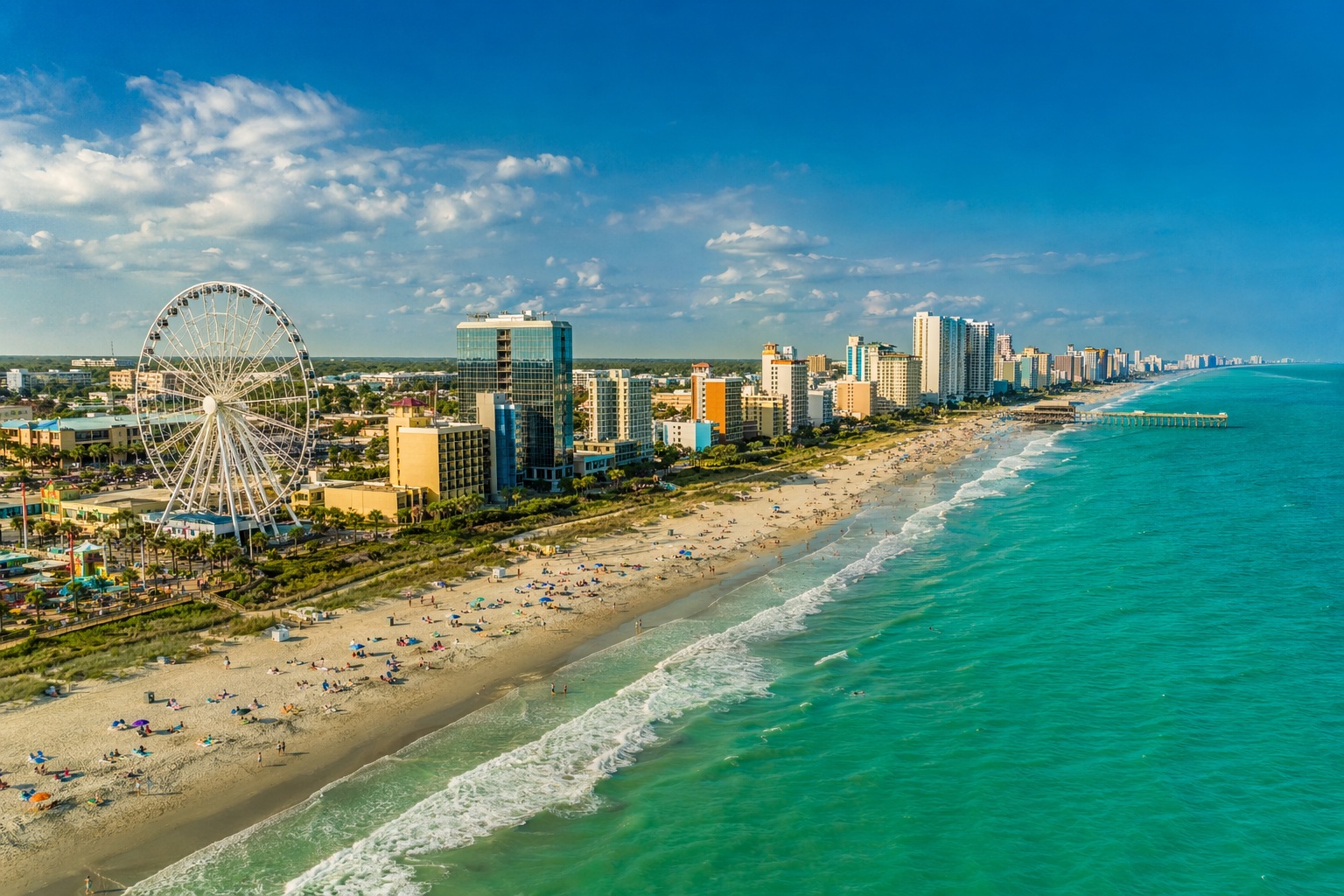
There is a particular kind of place that earns a permanent spot in the American imagination — not through a single moment or a marketing campaign, but through decades of delivering exactly what it promises. Myrtle Beach is one of those places. Drive down Ocean Boulevard on a summer evening, watch the SkyWheel turning slowly against a deepening sky, and listen to the Atlantic rolling in behind the restaurants and the laughter and the smell of sunscreen on warm pavement, and you will understand something immediately: this is a place that people return to. Not because it is the most glamorous destination on the East Coast. Because it feels like something. It feels like vacation, in the most elemental and uncomplicated sense of the word.
That feeling did not happen by accident, and it did not happen overnight. The story of how Myrtle Beach went from a quiet Carolina town to one of the most visited destinations in the United States is a story worth knowing — especially if you are among the more than 20 million people who make the trip down U.S. 17 each year to see what all the fuss is about.
Before the Boom: A Quiet Stretch of Carolina Coastline
For most of its early history, what would become Myrtle Beach was barely accessible at all. The beaches of Horry County sat behind a wall of geography — rivers, marshland, and poor roads that kept the coastline isolated from the rest of South Carolina well into the late 1800s. It was timber, not tourism, that finally cracked the region open. The Burroughs and Collins Company, a timber and turpentine operation that owned vast stretches of beachfront land, built a railroad to the coast in 1900 to move its product to market. The railroad brought workers to the beach — and workers brought the realization that this sand and surf had potential far beyond lumber.
The town took its name from the wax myrtle trees that grew wild along the shore. By the 1920s it had a modest hotel, a handful of beachfront cottages, and a reputation among middle-class families from the Carolinas as a reliable summer getaway. The tourist season ran roughly from Easter to Labor Day. It was modest and regional and entirely unpretentious — qualities that, as it turned out, would prove to be among its greatest long-term assets.
The postwar decades brought steady but unspectacular growth. Hurricane Hazel swept through in 1954, demolishing much of the oceanfront property along the Grand Strand, but the destruction had an unintended consequence: it cleared the way for a first wave of low-rise hotels and modern development, triggering what would become the area’s first real tourism boom. By the time Myrtle Beach officially incorporated as a city in 1957 — with a permanent population that had just crossed 5,000 — the foundations were in place for something much larger.
The 1970s: When Everything Changed
Fifty years ago, Myrtle Beach was a destination that most Americans outside the Carolinas had still never heard of. That was about to change in a hurry. The 1970s were the decade when Myrtle Beach stopped being a regional secret and became a national name. New construction during that decade alone topped $75 million, and the city’s permanent population tripled. Families from across the East Coast began loading up station wagons and pointing them south, drawn by something that was becoming increasingly difficult to ignore: here was a place where you could have a full, satisfying, genuinely fun vacation without spending a fortune.
Developers recognized the momentum and moved quickly. High-rise oceanfront hotels began replacing the small motels and beach cottages that had defined the earlier skyline. Amusement parks, water slides, arcades, and shopping centers appeared in rapid succession, transforming what had been a laid-back beach town into a full-scale entertainment destination. The Myrtle Beach Convention Center had opened in 1970, a signal that the city was thinking beyond the summer vacation crowd. By the end of the decade, the tourist season — once bounded by Easter and Labor Day — had stretched to something approaching year-round.
The Formula That Made It Stick
A lot of beach towns have their moment in the sun. What separated Myrtle Beach from the destinations that peaked and faded was a deceptively simple combination: accessibility, affordability, and variety. Myrtle Beach is easy to get to from most of the Eastern Seaboard. It is easy to navigate once you arrive. And it has always offered enough variety — beach, golf, live music, water parks, seafood, arcades, outlet shopping, state park hiking — that different members of the same family can have entirely different vacations without ever leaving the Grand Strand.
That last point matters more than it might initially seem. A destination that works for a couple of college students, a family with young children, a pair of retired golfers, and a group of friends celebrating a birthday — and works for all of them simultaneously — is extraordinarily rare. Myrtle Beach has managed to be that destination for five decades running, and that breadth of appeal is the single most important reason it has outlasted so many competitors.
Golf Capital of the World
No single element of Myrtle Beach’s identity has done more to extend its reach into new markets than golf. The area’s golf boom began in the 1960s, when developers recognized that the Grand Strand’s climate, terrain, and flat coastal landscape made it nearly ideal for course construction. The creation of Myrtle Beach Golf Holiday in 1967 formalized the golf package as a distinct product, and the courses kept coming. By the 1980s, Myrtle Beach had earned the nickname Golf Capital of the World — more golf courses per square mile than any other destination on earth. At the peak, the region boasted over 120 courses and once recorded more rounds played annually than anywhere else in the world.
Today, the region has around 100 courses remaining, following some consolidation over the past two decades as real estate development claimed a number of layouts. But the golf identity has never faded. Players from beginners to seasoned low-handicappers continue to make the Grand Strand a primary destination, drawn by the combination of quality, variety, price, and the ability to play year-round in the mild South Carolina climate. For a significant portion of visitors — particularly those in the retiree and active adult demographic that has made Horry County one of the fastest-growing areas in the nation — golf is the primary reason for the trip.
Staying Relevant: The Boardwalk, the SkyWheel, and Beyond
One of the harder things for any destination to do is reinvent itself without losing what made people fall in love with it in the first place. Myrtle Beach has done this more successfully than most. The beach is still the star of the show — that same Grand Strand coastline delivers the same wide, flat, warm-water experience that pulled those first station wagons down the highway fifty years ago. The fundamentals have not changed because the fundamentals did not need to change.
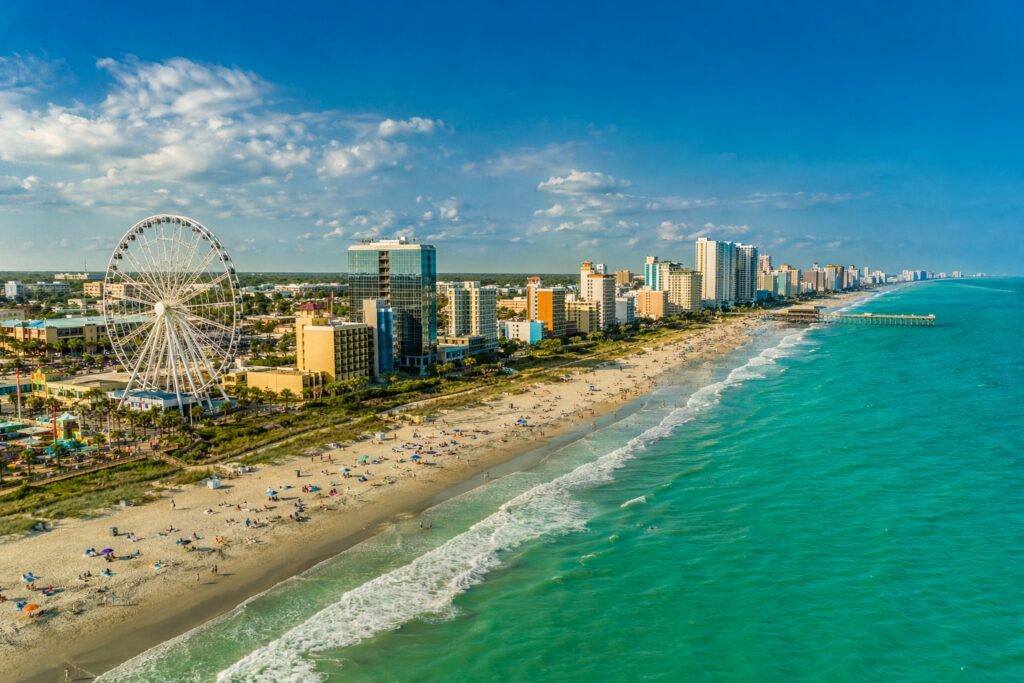
But the supporting cast has evolved considerably. The Myrtle Beach Boardwalk, completed in 2010, revitalized the downtown oceanfront with a 1.2-mile stretch of open-air restaurants, shops, and walkway that connected the heart of the city to the water in a way it had not been connected before. The Carolina Opry, which opened in 1986, pioneered the live entertainment theater scene that eventually gave Myrtle Beach something resembling a miniature Branson, Missouri on the South Carolina coast. And the SkyWheel, rising nearly 200 feet above the boardwalk, added a landmark that is visible from both the beach and the boulevard — a gondola ride that doubles as one of the best sunset viewing platforms on the East Coast.
Broadway at the Beach arrived in the 1990s as a 350-acre entertainment and shopping complex built around a central lake, adding a destination anchor that gave visitors a reason to spend an entire day — and evening — off the sand. Ripley’s Aquarium followed, and the complex became one of the most-visited attractions in South Carolina. Each addition has built on what came before, layering new reasons to visit on top of the original reason that never stopped working.
More Than Just a Beach Trip
Step off the sand and the Grand Strand reveals itself as something considerably deeper than its postcard version suggests. Myrtle Beach State Park, just south of the main commercial strip, offers a version of the Carolina coast that feels genuinely removed from the boardwalk crowds — maritime forest trails, a fishing pier, a campground, and the kind of quiet that reminds you how wild this coastline was before the hotels arrived. It is a twenty-minute drive from the SkyWheel and feels like a different world entirely.
For families traveling with children, the mini-golf culture alone is worth the trip. Myrtle Beach has more elaborately themed miniature golf courses per square mile than perhaps anywhere else in the country — pirate ships, dinosaurs, volcanoes, waterfalls — and the tradition runs deep enough that many adults have photographs of themselves as children playing the same courses their own kids are navigating now. That kind of generational continuity is not something a destination manufactures. It is something earned, slowly, over fifty years of doing things right.
The live entertainment scene — dinner theaters, concert venues, variety shows — continues to bring visitors who are not primarily drawn by the ocean. The restaurant landscape has matured well beyond the all-you-can-eat seafood buffets that defined the area’s dining identity for decades, though those institutions still exist and still fill up every night in season. And the shopping, anchored by Broadway at the Beach and extended by Barefoot Landing in North Myrtle Beach, gives the retail-minded traveler as much room to roam as the coast gives the beach lover.
North Myrtle Beach: The Quieter, Deeper Side of the Grand Strand
About fifteen miles up the coast from downtown Myrtle Beach, North Myrtle Beach offers a different entry point into the Grand Strand experience — one that trades the high-rise density of the main strip for wider beaches, quieter neighborhoods, and a sense of place that feels more rooted in the area’s original character. It is a separate city with its own government and its own identity, and for many visitors it is the preferred base for exploring everything the Grand Strand has to offer.
The four communities of North Myrtle Beach each carry their own personality. Cherry Grove Beach is known for its fishing pier and unhurried pace. Ocean Drive is the birthplace of the shag — the official state dance of South Carolina — and carries the kind of boardwalk history that no amount of development can fully replicate. Crescent Beach sits in the relaxed center, and Windy Hill offers the peaceful southern end of the strip for those who want ocean views without the foot traffic. Visitors can choose from spacious oceanfront home rentals and well-positioned oceanfront condos — putting the Atlantic directly outside the door and everything the Grand Strand has built over the past fifty years just a short drive away.
Frequently Asked Questions
Fifty years of earning a reputation is not something that happens by accident — and experiencing it firsthand is easier than you might think. Thomas Beach Vacations has oceanfront homes and condos across North Myrtle Beach ready for your next Grand Strand trip. Browse the full collection at northmyrtlebeachvacations.com or call (866) 249-2100 and let the team help you find exactly the right place on the coast.