



beach vacation South Carolina Archives |

logo ×

  • This field is for validation purposes and should be left unchanged.
  • Privaty Policy

Undertow Movie Filming in Myrtle Beach: Hollywood Comes to the Grand Strand

A Thriller Finds Its Stage on the Shore

The morning light off the Myrtle Beach coastline can fool you. It slides across the pier planks, catches the spray where the Atlantic breaks against the pilings, and makes everything look like a postcard. But for the past month, that same light has been doing double duty — illuminating something you do not see every spring along the Grand Strand. Film crews. Cameras mounted on rigs. Directors calling for quiet on a public beach where quiet almost never happens. The movie is called Undertow, and it has turned familiar stretches of sand and local landmarks into the backdrop of a Hollywood psychological thriller.

Director Adam Sigal brought the production to the Grand Strand after the script was originally slated to film in Ireland. The reason for the change was straightforward — South Carolina offered stronger financial incentives and, once the filmmakers scouted the coastline, the visual pull of this place did the rest. The South Carolina Film Commission confirmed that the creative team was so taken with what the Grand Strand offered that they rewrote the script to set the story here. That kind of pivot does not happen because of a tax break alone. It happens because a place looks right on camera and feels right in a story.

The production has been spotted at locations stretching from Garden City to North Myrtle Beach — surf shops, the boardwalk, a municipal aquatic center, even the police station. Beachgoers on spring break have walked into active film sets without realizing it. Local paddleboarders have been recruited for ocean scenes. The whole thing has had the feeling of a town discovering, in real time, that its everyday landscape is somebody else’s cinematic vision.

Grand Strand Filming Locations

What makes the Undertow production interesting from a local perspective is how widely the crew has spread across the region. This is not a case of a film company renting a single soundstage and calling it a day. Sigal and his team have used the entire Grand Strand as their set, and the result is a production deeply woven into the geography that visitors and residents know by heart.

Filming kicked off at Village Surf Shoppe in Garden City, a place that has been part of the beach culture down here for years. The historic surf shop closed its doors temporarily for interior and exterior scenes, and one of the film’s characters reportedly owns a surf shop in the story — a detail that fits Garden City’s vibe like a wetsuit in October. From there, the production moved north.

Pier 14 in Myrtle Beach served as another key location. Sitting directly over the Atlantic at 1306 North Ocean Boulevard, right along the Myrtle Beach Boardwalk, Pier 14 has been a Grand Strand landmark since the mid-1980s. The pier’s position — jutting out over the waves with an unobstructed ocean horizon — gives it the kind of dramatic framing that directors look for without having to build anything. Scenes involving a search-and-rescue sequence were filmed near the pier, and local paddleboarders were even asked to participate in the shoot.

Up in North Myrtle Beach, the North Myrtle Beach Aquatic and Fitness Center on Second Avenue South became the site for controlled ocean sequences. A significant portion of the film takes place on a yacht, and the aquatic center’s pools allowed the crew to stage underwater chase scenes and swimming sequences in a safe, repeatable environment. It is the kind of creative problem-solving that makes location shooting work — using a municipal pool to simulate open water, surrounded by the same coastal town where the outdoor beach scenes are happening a few blocks away.

The production also filmed along the beach near Riptydz Oceanfront Grille and Rooftop Bar, where what appeared to be a wedding scene drew a crowd of onlookers from the nearby Myrtle Beach Boardwalk. Additional shooting took place at the Myrtle Beach International Airport, local restaurants, the city’s Chamber of Commerce offices, and the police station — which was temporarily shut down to accommodate filming.

The Cast and Crew Behind Undertow

Adam Sigal is a writer, director, and producer with more than twenty years in the industry. His path to filmmaking took an unusual route — he worked as a private investigator in Los Angeles before turning to screenwriting, a background that likely informs the kind of tension and suspicion that drives a thriller like Undertow. His previous directorial credits include Chariot (2022), starring John Malkovich and Rosa Salazar, and Nandor Fodor and the Talking Mongoose (2023), which featured Simon Pegg, Minnie Driver, and Christopher Lloyd. Producer Joel Shapiro’s credits include Gunner (2024) and River Runs Red (2018).

The cast is headlined by Tania Raymonde, an actress whose face many viewers will recognize even if they cannot immediately place it. She played Alex Rousseau in the ABC phenomenon Lost, appeared as Cynthia Sanders on Fox’s Malcolm in the Middle, and starred alongside Billy Bob Thornton in the Amazon legal drama Goliath. Raymonde was spotted on set at Village Surf Shoppe in early March, and her involvement brought a visible level of industry credibility to the production. Additional cast and local extras have been involved throughout the shoot, though the full roster has not been publicly released.

The plot itself remains tightly guarded. What has been confirmed is that the story centers on a seaborne kidnapping — a woman is taken from the ocean, and the narrative unfolds from there. Sigal described a scenario involving a yacht, a pursuit through the water, and the kind of tension that builds when a character is trapped between the open sea and a threat that will not let go. The Myrtle Beach setting is not incidental to the story. It is the story. The coastline, the piers, the salt air — all of it feeds the atmosphere the film needs.

Why South Carolina Is Winning the Film Incentive Game

The reason Undertow ended up on the Grand Strand instead of the coast of Ireland comes down to money and momentum. South Carolina has built one of the more attractive film incentive packages in the Southeast, and productions are responding. The state’s Motion Picture Incentive program offers qualifying productions a cash rebate — not a tax credit that has to be brokered, but a direct check — of up to 25 percent on in-state crew wages and up to 30 percent on goods and services purchased from South Carolina suppliers. Productions need to spend at least one million dollars in the state to qualify for the main program.

That rebate structure is significant. Unlike states that offer tax credits requiring brokers and extended waiting periods, South Carolina reserves the estimated rebate funds upfront and cuts the check within 30 days of the final audit. For a production company managing cash flow across locations and schedules, that kind of certainty matters. The wage rebate is even assignable to a financial institution, meaning producers can use it to finance the production itself.

In 2025, South Carolina introduced the Local Filmmaker Incentive, a pilot program with two million dollars in annual funding aimed at smaller productions. This newer program lowered the spending threshold to $250,000, opening the door for independent filmmakers who previously could not hit the million-dollar mark. The requirement that at least one producer be a South Carolina native has helped ensure the program builds local industry talent rather than just importing it. Matt Storm of the South Carolina Film Commission has been instrumental in managing the state’s incentive program and guiding productions through the application process.

The state legislature is also considering Bill H.3832, which would increase the annual rebate cap from ten million dollars to thirty million dollars. If passed, the expanded cap would position South Carolina to compete even more aggressively with states like Georgia and Louisiana for major studio productions. The trajectory is clear — South Carolina is not just dipping a toe into the film industry. It is building infrastructure.

Film Tourism and the Grand Strand Economy

When a film crew sets up on a public beach and starts shooting, the first thing that happens is entirely predictable — people stop and watch. Spring breakers near Riptydz slowed their boardwalk strolls to a halt when they realized a movie was being made in front of them. Visitors from out of state tried to take photos before being told the set was closed. That kind of curiosity is the seed of something the tourism industry calls film-induced tourism, and the Grand Strand is positioned to benefit from it in ways that go well beyond the weeks of active production.

The economics are layered. During production, the film company spends money locally — hotels for the crew, meals at area restaurants, equipment rentals, location fees, and wages for local hires. That is the immediate impact. The longer-term value comes after the film is released, when audiences see the Grand Strand on screen and start thinking about visiting. The Myrtle Beach Boardwalk, the beaches of Cherry Grove Beach and Ocean Drive, the pier at sunset — these are not just film backdrops. They are destinations, and seeing them in a movie makes them feel both familiar and aspirational to potential visitors.

South Carolina state officials have noted that productions like Undertow generate both direct revenue and tourism interest that extends well beyond the production schedule. The South Carolina Film Commission actively works to attract directors and production companies for exactly this reason — every film shot here is, in effect, a feature-length advertisement for the state’s coastline, communities, and culture.

Myrtle Beach’s Growing Film Legacy

Undertow is not an isolated event. It is the latest chapter in a story that has been building across South Carolina for years. More than 200 feature films, television series, and TV movies have been shot in the state, and the South Carolina Film Commission has signaled its intention to increase that number. The Grand Strand in particular has become a recurring location choice for productions that need a coastal setting with accessible infrastructure, cooperative local government, and a visual palette that ranges from quiet tidal creeks to wide public beaches to neon-lit commercial strips.

The appeal for filmmakers is practical as much as it is aesthetic. The Grand Strand offers a concentrated range of environments within a short drive — the marshlands and surf culture of Garden City, the boardwalk energy of downtown Myrtle Beach, the quieter residential feel of Crescent Beach and Windy Hill in North Myrtle Beach. A production does not have to relocate to find a different look. It just drives fifteen minutes up or down the coast.

Dan Rogers, Senior Project Manager at the South Carolina Film Commission, has spoken publicly about the growing interest from filmmakers in the Myrtle Beach region. The fact that the Undertow production rewrote its script to move the setting from Ireland to Myrtle Beach says something about the confidence the creative community is placing in this coastline. It is one thing to film here because the incentives are good. It is another thing entirely to change your story because the place itself demanded it.

Visit the Filming Locations Yourself

One of the best parts about a movie filmed on the Grand Strand is that every location the crew used is a place you can visit on your next vacation. You do not need a backstage pass or a studio tour. You just need to show up.

Walk the Myrtle Beach Boardwalk and stop at Pier 14 for a seafood lunch over the Atlantic — the same pier where search-and-rescue scenes were filmed for Undertow. Head south to Garden City and browse Village Surf Shoppe, where the first scenes of the production were shot inside a real working surf shop that has been part of the local beach scene for decades. Drive up to North Myrtle Beach and explore the neighborhoods around the Aquatic and Fitness Center on Second Avenue South, where the controlled water sequences were staged.

And while you are in North Myrtle Beach, take some time to explore what the rest of the area has to offer beyond the film sets. Walk the wide, family-friendly sand at Cherry Grove Beach, where the marsh inlet meets the ocean and the fishing pier stretches out over the waves. Stroll through Ocean Drive, the birthplace of the Shag dance and the heart of North Myrtle Beach’s social scene. Settle into the quieter rhythm of Crescent Beach, or catch the sunset from Windy Hill, where the pace slows down and the ocean view widens. Whether you want a front-row seat to the waves from an oceanfront home or the convenience of an oceanfront condo, the Grand Strand has a rental that fits the trip you are planning.

When Undertow eventually hits screens, you will be able to watch it and say you have been to those places. You have walked that beach. You have eaten at that pier. That is the kind of connection a filmed-on-location movie gives you — and the Grand Strand has always been a place that rewards people who actually show up.

Frequently Asked Questions

What is the movie Undertow being filmed in Myrtle Beach about?
+
Undertow is a psychological thriller directed by Adam Sigal. The story centers on a seaborne kidnapping — a woman is abducted from the ocean and the tension builds from there. The script was originally set in Ireland but was rewritten to take place in Myrtle Beach after the filmmakers scouted the Grand Strand and were drawn to its coastal landscape. South Carolina’s competitive film production incentives also played a significant role in the decision to relocate the production.
Where is Undertow being filmed along the Grand Strand?
+
The production has filmed at multiple locations across the Grand Strand, including Village Surf Shoppe in Garden City, Pier 14 in Myrtle Beach, the North Myrtle Beach Aquatic and Fitness Center, the beach near Riptydz Oceanfront Grille and Rooftop Bar along the Myrtle Beach Boardwalk, the Myrtle Beach International Airport, area restaurants, the city Chamber of Commerce offices, and the police station.
Who stars in the movie Undertow filmed in Myrtle Beach?
+
The cast includes actress Tania Raymonde, known for her roles in the Amazon series Goliath, the ABC hit show Lost, and the Fox comedy Malcolm in the Middle. The film also features other professional actors along with local talent and extras recruited from the Grand Strand area. The full cast list has not been publicly released by the production team.
What film incentives does South Carolina offer to attract movie productions?
+
South Carolina offers qualifying productions a cash rebate of up to 25 percent on in-state crew wages and up to 30 percent on goods and services purchased from South Carolina suppliers. Productions must spend at least one million dollars in the state to qualify for the main rebate program. The state also introduced the Local Filmmaker Incentive in 2025, which allows smaller productions spending between $250,000 and $1 million to qualify for a 25 percent rebate. Additionally, qualified productions are exempt from state and local sales and use taxes on supplies.
When will the movie Undertow be released?
+
As of March 2026, no official release date has been announced for Undertow. The production team has kept many details under wraps, including the complete cast list and specific release timeline. Filming along the Grand Strand was scheduled to wrap by late March 2026, and the film will enter post-production after that. Check back for updates as more information becomes available.

Whether you are coming to walk the same beaches where Undertow was filmed, explore the Myrtle Beach Boardwalk, or simply settle into a week of ocean air and slow mornings, Thomas Beach Vacations can help you find the perfect place to stay in North Myrtle Beach. Browse oceanfront homes and oceanfront condos across Cherry Grove, Ocean Drive, Crescent Beach, and Windy Hill. Call us at (866) 249-2100 or visit northmyrtlebeachvacations.com to start planning your Grand Strand getaway.
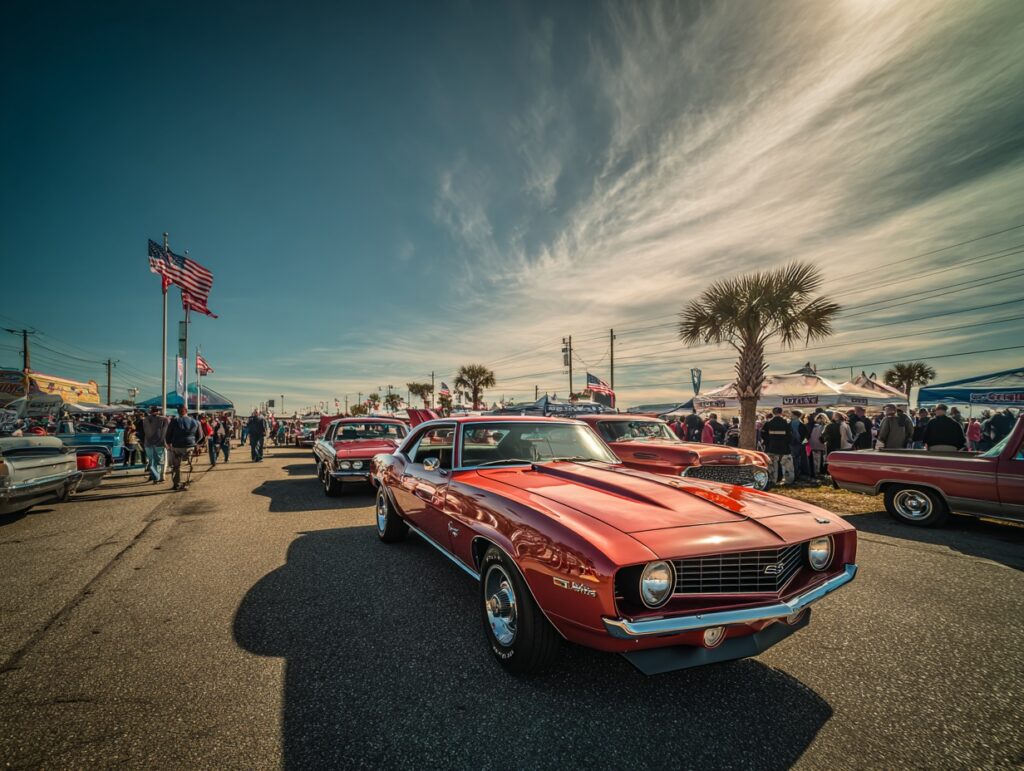

Run to the Sun Car Show 2026 – Myrtle Beach’s Biggest Classic Car Even

There’s a certain sound that belongs to Myrtle Beach in March. It starts in the distance — a low rumble that rolls in from Highway 17 like distant thunder, except the sky is clear and the sea air smells like salt and motor oil and something good. It’s the sound of American steel headed south, chrome catching the late-winter sun, engines tuned the way they don’t build them anymore. It’s the Run to the Sun Car and Truck Show, and it’s been making that sound for 37 years.

If you’ve never seen the Run to the Sun in person, it’s difficult to describe the scale of it. Over 3,500 pre-1989 vehicles spread across 56 acres of the Grand Strand. Muscle cars. Vintage pickups. Resto-mods that took somebody twenty years and a second mortgage to finish just right. Spectators shoulder-to-shoulder on a warm March morning, leaning in to read the placards, asking questions, trading stories. The largest independent classic car show on the East Coast, and it comes to Myrtle Beach every spring like a reunion between old friends.

The 37th annual show runs March 19–21, 2026, at the Old Myrtle Square Mall. Whether you’re registering a vehicle, buying a spectator ticket, or just planning a March beach trip and looking for something extraordinary to fill a Saturday, this is one of those events that reminds you why people keep coming back to the Grand Strand year after year. It isn’t just a car show. It’s a community gathering with chrome and horsepower and a whole lot of heart.

Run to the Sun Car and Truck Show 2026 at Old Myrtle Square Mall in Myrtle Beach, SC

What Is the Run to the Sun Car Show?

Run to the Sun started in 1988 as a grassroots gathering of classic car lovers who saw the Grand Strand for what it is: a wide-open stretch of coastal South Carolina that welcomes people, warmth, and a good time in equal measure. What began as a modest local event has grown — without losing its independent spirit — into one of the most respected classic car shows on the eastern seaboard.

The show is independently owned and managed by Michael Leaventon, who has kept the event rooted in its original values: a genuine celebration of pre-1989 automobiles, a commitment to giving back to the community, and a crowd-friendly atmosphere where car lovers from across the country feel at home. Cars come from over 28 states. That’s not a marketing statistic — that’s a testament to what Leaventon and his team have built over nearly four decades.

What makes Run to the Sun stand apart from larger, corporate-sponsored car shows is the people. The judging is personal. Staff, partners, and sponsors personally present winner plaques. The vendors are mostly regional. The charities are local. The whole thing feels like something that belongs to the Grand Strand, even when attendees are rolling in from Ohio or Pennsylvania or Tennessee with a trailer full of polished metal and a three-day weekend to enjoy.

2026 Dates, Location & What to Expect

The 37th annual Run to the Sun Car and Truck Show takes place March 19–21, 2026, at the Old Myrtle Square Mall in Myrtle Beach, South Carolina. The site spans 56 acres — enough room for 3,500 vehicles, 150 vendors, and upward of 10,000 spectators across three days.

March is one of the best times to be on the Grand Strand. The tourist crowds of summer haven’t arrived yet, so parking is manageable, restaurants have open tables, and the beach is peaceful in the mornings before the car show kicks off. Daytime temperatures in mid-March typically range from the low 50s to the low 70s — cool enough to walk comfortably in the sun, warm enough to enjoy being outside all day without much effort.

The Old Myrtle Square Mall property sits in a central location in Myrtle Beach, easily accessible from Highway 17 and close to a range of restaurants, shops, and entertainment options along the strip. If you’re driving in a show vehicle, the flat, open lot makes for easy maneuvering and display. If you’re arriving as a spectator, you’ll want comfortable shoes — 56 acres covers a lot of ground, and there’s plenty worth walking.

For full event schedules, vehicle registration details, and spectator ticket purchases, the official site is the best resource: runtothesuncarshow.com.

The Cars: 3,500 Classics on 56 Acres

The cut-off year is 1989 — anything pre-1990 is eligible — and the variety that rule produces is remarkable. Walk the show floor on a Saturday morning and you’ll move from a row of perfectly preserved 1950s Chevrolets to a cluster of late-1960s muscle cars to a collection of first-generation Broncos and Blazers with more personality than most of what rolls off assembly lines today.

Run to the Sun draws vehicles from over 28 states, which means you’re not just looking at local restorations. You’re seeing the best work from garages across the Mid-Atlantic, the Deep South, the Midwest, and New England — owners who hauled their pride and joy down to the beach specifically because this show has that kind of reputation. Decades of careful bodywork. Original engine bays that look better than the day the car left the factory. Custom builds that blend eras and styles into something wholly original.

The show includes a formal judging process, with winner plaques presented personally by staff, partners, and sponsors. Categories cover everything from stock restorations to radical customs, and the competition is taken seriously by everyone involved. But even if you’re just a spectator with a passing appreciation for old cars, the sheer density of beautiful machines in one place is something you don’t forget easily.

What Kinds of Vehicles Are Typically Featured?

Expect a broad mix: classic American muscle (Camaros, Mustangs, GTOs, Chargers), vintage pickups and trucks, pre-war rarities when they appear, custom hot rods, lowriders, and surf-ready woodies. European and Japanese classics occasionally make appearances in their own right. The pre-1989 rule keeps the focus on vehicles with genuine history, and the quality of what’s on display reflects the dedication of owners who take the craft seriously.

Vendors, Awards & Entertainment

With 150 vendors on-site, the Run to the Sun isn’t just a car show — it’s a market, a gathering spot, and a full weekend of activity. Vendors typically offer automotive parts and accessories, restoration supplies, memorabilia, vintage signage, apparel, and a range of food and refreshment options to keep you going through a full day of walking. The vendor section draws its own crowd of enthusiasts looking for hard-to-find parts or just a good deal on something they didn’t know they needed until they saw it.

A charity silent auction is held in partnership with the National MS Society, with 100% of proceeds going directly to the society. The auction items vary year to year but typically include automotive memorabilia, experiences, and locally sourced goods. It’s worth making a lap through the auction area early — popular items get competitive quickly.

There’s also a 50/50 raffle hosted by McLeod Children’s Hospital, giving attendees another way to support a worthy cause while putting a little skin in the game. The combination of competition, community giving, and casual weekend energy is what separates this show from a simple parking lot display.

Winner plaques are presented personally by show staff and sponsors — a touch that keeps the recognition feeling genuine rather than ceremonial. If you’re showing a vehicle, this is the kind of event where winning actually means something, because the people handing you that plaque know what went into the build.

Giving Back: Charities & Community Impact

In 37 years, Run to the Sun has donated more than $2.3 million to local and national charitable organizations — including over $175,000 in the last four years alone. That’s not background noise. That’s a meaningful part of what this event is. The car show has become one of the Grand Strand’s most significant annual charitable fundraising events, and the community it supports is broad and deep.

The 2026 beneficiaries include:

  • National Multiple Sclerosis Society — silent auction proceeds
  • Children’s Miracle Network at McLeod Children’s Hospital — 50/50 raffle proceeds
  • Horry County Sheriff’s Department Benevolent Fund
  • Grand Strand Miracle League
  • Florence Miracle League
  • Carolina Forest High School NJROTC Booster Club
  • Boys and Girls Club of Grand Strand

The Boys and Girls Club of Grand Strand, the Miracle League programs that give children with disabilities the chance to play baseball, the NJROTC cadets at Carolina Forest — these are local organizations doing real work in Horry County. When you buy a spectator ticket or register a vehicle, you’re contributing to all of that. The show owner has been deliberate about keeping this connection alive for 37 years, and it shows in the loyalty the event commands from participants who return every single spring.

Where to Stay for the Run to the Sun Car Show

If you’re driving in for the weekend — whether you’re trailering a show car or just coming to spectate — the Grand Strand gives you options at every price point and preference level. But for visitors who want the full coastal experience alongside the car show, North Myrtle Beach is a particularly appealing base.

North Myrtle Beach sits roughly 15 miles north of the show venue, easily accessible on Highway 17. It’s a separate city from Myrtle Beach — quieter, with a more residential beach-town character — and it offers everything you need for a comfortable long weekend: easy beach access, good restaurants, and the kind of laid-back atmosphere that makes March on the coast feel like a genuine getaway rather than just a drive-in, drive-out event trip.

What’s Nearby the Show Venue?

Within walking or short driving distance of the Old Myrtle Square Mall, you’ll find a full range of Grand Strand dining and entertainment. Collector’s Café on Highway 17 Bypass offers a sophisticated dining experience in a setting that would feel right at home among car show enthusiasts — the walls are covered in original artwork and the food matches the ambition. For something more casual after a long day on your feet, River City Café on Highway 17 is a Myrtle Beach institution known for enormous burgers and a relaxed atmosphere. Down toward the Boardwalk, the Myrtle Beach Boardwalk and Promenade gives you a waterfront walk and easy access to coastal dining.

If the car show is just one part of a longer beach vacation — and honestly, why not make it that — North Myrtle Beach vacation rentals put you close enough to enjoy the show each day and far enough from the main tourist corridor to actually decompress at night. March rates are typically far more reasonable than peak summer pricing, and the weather is genuinely pleasant. It’s one of the better-kept secrets of Grand Strand travel planning.

For more ideas on how to spend your time on the beach this spring, check out our guide to things to do in Myrtle Beach and our roundup of Myrtle Beach events happening throughout the season.

More Things to Do Around Myrtle Beach in March

The Run to the Sun takes up most of a Saturday, but three days on the Grand Strand gives you time for more. March is underrated as a travel month here — the ocean is still too cool for a long swim, but the beach itself is beautiful for walks, and the town operates at a pace that feels like breathing room compared to July.

Broadway at the Beach

Broadway at the Beach, just a few miles from the show venue, is Myrtle Beach’s largest entertainment complex — restaurants, shops, miniature golf, and attractions centered around a 23-acre lake. In March it’s pleasantly uncrowded, and the waterfront dining options are worth an evening. Restaurants like Margaritaville and Dave & Buster’s are right on the complex if you’re looking for something casual and lively after the show.

Myrtle Beach Boardwalk and SkyWheel

The Myrtle Beach Boardwalk stretches 1.2 miles along the oceanfront and is one of the few boardwalks in the country that still feels genuine rather than manufactured. The SkyWheel at its northern end gives you a bird’s-eye view of the coastline that puts the whole Grand Strand in perspective — from up there, you can almost trace the route the car show participants took coming into town. Rides are available year-round and the lines in March are practically nonexistent.

Barefoot Landing in North Myrtle Beach

If you’re staying in North Myrtle Beach, Barefoot Landing is a waterfront shopping and dining complex on the Intracoastal Waterway that’s worth a slow evening. The Alabama Theatre hosts live entertainment, and the surrounding walkways and docks have a genuinely pleasant low-key atmosphere that makes it easy to linger over a meal. It’s a nice counterpoint to the energy of the car show — quieter, more scenic, unhurried.

The Beach Itself

It seems obvious, but it’s worth saying: March mornings on the Grand Strand are among the most peaceful moments the coast offers. The light is low and golden before 9 a.m., the water is steel blue and cold and honest, and the beach belongs almost entirely to whoever shows up with coffee and a willingness to walk. After a full day of 3,500 cars and 10,000 people, a morning beach walk has a way of resetting everything.

Frequently Asked Questions

When is the Run to the Sun Car Show in 2026?
+
The 2026 Run to the Sun Car and Truck Show runs March 19–21 at the Old Myrtle Square Mall in Myrtle Beach, SC. The show is held outdoors across 56 acres and features over 3,500 pre-1989 vehicles, 150 vendors, and approximately 10,000 spectators over three days.
Where exactly is the Run to the Sun Car Show held?
+
The show is held at the Old Myrtle Square Mall property in Myrtle Beach, South Carolina. The sprawling 56-acre site accommodates thousands of vehicles and spectators and is centrally located with easy access from Highway 17.
How do I register a vehicle or buy spectator tickets?
+
All registration and ticketing is handled through the official show website at runtothesuncarshow.com. You’ll find vehicle registration forms, spectator ticket options, pricing details, and the full schedule of events on the site.
What charities benefit from the Run to the Sun Car Show?
+
The 2026 show supports the National MS Society, Children’s Miracle Network at McLeod Children’s Hospital, Horry County Sheriff’s Department Benevolent Fund, Grand Strand Miracle League, Florence Miracle League, Carolina Forest High School NJROTC Booster Club, and the Boys and Girls Club of Grand Strand. Over 37 years, the show has donated more than $2.3 million to charitable causes.
Where should I stay for the Run to the Sun Car Show?
+
North Myrtle Beach makes an ideal base — just a short drive from the show venue, with easy beach access, great dining, and a relaxed coastal atmosphere. Thomas Beach Vacations offers vacation rentals throughout the North Myrtle Beach area at rates that are especially reasonable in March. Call (866) 249-2100 or visit northmyrtlebeachvacations.com to explore available properties.

If you’re planning to be on the Grand Strand for the Run to the Sun Car Show — or if the show just reminded you that a March beach trip is long overdue — Thomas Beach Vacations can help you find exactly the right place to stay. The team knows North Myrtle Beach the way locals do, and the vacation rental options range from cozy off-season retreats to properties with enough room to bring the whole crew. Give them a call at (866) 249-2100 or browse available properties at northmyrtlebeachvacations.com. A great car show deserves a great weekend to go with it.


Myrtle Beach vs North Myrtle Beach: What’s the Real Difference? (2026 Guide)

✓ Last Updated: March 2026

Planning a Grand Strand vacation and not sure which “Myrtle Beach” to choose? You’re not alone. Most visitors have heard of Myrtle Beach — but North Myrtle Beach is an entirely separate city just 15 miles north, with its own personality, its own beaches, and its own loyal following of families who come back year after year. This guide breaks down every key difference so you can choose with confidence and book the vacation that actually fits your style.

The Basics: Two Different Cities

Here is the most important thing to understand before planning your trip: Myrtle Beach and North Myrtle Beach are two entirely separate cities in Horry County, South Carolina. They share a coastline and a general region — both sit on the 60-mile stretch of Atlantic shoreline known as the Grand Strand — but they are governed independently, have distinct characters, and offer genuinely different vacation experiences.

North Myrtle Beach was officially incorporated in 1968 when four historic beach communities — Cherry Grove, Ocean Drive, Crescent Beach, and Windy Hill — merged into one city. Today it has its own city government, its own beach regulations, and a loyal fan base of repeat visitors who would not trade it for the busier city to the south.

The geographic distance between the two downtowns is roughly 15 miles — typically a 20 to 25 minute drive, longer during peak summer Saturday traffic on Highway 17. That distance is enough to make the two feel like entirely different worlds, yet close enough that staying in North Myrtle Beach gives you easy access to everything Myrtle Beach has to offer for day trips.

Key Fact: Many visitors search for “Myrtle Beach vacation rentals” when they actually want North Myrtle Beach. If you’re looking for a quieter, more residential, family-focused beach experience in the same general area, there is a very good chance North Myrtle Beach is the right fit.

Overall Vibe & Atmosphere

Myrtle Beach: High Energy, Always On

Myrtle Beach is the undisputed entertainment capital of the Grand Strand. The city is built around the experience of being in the middle of everything: the 1.2-mile Oceanfront Boardwalk and Promenade buzzes with activity year-round, Ocean Boulevard hums with shops, arcades, and restaurants, and the iconic SkyWheel — a 187-foot observation wheel with 42 climate-controlled gondolas — lights up the night sky. Broadway at the Beach brings a massive outdoor entertainment and shopping complex, and new openings in 2026 including Ole Smoky Distillery at Broadway and the coming Guy Fieri’s Downtown Flavortown continue to add to the lineup.

The energy here is real and can be exhilarating — but it also means noise, crowds, traffic, and a general sense that there is always something happening whether you want it or not. High-rise resort towers line the beachfront for miles, creating a dense, city-at-the-beach feel that some visitors love and others find overwhelming.

North Myrtle Beach: Relaxed, Residential, Unhurried

North Myrtle Beach occupies the opposite end of the spectrum. The landscape here is noticeably more open — fewer high-rises crowd the shoreline, residential streets run behind the beachfront, and the pace slows down in a way that is immediately noticeable when you arrive. There is no equivalent of the Boardwalk or Ocean Boulevard strip. Instead, the focal points are the natural landscape, neighborhood character, and the easy rhythm of coastal life.

That does not mean there is nothing to do. Barefoot Landing — a sprawling waterfront entertainment complex at Windy Hill — offers shopping, dining, House of Blues, the Alabama Theatre, and Alligator Adventure. Ocean Drive’s Main Street brings live beach music, shag dancing, and a walkable strip of local restaurants and shops. The difference is that the entertainment here feels woven into the community rather than bolted on top of it.

The Beaches: Side by Side

Both cities sit on the same stretch of Atlantic shoreline, and the water quality, sand color, and ocean conditions are comparable across the Grand Strand. The key differences are in the beach experience itself.

Myrtle Beach Beaches

Myrtle Beach’s most famous stretch includes the Golden Mile — a scenic section of wide sand near the northern residential end — and the beaches fronting the Boardwalk, which are among the most visited in the region. The beaches near the boardwalk are lively and social, with people, umbrellas, vendors, and the ambient sound of the strip behind you. Myrtle Beach State Park on the south end offers a quieter alternative within city limits, with nature trails, a fishing pier, and a more natural environment.

North Myrtle Beach Beaches

The beaches of North Myrtle Beach are consistently described by visitors as wider, less crowded, and more relaxed. Each of the four neighborhoods offers a slightly different beach experience, but all share the same generously wide strand — particularly during low tide — that gives families room to spread out comfortably even during peak season.

Cherry Grove Beach at the northern end is recognized as one of the best beaches in South Carolina and is the most family-oriented of NMB’s four sections. The iconic Cherry Grove Pier juts nearly 1,000 feet over the Atlantic, making it a beloved spot for fishing and sunrise photography. Crescent Beach draws families with its gentle surf and ample width. Ocean Drive has a more social beach scene with the OD Pavilion nearby. Windy Hill at the southern end provides a quieter oceanfront with Barefoot Landing just minutes inland.

Local Insider Tip: Cherry Grove Point — at the very northern tip of the beach where the Atlantic meets the inlet — is one of North Myrtle Beach’s best-kept secrets. The wide, windswept sandbar offers extraordinary views and natural solitude that is hard to find anywhere else on the Grand Strand.

Attractions & Things to Do

Myrtle Beach Highlights

Myrtle Beach packs in an exceptional density of attractions. Broadway at the Beach is home to Ripley’s Aquarium, WonderWorks, an amusement park, dozens of restaurants, and regular live entertainment. Family Kingdom Amusement Park — celebrating its 60th anniversary in 2026 with a brand-new single-rail roller coaster and three additional rides — is a beloved beachfront theme park that has been thrilling visitors for generations. The 1.2-mile Boardwalk hosts the SkyWheel, the Slingshot reverse bungee, shops, live music, and seasonal events including the Carolina Country Music Fest (June 4–7, 2026). Brookgreen Gardens recently debuted a stunning new $17 million conservatory.

North Myrtle Beach Highlights

North Myrtle Beach’s headline attraction is Barefoot Landing — a 100-plus-acre waterfront complex on the Intracoastal Waterway at Windy Hill — featuring Alabama Theatre, House of Blues, Alligator Adventure, Duplin Winery, and a cluster of waterfront restaurants. Alligator Adventure, which houses the largest crocodile on exhibit in the United States along with monkeys, hyenas, snakes, and other wildlife, is a particular hit with families.

For outdoor enthusiasts, Heritage Shores Nature Preserve at Cherry Grove offers boardwalks, hiking trails, and observation docks on a natural island in the salt marsh. Kayaking to Waities Island is a popular adventure, and horseback tours on the beach draw visitors looking for something genuinely memorable. Cherry Grove Pier remains a top destination for fishing, with bait shops, rentals, and a café conveniently on site.

The Ocean Drive Pavilion on Main Street anchors North Myrtle Beach’s cultural identity as the birthplace of the shag — South Carolina’s official state dance — and the Shaggers Hall of Fame Museum preserves that history for visitors.

Nightlife & Entertainment

Myrtle Beach After Dark

Myrtle Beach has the more conventional and expansive nightlife scene. The Bowery has hosted live country music for decades. Tin Roof draws an eclectic crowd with live bands. Ocean Boulevard bars and clubs attract a younger crowd looking for a high-energy night out. There is also a strong live theater tradition: The Carolina Opry continues to host touring acts and musical productions, and a new downtown performing arts center is in development — renovating the historic Broadway Theater into a 300-seat state-of-the-art venue.

North Myrtle Beach After Dark

North Myrtle Beach’s nightlife scene is distinctive rather than simply smaller. The Ocean Drive neighborhood on Main Street is the home of shag dancing, and venues like Fat Harold’s Beach Club and Duck’s are genuine cultural institutions where live beach music fills the dance floor most evenings in season. The Society of Stranders (SOS) hosts two major shag festivals each year — in spring and fall — that draw thousands of dancers and spectators from across the country.

For larger shows, Barefoot Landing delivers House of Blues and Alabama Theatre. The overall feel is more relaxed and rooted in local culture than the louder scene in Myrtle Beach proper — a distinction many visitors find refreshing.

Dining: Local Flavor vs. Chain Row

Both areas offer abundant dining, but the character of the scenes differs considerably. Myrtle Beach has an enormous variety — from all-you-can-eat seafood buffets to national chains to some genuinely excellent independent spots. The density around Broadway at the Beach and the Boardwalk means dozens of options within a short walk. The Sea Captain’s House — an oceanfront classic known for fresh seafood — remains among the most beloved in the region.

North Myrtle Beach’s dining scene tilts more noticeably toward locally-owned restaurants with a relaxed waterfront atmosphere. Barefoot Landing contributes a cluster of quality options including Lulu’s — a popular Gulf-inspired spot from the family of Jimmy Buffett — alongside waterfront options for crab legs, steam pots, and local catch. Cherry Grove in particular has developed a strong reputation for excellent seafood at independently-owned spots. Ocean Drive’s Main Street offers casual beach fare alongside local character that is harder to find in the busier city to the south.

Best for Families: The Real Comparison

Both cities are considered family-friendly destinations, but they appeal to different definitions of a family vacation. Myrtle Beach is ideal for families who want maximum activity density — kids who want amusement parks, arcades, water parks, aquariums, and mini-golf all within close range. The trade-off is noise, crowds, and the need to navigate a high-traffic commercial environment.

North Myrtle Beach is the better choice for families who define a great beach vacation as space to breathe, room on the sand, and the ability to slow down and actually enjoy each other. It is consistently rated as calmer and less hectic, with beaches wide enough for children to run freely. Multi-generational families — grandparents, parents, and kids traveling together — find North Myrtle Beach particularly well-suited because vacation home rentals here comfortably accommodate everyone under one roof.

North Myrtle Beach Neighborhoods Explained

One of the most useful things to understand about North Myrtle Beach is that it is not one uniform beach — it is four distinct communities, each with its own personality. Where you stay shapes your entire experience.

Northernmost

🦀 Cherry Grove

The most peaceful and nature-forward of NMB’s four neighborhoods. Known for the famous Cherry Grove Pier, channel homes with salt marsh views, excellent seafood restaurants, and a strong reputation as the most family-friendly beach section. Best for those who want genuine quiet and natural surroundings.

Cultural Heart

💃 Ocean Drive (O.D.)

The cultural center of North Myrtle Beach. Home to Main Street, the birthplace of the shag dance, the Shaggers Hall of Fame, Fat Harold’s, Duck’s, free summer live music at the Horseshoe, and the OD Pavilion. Walkable, lively, and steeped in local tradition. Best for those who want a social beach community atmosphere.

Best All-Rounder

🌊 Crescent Beach

Named for the gentle curve of its shoreline, Crescent Beach is widely considered the best balance of quiet and convenient. Centrally located, with wide beaches and easy access to both Main Street and Barefoot Landing. Ideal for multi-generational trips and families who want a calm home base with options nearby.

Southernmost

Windy Hill

The southernmost section of NMB, directly adjacent to Barefoot Landing — home to House of Blues, Alabama Theatre, Alligator Adventure, and waterfront dining on the Intracoastal Waterway. More residential behind the beachfront, with easy highway access. Best for travelers who want entertainment options within walking distance.

Staying in North Myrtle Beach?

Thomas Beach Vacations has offered oceanfront homes, condos, and beach houses across all four North Myrtle Beach neighborhoods for over 60 years. Find the right property for your family’s vacation style.

Browse NMB Vacation Rentals →

Where to Stay: Hotels vs. Vacation Rentals

Myrtle Beach is dominated by high-rise resort hotels and condo towers. You can find everything from budget oceanfront motels to large resort complexes with water features, lazy rivers, and on-site dining. The Ocean Reef Resort at the north end of Myrtle Beach just completed a $15 million renovation in 2025, modernizing rooms and amenities throughout.

North Myrtle Beach is much more of a vacation rental destination. Because of its residential character, the majority of its oceanfront and near-ocean inventory consists of privately owned homes and condos available for weekly rental. These range from cozy one-bedroom oceanfront condos to large 8-to-10-bedroom beach houses with private pools, game rooms, and full kitchens — ideal for large families or groups who want to be together in a single home rather than spread across multiple hotel floors.

For families and groups, the economics are particularly compelling. A large home with a private pool, full kitchen, and multiple bedrooms often costs less per person than booking two or three hotel rooms — and delivers a fundamentally different experience. Peak summer rental prices in NMB average around $525 per night in July, with off-peak rates dropping significantly — March averages closer to $378 per night, making spring and fall excellent value seasons for families with schedule flexibility.

Quick Comparison Table

Factor Myrtle Beach North Myrtle Beach
Overall Vibe Energetic, commercial, bustling Relaxed, residential, unhurried
Beach Feel Lively, urban beachfront Wide, uncrowded, more natural
Best For Young couples, thrill-seekers, first-timers Families, multi-gen trips, repeat visitors
Signature Attraction Boardwalk, SkyWheel, Broadway at the Beach Barefoot Landing, Cherry Grove Pier, Main Street shag
Nightlife Clubs, bars, high-energy entertainment Shag bars, live beach music, Alabama Theatre
Dining Scene Wide variety, many chains, high volume More locally owned, seafood-forward, waterfront
Accommodation Type Primarily hotels & resort towers Primarily vacation rentals & beach homes
Crowd Level High — especially in summer Moderate — busier in peak season but never overwhelming
Distance from Each Other ~15 miles / 20–25 min drive on Hwy 17
Pet-Friendly Beaches Limited — check city rules Yes — dogs allowed (leash rules apply; check 2026 ordinance)
Golf Access Excellent — 80+ courses in region Excellent — many top courses minutes away
Cultural Identity Entertainment & tourism capital Birthplace of the shag; Gullah/Geechee heritage at Atlantic Beach

The Verdict: Which Is Right for You?

Choose Myrtle Beach if you want wall-to-wall entertainment, a large hotel or resort stay, maximum activity density for teenagers, and don’t mind — or actively enjoy — the noise and buzz of a busy beach city. Myrtle Beach rewards visitors who want to stay busy, try something new every day, and experience the classic American beach boardwalk at full volume.

Choose North Myrtle Beach if you want space on the beach, a home to come back to rather than a hotel room, quieter mornings, a genuine sense of coastal community, and the ability to take an easy day trip to Myrtle Beach’s attractions without living in the middle of them. North Myrtle Beach rewards visitors who measure a great vacation by the quality of the slow moments — the sunrise walks, the dinner cooked together, the afternoon spent doing nothing on the sand.

The good news: you don’t have to fully choose. Many families who stay in North Myrtle Beach spend a day at Broadway at the Beach, an evening on the Boardwalk, and then return to their quiet vacation home to decompress. You get the best of both worlds — access to everything Myrtle Beach has to offer, with the comfort and calm of North Myrtle Beach as your home base. That combination is why so many families who started their Grand Strand vacations in Myrtle Beach eventually make the move north and never look back.

Frequently Asked Questions

Is North Myrtle Beach the same as Myrtle Beach?
+
No. Myrtle Beach and North Myrtle Beach are two entirely separate cities in South Carolina. North Myrtle Beach was incorporated in 1968 and sits roughly 15 miles north of downtown Myrtle Beach. Each city has its own government, police force, beach rules, and distinct atmosphere. Many visitors unfamiliar with the area assume they are the same place, but they offer very different vacation experiences.
Which is better for families — Myrtle Beach or North Myrtle Beach?
+
North Myrtle Beach is generally considered the better choice for families. It offers wider, less crowded beaches, a quieter and more residential atmosphere, and attractions like Barefoot Landing and Alligator Adventure that are well-suited for all ages. Myrtle Beach has more sheer volume of attractions but tends to be busier, louder, and more commercially packed — particularly around the Boardwalk and Ocean Boulevard area.
How far is North Myrtle Beach from Myrtle Beach?
+
The two cities are approximately 15 miles apart, typically a 20 to 25 minute drive depending on traffic. In peak summer months, traffic on Highway 17 can extend that drive. The geographic separation is enough to give each city a genuinely different atmosphere, but close enough that guests staying in North Myrtle Beach can easily visit Myrtle Beach attractions for a day trip.
What are the neighborhoods of North Myrtle Beach?
+
North Myrtle Beach is made up of four main historic beach communities: Cherry Grove in the north, known for its fishing pier and relaxed family vibe; Ocean Drive in the center, the cultural heart of NMB and birthplace of the shag dance with its lively Main Street; Crescent Beach in the middle, popular for wide beaches and multi-generational vacations; and Windy Hill at the southern end, closest to Barefoot Landing and the Intracoastal Waterway.
Is North Myrtle Beach good for nightlife?
+
North Myrtle Beach has a relaxed but lively nightlife scene centered around Ocean Drive’s Main Street, where shag bars like Fat Harold’s Beach Club and Duck’s host live beach music. Barefoot Landing at Windy Hill offers House of Blues and Alabama Theatre for larger live performances. The vibe is more local, laid-back, and dance-focused than Myrtle Beach’s louder club scene — perfect for adults who want fun without the heavy party atmosphere.
Are vacation rentals better than hotels in North Myrtle Beach?
+
For most families and groups, yes. Vacation rentals in North Myrtle Beach offer full kitchens, multiple bedrooms, private pools, oceanfront balconies, and space to gather as a group — at a cost that often rivals or beats booking multiple hotel rooms. North Myrtle Beach is especially well-suited to vacation home rentals because of its residential character, wide beaches, and the availability of large homes suitable for reunions and multi-generational trips.
Where exactly in North Myrtle Beach should I stay?
+
It depends on your vacation style. Stay in Cherry Grove for the most peaceful, nature-forward experience with easy pier access. Choose Ocean Drive if you want walkable nightlife and Main Street energy. Crescent Beach is the best all-rounder for families — calm beaches, central location, and easy access to both Ocean Drive and Barefoot Landing. Windy Hill is ideal if proximity to Barefoot Landing shopping and entertainment is a priority.
What is the shag dance and why is it famous in North Myrtle Beach?
+
The shag is South Carolina’s official state dance — a smooth, rhythmic style of swing dancing that developed on the Grand Strand in the 1940s and 1950s. Ocean Drive in North Myrtle Beach is widely considered the birthplace of the shag. Today, Main Street’s beach clubs like Fat Harold’s and Duck’s preserve the tradition, and the Society of Stranders (SOS) hosts two major shag festivals each year drawing thousands of dancers from across the country.

Ready to Experience North Myrtle Beach?

Thomas Beach Vacations has been helping families find their perfect NMB vacation home since 1962.
Browse oceanfront condos, private pool homes, and beach houses across Cherry Grove, Ocean Drive,
Crescent Beach, and Windy Hill.


Search Available Rentals for 2026 →