




How North Myrtle Beach Became the Soul of the Grand Strand
Table of Contents
- Four Communities Before There Was One City
- Hurricane Hazel: The Storm That Reshaped Everything
- 1968: Four Towns Become One City
- The Carolina Shag: A Dance Born on Ocean Drive
- The OD Pavilion: Where Generations Gathered
- Fat Harold’s and the Living Shag Culture
- Landmarks That Tell the Story
- Beyond the History: North Myrtle Beach Today
- Frequently Asked Questions
There is a sign on the edge of the city that reads: Welcome to North Myrtle Beach, Home of the Shag. It shows two dancers mid-step, caught in that easy, unhurried rhythm that has defined this stretch of South Carolina coastline for more than eighty years. The sign is not wrong, but it is incomplete. North Myrtle Beach is a city built from four separate communities with four separate identities, tested by one of the most destructive hurricanes in American history, shaped by a dance born from the cross-pollination of Black and white musical traditions, and eventually incorporated into a single city whose residents still quietly insist they are from Cherry Grove, or Ocean Drive, or Crescent Beach, or Windy Hill. The name on the sign belongs to everyone. The identity belongs to wherever you grew up on these nine miles of coast.
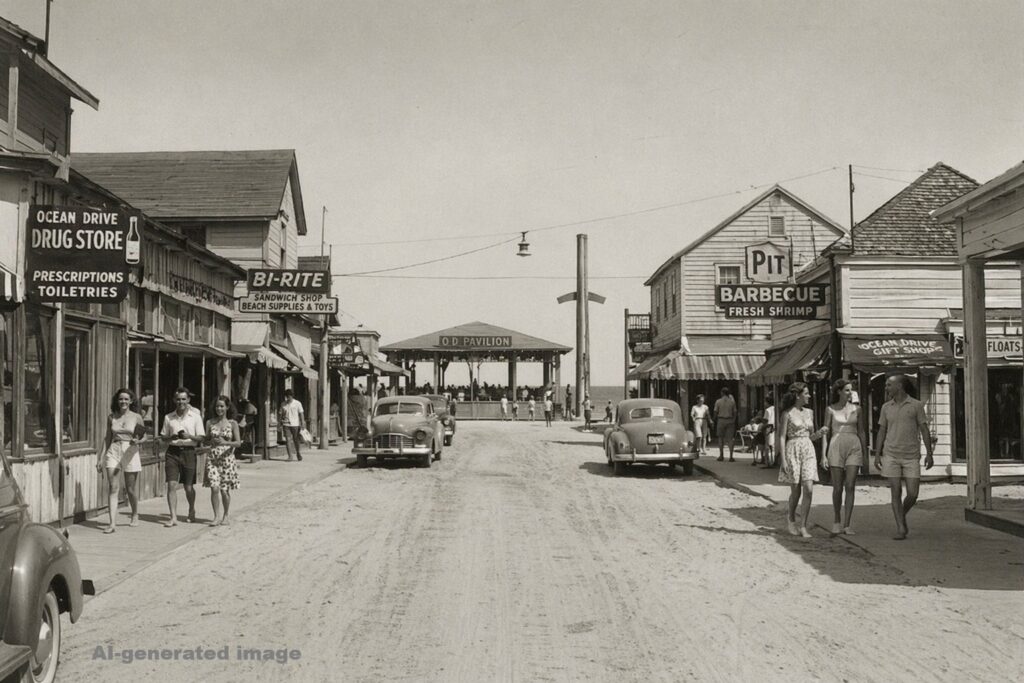
The story of North Myrtle Beach does not begin in 1968, when the city was officially incorporated. It begins in the 1740s, when William Gause obtained a land grant near what is now Windy Hill Beach and set up a tavern along the Kings Highway for travelers heading between the Carolinas. It runs through rice plantations and timber operations and covered wagons, through fishing families who understood the rhythms of this coast long before anyone thought to build a hotel on it. And it finds its clearest voice in the pavilions and dance halls of Ocean Drive, where the Carolina Shag was born and where it still lives today with a stubbornness and joy that no amount of time seems capable of diminishing.
Understanding North Myrtle Beach means understanding what makes it distinct from the 60-mile Grand Strand it anchors at its northern end. This is not the high-rise density of downtown Myrtle Beach. This is something older, more personal, and in many ways more deeply rooted. A community that survived a Category 4 hurricane, rebuilt from rubble, invented a state dance, and chose to merge four stubborn, independent towns into one city rather than disappear from the map. Not a bad origin story.
Four Communities Before There Was One City
The territory that is now North Myrtle Beach was originally home to the Waccamaw and Winyah peoples, who called the broader coastal region Chicora and understood this land as a seasonal resource long before European colonization arrived. The area remained largely inaccessible to outside settlement well into the 1800s — a combination of geography, marshland, and the absence of reliable roads kept the coastline isolated from the rest of South Carolina. A handful of early families — the Bellamys, Bessants, Nixons, and Vereens — acquired large tracts along the shore, but the plantation culture that defined so much of the South Carolina coast farther south never fully took hold here. Instead, subsistence farming, fishing, and logging became the rhythms of life for generations.
Meaningful tourist development began to arrive in the early twentieth century, accelerated by the extension of the Seaboard Air Line Railroad to the Grand Strand in 1904 and by the steady increase in automobile travel that came with the paving of the Kings Highway. By the 1940s, four distinct beach communities had taken shape along the northern strand, each with its own character and its own investors. Cherry Grove Beach emerged from the merger of two older properties in 1950, when an inlet separating Futch Beach from the Nixon family’s land was filled in. Ocean Drive Beach, incorporated in June 1948 with a population of two to three hundred full-time residents, was developed by investors from Florence, South Carolina, who built a pavilion and amusement park that became the social and cultural heart of the northern coast. Crescent Beach occupied the center ground with its quiet residential character. Windy Hill Beach, developed by Conway investors in the postwar years, rounded out the group at the southern end.
These four communities were never particularly unified. They competed for visitors, disagreed on governance, and maintained separate identities with a fierceness that anyone who has spent time in small Southern towns will immediately recognize. They shared a coastline, but they shared little else until a Category 4 hurricane arrived in October 1954 and changed the calculation entirely.
Hurricane Hazel: The Storm That Reshaped Everything
On the morning of October 15, 1954, Hurricane Hazel made landfall near the North Carolina-South Carolina border as a Category 4 storm, hitting directly on top of what is now North Myrtle Beach. The timing was catastrophic in a specific and almost unbelievable way: Hazel arrived at the exact moment of the highest lunar tide of the year, producing an 18-foot storm surge that swept across the barrier islands with a force that erased decades of development in a matter of hours. Wind gusts reached 160 miles per hour. Every pier along 170 miles of coastline was demolished. The name Hazel was permanently retired from use for Atlantic hurricanes — one of only a handful of storm names to receive that distinction.

Historical records from the Horry County Archives Center at Coastal Carolina University document the scale of destruction across the four communities: 450 structures destroyed at Ocean Drive, 300 at Cherry Grove, 200 at Crescent Beach, and 120 at Windy Hill. The Roberts Pavilion on Main Street in Ocean Drive — built in 1936 by William Roberts, one of the original open-air dance pavilions on the Grand Strand where beach music played on jukeboxes and the Shag was danced by teenagers in the postwar years — was completely demolished. A three-story hotel and an 800-foot pier were washed out to sea. The storm killed just one person in South Carolina, a number that speaks to the remarkable advance notice residents received, even amid the chaos of a coastline with no functioning radio station during the final hours before landfall.
The aftermath contained something unexpected. Many property owners, daunted by the scale of what rebuilding would require, chose instead to sell their land at bargain prices. This created larger consolidated parcels that developers could acquire at low cost and build upon at scale — replacing the small beach cottages and single-family homes that had lined the oceanfront with the first generation of hotels and commercial properties. Hurricane Hazel, paradoxically, became the engine of the Grand Strand’s first real development boom. The beach that emerged from the rubble was physically different from the one that had preceded it — and within a decade, it was drawing more visitors than it ever had before.
1968: Four Towns Become One City
By the early 1960s, the case for consolidation was becoming difficult to ignore. Four separate municipal governments serving a combined population of roughly 4,000 permanent residents along seven miles of coastline was an inefficient arrangement, and the shared infrastructure challenges — roads, utilities, public safety — made cooperation increasingly necessary. The idea of merging had been floated before and rejected, but a steering committee organized in 1967 under Elbert Jordan finally gained the pledges needed from all four municipalities to put the question to voters.
The vote passed in March 1968. On May 7 of that year, the South Carolina Legislature passed legislation incorporating the four communities — Cherry Grove Beach, Ocean Drive Beach, Crescent Beach, and Windy Hill Beach — into the City of North Myrtle Beach, with Robert L. Edge as the first mayor. The naming of the new city was not without its lighter moments: among the alternatives considered and rejected were Grandest Grand Strand Beach, Honey Hill Beach, Ocean City, Palm City, Petticoat Junction Beach, and Peyton Place Beach. North Myrtle Beach, as names go, was clearly the sensible choice.
One community notably absent from the merger was Atlantic Beach — a historically Black resort town that had developed in the gap between Windy Hill and Crescent Beach, incorporated in 1966 and choosing to remain independent at the time of the consolidation. Atlantic Beach is today still its own municipality, bordered on three sides by North Myrtle Beach, and its story represents a distinct and important thread in the history of the northern Grand Strand during the era of segregation. As the South Carolina Encyclopedia notes, Atlantic Beach declined the invitation to join and has remained an independent municipality to this day.
The decades following incorporation brought rapid growth. The permanent population grew from roughly 1,957 residents in 1970 to more than 8,600 by 1990 — an increase of over 340 percent in two decades. Multi-story condominiums and hotels began replacing single-family oceanfront homes. The communities developed shared infrastructure, a unified identity for marketing purposes, and the kind of consolidated civic pride that allowed each neighborhood to maintain its distinct character while benefiting from the resources of a single governing body. Today North Myrtle Beach’s population stands at approximately 18,790 permanent residents, with that figure multiplying many times over during peak summer season.
The Carolina Shag: A Dance Born on Ocean Drive
If North Myrtle Beach has a single cultural contribution that is entirely, irreducibly its own, it is the Carolina Shag. A smooth, six-count, eight-step partner dance set to the rhythm of beach music — a genre sometimes described as rhythm and blues slowed down to match the pace of a South Carolina summer afternoon — the Shag emerged in the late 1930s and early 1940s from African American dance traditions along the Grand Strand. Black musicians and dancers had developed their own clubs and open-air pavilions along the coast during the era of segregation, where rhythm and blues — then known as race music and largely shut out of mainstream radio — was performed and danced with a freedom and fluency that was unavailable on the other side of the color line.
Young white vacationers and college students, drawn to that sound and those movements through the proximity that beach culture created even within the confines of a segregated South, adapted what they observed into their own version. By the 1940s and 1950s, the clubs and pavilions along Main Street in Ocean Drive had become the proving ground for what would eventually be called the Carolina Shag — a dance that one veteran teacher famously described as the jitterbug on valium, slowed down to adapt to the warmth and the weight of the coastal South. The footwork is deceptively intricate. The posture is relaxed. The overall effect is of two people having a genuinely good time without working very hard at it, which turns out to be a fairly accurate description of the North Myrtle Beach philosophy in general.
The Roberts Pavilion on Main Street — later rebuilt as the Ocean Drive Pavilion after Hazel’s destruction — was one of the earliest and most important stages for the dance’s development. An open-air oceanfront pavilion built in 1936, it served as the gathering point for generations of young beach visitors who danced on its floors to jukebox rhythm and blues. When the pavilion’s operators eventually moved entertainment indoors and removed the jukebox, the shaggers migrated up Main Street to the clubs that lined the boulevard. The dance found new homes. It always has.

Roberts Pavilion Dance Floor
In 1984, the South Carolina General Assembly made it official: the Carolina Shag is the State Dance of South Carolina. That same year, the first National Shag Dance Championship was held. The dance had survived the 1960s, when rock and roll briefly threatened its popularity, and the 1970s, when disco took the floor. It came roaring back in the 1980s through a revival driven by older dancers who brought competition and institutional structure to what had previously been an informal tradition. Shag clubs formed across both Carolinas. The Society of Stranders — known universally by its initials, SOS — was established as the umbrella organization for dozens of member clubs, and it began hosting its major annual gatherings on Main Street in Ocean Drive: the Spring Safari in April and the Fall Migration in September, described by participants as the biggest adult party on the East Coast.
The OD Pavilion: Where Generations Gathered
At the corner of Main Street and Ocean Boulevard in the Ocean Drive section sits the OD Pavilion — not quite a landmark in the polished, institutional sense, but something more significant: a place that belongs to everyone who has ever come of age on these beaches. The original structure, Roberts Pavilion, was built in 1936 by William Roberts and served as one of the first open-air oceanfront pavilions on the Grand Strand. When Hurricane Hazel leveled it in 1954, it was rebuilt between 1955 and 1957 using salvaged timbers and the same foundation — a detail that carries a particular kind of poetic weight in a community that rebuilt so much of itself from what the storm left behind. A historical marker erected in 2007 by the OD Pavilion Social Shag Club commemorates the site at the intersection of Main Street and Ocean Boulevard.
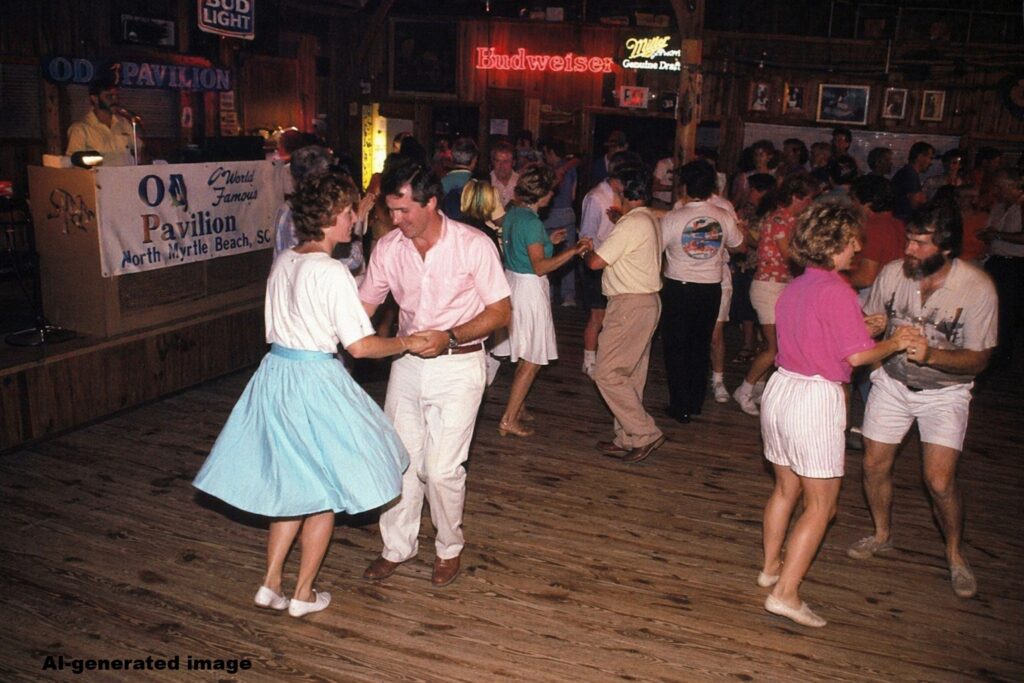
For the generations of young people who vacationed in North Myrtle Beach through the 1950s, 1960s, and 1970s, the OD Pavilion was the center of gravity. It was where you went when you arrived, where you arranged to meet your friends, where you spent the hours between the beach and wherever the night was going. Its sandy dance floor, its jukebox, its open-air design that let the ocean breeze move through the music — these were the specific physical conditions that shaped a culture. The 1989 film Shag — which starred Bridget Fonda and Phoebe Cates and was filmed partly in North Myrtle Beach — captured something of what that culture felt like, and introduced the Shag and the OD scene to audiences who had never experienced the real thing.
Today, the OD Pavilion continues to operate at 3500 North Ocean Boulevard as North Myrtle Beach’s only seaside amusement park, hosting rides, games, and a sandy dance floor that remains one of the last open-air beach music pavilions of its kind on the East Coast. DJs spin beach music seven nights a week during the season, and the pavilion hosts shag events from April through November. It is a place where a twelve-year-old on a first beach vacation and a seventy-year-old on their fiftieth can occupy the same dance floor with equal legitimacy — which is, in the end, what the Shag has always been about.
Fat Harold’s and the Living Shag Culture
If the OD Pavilion is the historical heart of the Shag, Fat Harold’s Beach Club at 212 Main Street is its beating present tense. The original Fat Harold’s was located across the street from the OD Pavilion — on a parking lot that now holds the faint memory of what it once was — alongside another legendary club called The Pad, which opened on July 4, 1955, and burned down in 1987. The original Fat Harold’s was torn down in 1988, but the club was reborn in a new building on Main Street and has been there ever since, inducted into the Carolina Beach Music Awards Hall of Fame in 1996 and drawing dancers from across North America to its floors every week of the year.
Fat Harold’s offers free shag lessons every Tuesday night beginning at 7 p.m. — a two-hour session that starts with a narrated history of the dance and how it evolved in the Ocean Drive community. The club’s Front Room is where the serious shaggers go, and where first-timers are welcomed with a generosity that speaks to the particular spirit of the Shag community: a community that has always believed the dance belongs to anyone willing to step onto the floor. DJs spin seven nights a week, and live bands perform for major events including the SOS gatherings. More than a bar, Fat Harold’s functions as an institution — the kind of place that cities rarely produce but never forget once they have it.
The physical landscape of Shag culture on Main Street extends beyond any single venue. Duck’s Nightclub, the Spanish Galleon, Harold’s on the Ocean, and the OD Arcade and Lounge each play their part in a living ecosystem of beach music and dancing that operates year-round and intensifies to a remarkable degree during the SOS gatherings each April and September. A Shag Walk of Fame runs along Main Street, commemorating the figures who shaped the dance’s history. The Shaggers Hall of Fame Museum occupies a space inside the Ocean Drive Beach and Golf Resort at 98 North Ocean Boulevard, with free admission and exhibits that place the dance in its full cultural and social context. When North Myrtle Beach marked the fortieth anniversary of the Shag’s designation as the state dance in 2024, the city proclaimed the year of the Shag — a recognition that this is not a nostalgia project but a living tradition that continues to recruit new practitioners every season.
Landmarks That Tell the Story
The North Myrtle Beach Area Historical Museum at 799 Second Avenue North opened on April 7, 2013, after eight years of planning and community effort. Its mission is to preserve the cultural history of all four of the city’s original communities, with exhibits covering the area’s first inhabitants through the full arc of tourism development on the northern Grand Strand. Inside, visitors will find a wooden shag dance floor, a jukebox that plays 45s, Weejuns — the shoe of the Shag — displayed alongside other memorabilia, historical maps, personal items from notable North Myrtle Beach residents including Vanna White, marine life exhibits, and artifacts from Cherry Grove, Ocean Drive, Crescent Beach, and Windy Hill. The museum is open Tuesday through Saturday, 10 a.m. to 4 p.m., and admission is free. It is a small museum in the physical sense, but an essential one for anyone who wants to understand what this city actually is beneath the vacation rental listings and the restaurant menus.
Cherry Grove Pier has been extending 985 feet into the Atlantic since it was first built in the early 1950s, making it one of the oldest and most-loved landmarks on the northern Grand Strand. From its raised gazebo at the end, on a clear morning, you can see the coastline running from Little River down toward Myrtle Beach in a single unbroken arc of sand and water that gives you the full measure of what the Grand Strand actually looks like. The pier has a tackle shop, a restaurant and bar, and a two-story observation deck. It holds a particular place in the record books: in 1964, Walter Maxwell of Charlotte caught a 1,780-pound tiger shark from its boards — still the only all-tackle world record catch in South Carolina history.
Barefoot Landing, the waterfront shopping and entertainment complex at the southern end of North Myrtle Beach along the Intracoastal Waterway, opened in 1988 and brought a different kind of anchor to the community — one oriented toward evening entertainment, dining, and the kind of casual waterside strolling that families do when the beach day is done. It is home to the Alabama Theatre, which has packed the house since the mid-1990s with its current house band The Bounty Hunters, and the House of Blues, co-founded by Dan Aykroyd and hosting national touring acts in one of the Grand Strand’s premier concert venues. Barefoot Landing also sits adjacent to Alligator Adventure, a 15-acre reptile park that has been welcoming families for more than thirty years and holds the distinction of housing Utan — one of the largest crocodiles in the United States, measuring over 20 feet in length.
Notable North Myrtle Beach residents have added their own threads to the city’s identity. Vanna White, co-host of Wheel of Fortune for more than four decades and arguably the most recognizable face on American television during the 1980s and 1990s, was born and raised here. Kelly Tilghman, the PGA Tour’s first female lead golf announcer, grew up in North Myrtle Beach. The Surf Golf and Beach Club, founded in the 1940s, is the oldest golf course in the area — predating the golf boom that would eventually transform the entire Grand Strand into one of the world’s premier golf destinations.
Beyond the History: North Myrtle Beach Today
All of this history underlies a city that functions today as one of the most appealing vacation destinations on the East Coast precisely because it has never fully surrendered its character to the demands of mass tourism. North Myrtle Beach is quieter than its neighbor to the south without being sleepy. It has wide, uncrowded beaches, a Main Street culture that is genuinely alive rather than preserved in amber, a fishing pier that has been drawing people out over the Atlantic for more than seventy years, and a shag dance scene that continues to generate new devotees every single season.
The four original communities retain their identities in ways that matter to visitors who take the time to notice. Cherry Grove Beach is the northernmost community, with its fishing pier, its wide-open sand, and the kind of unhurried pace that makes mornings here feel like a different planet from the boardwalk scene fifteen miles to the south. Ocean Drive is the cultural and historical center — Main Street, the shag clubs, the pavilion, the Walk of Fame, the Hall of Fame Museum, the intersection where everything that is most distinctively North Myrtle Beach about North Myrtle Beach converges. Crescent Beach sits in the residential middle, quieter and more settled in its rhythms, the kind of beach neighborhood where the same families have been coming for three generations. Windy Hill anchors the southern end with Barefoot Landing nearby and the Intracoastal Waterway running behind it — a community that offers ocean access and waterway views in equal measure.
The full history of this place is preserved and celebrated at the North Myrtle Beach Area Historical Museum. The Shag is danced year-round at Fat Harold’s, the OD Pavilion, and the clubs of Main Street. The pier at Cherry Grove still catches fish and still catches sunrises. And the nine miles of coastline that four stubborn beach communities chose to share in 1968 continue to draw visitors who return year after year, some of them because of the history, most of them because once you have spent a week here, the pull of the place is genuinely difficult to explain to anyone who has not felt it.
Frequently Asked Questions
A city with this much history deserves to be experienced slowly — a few days at Cherry Grove Pier, a Tuesday night at Fat Harold’s, a morning at the Historical Museum, and as many sunrises as you can fit into the trip. Thomas Beach Vacations has oceanfront homes and condos throughout all four communities of North Myrtle Beach, ready for your next visit. Browse the full collection at northmyrtlebeachvacations.com or call (866) 249-2100 to find the right property for your Grand Strand story.