



myrtle beach boardwalk Archives |

logo ×

  • This field is for validation purposes and should be left unchanged.
  • Privaty Policy

Myrtle Beach Shines on The Kelly Clarkson Show

Every so often, the rest of the country gets a glimpse of what Grand Strand locals wake up to every morning. Sometimes it’s a postcard shot in a magazine spread. Sometimes it’s a puzzle board on a game show. And on the afternoon of June 9, it was Kelly Clarkson’s studio audience watching the SkyWheel turn against a Carolina-blue sky — sixty miles of coastline compressed into a few minutes of national daytime television.

Myrtle Beach landed a coveted feature on The Kelly Clarkson Show this summer, courtesy of nationally recognized travel expert Emily Kaufman — better known to millions of viewers as The Travel Mom. The segment, which aired June 9 as the finale of her South Carolina coastal road trip series, spotlighted the destination’s family-friendly attractions, oceanfront atmosphere, and famous affordability to an audience of potential travelers from coast to coast.

And Kaufman didn’t just talk about the beach — she brought it into the studio. After wrapping her road trip on the Grand Strand, she surprised two lucky audience members with a $10,000 Myrtle Beach getaway, courtesy of the segment’s sponsor, Take 5. Somewhere out there, two very happy families are packing beach bags right now.

Here’s what the feature covered, why placements like this one keep the Grand Strand in the national spotlight, and how to see everything the cameras captured for yourself — with a quieter home base just up the coast.

What Aired on June 9: The Travel Mom’s South Carolina Road Trip

The Myrtle Beach feature came as the closing chapter of a South Carolina coastal road trip series Kaufman produced for the show — a journey that wound its way along the Palmetto State’s shoreline before finishing where so many family road trips do: on the Grand Strand. The format suited the destination perfectly. Myrtle Beach has always been, at heart, a road trip town — the place families from Ohio, Pennsylvania, New York, and half of the eastern seaboard have been steering toward for generations, coolers packed and radio on.

Visit Myrtle Beach, the area’s destination marketing organization, supported the production with coordination, local logistics, and video assets that helped bring the region to life on screen — the kind of behind-the-scenes teamwork that turns a few minutes of airtime into a genuine showcase.

The studio moment sealed it. Kaufman returned from the road to Kelly Clarkson’s stage and handed two audience members a $10,000 Myrtle Beach vacation, turning a travel segment into the kind of feel-good giveaway daytime television does best — and putting the words “Myrtle Beach” on the lips of everyone watching at home.

Who Is The Travel Mom?

If you’ve watched morning or daytime television at any point in the last three decades, you’ve likely met Emily Kaufman. A pioneer of the family travel beat, she has spent roughly thirty years helping households plan accessible, affordable, memorable vacations — appearing regularly on Good Morning America, The Today Show, NBC Nightly News, CBS Mornings, and CNN, and currently serving as the travel correspondent for The Kelly Clarkson Show.

That résumé matters for a simple reason: trust. When The Travel Mom tells a national audience that a destination delivers for families — real value, real variety, something for the grandparents and the toddlers alike — travelers listen. It’s third-party validation from one of the most familiar voices in family travel, and Myrtle Beach earned the nod.

Her verdict echoed what generations of returning visitors already know. The Grand Strand’s combination of wide public beaches, attraction-packed entertainment districts, and vacation costs that don’t require a second mortgage has kept it among America’s most visited beach destinations year after year.

The segment leaned into the icons — the places that define the Myrtle Beach skyline and fill a family’s first-day itinerary.

The Myrtle Beach Boardwalk

The 1.2-mile oceanfront promenade is the destination’s front porch — a stroll past arcades, souvenir shops, ice cream windows, and the sound of waves that never quite leaves the background. It’s the Myrtle Beach that lives in family photo albums, and it photographs just as well for television.

The SkyWheel

Rising nearly 200 feet above the Boardwalk, the SkyWheel is the coast’s unmistakable landmark — climate-controlled glass gondolas turning slowly over the Atlantic, with views that stretch up and down the Strand. When a TV producer needs one shot that says “Myrtle Beach,” this is the one they reach for.

Broadway at the Beach

The sprawling entertainment complex around Lake Broadway packs dining, shopping, nightlife, and attractions into one walkable district — the rare place where a family of four with four different opinions can all get their way in a single evening.

Ripley’s Aquarium of Myrtle Beach

Anchoring Broadway at the Beach, Ripley’s Aquarium sends visitors along a moving glidepath through an underwater tunnel while sharks and rays sail overhead — reliably the moment when even the teenagers put their phones down. It’s a staple of rainy-day plans and hot-afternoon escapes alike, and a natural pick for a family-focused travel feature.

Beyond the marquee names, the segment captured the thing that’s harder to put in a listicle: the oceanfront atmosphere itself. The wide sand, the pier silhouettes, the particular gold of a Grand Strand evening — the reasons people don’t just visit once.

A Big Year for Myrtle Beach on National Television

The Kelly Clarkson Show feature didn’t arrive in a vacuum. Just a month earlier, Wheel of Fortune devoted an entire week of programming to the destination — Myrtle Beach Family Week, which aired May 4–8, 2026, with family teams competing for prizes that included Myrtle Beach trips, plus a companion sweepstakes that sent five winning families on five-night Grand Strand vacations.

There’s a lovely bit of hometown poetry in that one: Wheel of Fortune’s own Vanna White grew up right here in North Myrtle Beach, and the giveaway invited viewers to come explore her hometown. For a game show watched by millions every weeknight, that’s a full week of the Grand Strand glowing on America’s living room screens.

Put the year’s placements side by side and the pattern is clear:

Program When It Aired The Myrtle Beach Spotlight
The Kelly Clarkson Show June 9, 2026 Travel Mom Emily Kaufman’s South Carolina road trip finale, featuring the Boardwalk, SkyWheel, Broadway at the Beach, and Ripley’s Aquarium — plus a $10,000 Myrtle Beach getaway surprise for two audience members
Wheel of Fortune May 4–8, 2026 Myrtle Beach Family Week — five nights of themed episodes with Myrtle Beach trip prizes and a sweepstakes awarding five family vacations to co-host Vanna White’s home turf

Two nationally syndicated shows, back to back, both choosing the same stretch of South Carolina coastline as their family-vacation shorthand. In a tourism marketplace where every beach town in America is competing for attention, that’s not luck — it’s a destination whose story keeps proving easy to tell.

Why National TV Coverage Matters for Your Vacation

It’s fair to ask what a talk show segment has to do with your beach week. More than you’d think, actually — and mostly in good ways.

National features introduce the destination to first-time travelers, sure. But they also work on everyone who’s been here before — the family that came in 2019 and keeps meaning to come back, the couple who honeymooned here and wonders if the kids would love it. A trusted voice like The Travel Mom saying “this place delivers” is often the nudge that turns someday into this summer. That awareness ripples outward to the hotels, attractions, restaurants, and small businesses that make up the Grand Strand’s tourism economy — the same ecosystem that keeps the area’s restaurant scene deep, its attractions fresh, and its calendar full.

For visitors, the practical takeaway is timing. Exposure like this tends to show up in demand, especially for summer and early fall. The families who watched that June 9 segment and started planning are booking now — which makes this a smart moment to lock in your own dates rather than waiting for the shoulder-season scramble. Our Myrtle Beach events calendar is a good place to pick your week; the full menu of things to do in Myrtle Beach will fill it.

Seeing the TV-Famous Spots from North Myrtle Beach

Here’s the local’s secret the cameras rarely linger on: you don’t have to stay in the middle of the spotlight to enjoy it. North Myrtle Beach sits about fifteen miles up the coast from the Boardwalk and SkyWheel — close enough for an easy evening outing, far enough that you come home to a quieter stretch of sand, a slower pace, and the kind of beach where your morning coffee comes with more pelicans than people.

Every one of the featured attractions is a straightforward drive down Highway 17 or the Highway 31 bypass. Spend an afternoon at Ripley’s Aquarium and Broadway at the Beach, ride the SkyWheel at dusk when the coast lights up beneath you, walk the Boardwalk with ice cream in hand — then point the car north and trade the bright lights for the sound of the surf outside your window.

Each of North Myrtle Beach’s four sections makes a fine base camp for it. Cherry Grove Beach offers its fishing pier and famously calm, family-friendly waters at the north end. Ocean Drive brings its own slice of television-worthy Americana — Main Street, the shag clubs, and beach music history (this is Vanna White’s hometown turf, after all). Crescent Beach and Windy Hill sit closest to the Myrtle Beach attractions, shaving minutes off the drive to Broadway at the Beach while keeping the wide, relaxed sand that defines the north end of the Strand.

Frequently Asked Questions

When was Myrtle Beach featured on The Kelly Clarkson Show?
+
The segment aired June 9, 2026, as part of a South Carolina coastal road trip series hosted by travel expert Emily Kaufman, known as The Travel Mom, who serves as the show’s travel correspondent. The feature highlighted Myrtle Beach’s family-friendly attractions and oceanfront atmosphere, and Kaufman surprised two audience members with a $10,000 Myrtle Beach getaway.
What Myrtle Beach attractions were shown in the feature?
+
The feature showcased the Myrtle Beach Boardwalk, the SkyWheel observation wheel, Broadway at the Beach, and Ripley’s Aquarium of Myrtle Beach, along with the destination’s signature oceanfront atmosphere. All are open year-round and sit within an easy drive of North Myrtle Beach vacation rentals.
Who is The Travel Mom?
+
The Travel Mom is Emily Kaufman, a national travel expert with roughly three decades of experience specializing in family travel. She appears regularly on programs including Good Morning America, The Today Show, and NBC Nightly News, and currently serves as the travel correspondent for The Kelly Clarkson Show, helping families find accessible, affordable, and memorable vacation destinations.
Was Myrtle Beach also on Wheel of Fortune this year?
+
Yes. Wheel of Fortune aired Myrtle Beach Family Week from May 4–8, 2026, featuring family teams competing for prizes that included Myrtle Beach trips, plus a viewer sweepstakes that awarded five family vacations to the Grand Strand. The tie-in had a hometown angle: longtime co-host Vanna White grew up in North Myrtle Beach.
How far is North Myrtle Beach from the attractions featured on the show?
+
North Myrtle Beach sits roughly 15 miles north of the Myrtle Beach Boardwalk and SkyWheel — typically a 20 to 30 minute drive via Highway 17 or the faster Highway 31 bypass. Broadway at the Beach and Ripley’s Aquarium fall along the same easy route, making North Myrtle Beach a quieter home base with full access to every attraction featured on the show.

See What the Cameras Saw — Then Stay Where the Locals Would

Millions of viewers just discovered what you may already suspect: the Grand Strand delivers a family beach vacation that’s hard to beat. The next move is making it yours. Thomas Beach Vacations offers oceanfront home rentals with room for the whole crew and oceanfront condos perfect for smaller families — across all four North Myrtle Beach sections, each an easy drive from the Boardwalk, SkyWheel, and Broadway at the Beach, and each with the ocean waiting right outside your door. Browse availability at www.northmyrtlebeachvacations.com or call our local team at (843) 273-3001 — and turn the vacation everyone saw on TV into the one your family actually takes.

Sources: Myrtle Beach Area Chamber of Commerce / Visit Myrtle Beach announcement; The Kelly Clarkson Show (NBC, aired June 9, 2026); Wheel of Fortune Myrtle Beach Family Week official promotion (May 2026).

World’s Strongest Man in Myrtle Beach: Everything You Need to Know

There is a particular kind of electricity that settles over the Myrtle Beach Boardwalk when the World’s Strongest Man rolls into town. The ocean is right there, doing what it always does — steady, indifferent, blue-gray to the horizon. And then, a few feet away on a competition stage built directly into the boardwalk, a man the size of a refrigerator picks up a 400-pound atlas stone and places it on a platform like it is something he has done a thousand times. Because he has. And the crowd on the South Carolina sand goes absolutely wild.

The World’s Strongest Man competition — now nearly five decades old and broadcast in over 100 countries — has found something of a second home here on the Grand Strand. Myrtle Beach hosted the event in 2023 and 2024, welcomed it back for 2026, and each time the result has been the same: thousands of fans, elite athletes from across the globe, and a setting that no stadium venue could replicate. The boardwalk, the ocean, the April sun, the salt in the air. It is unlike anywhere else the competition has been held, and the organizers know it.

Whether you are a longtime strongman fan who knows every competitor’s backstory, or a vacationer who stumbled onto the event while walking the boardwalk and found yourself unable to leave, this guide covers everything worth knowing about the World’s Strongest Man in Myrtle Beach — the history, the athletes, the events, and how to make the most of a long weekend on the Grand Strand while the strongest men in the world are in town.

What Is the World’s Strongest Man Competition?

The World’s Strongest Man began in 1977 as a television event — a simple, slightly ridiculous idea that turned out to be brilliant. What if you gathered the largest, most powerful human beings on the planet, gave them a series of physically outrageous tasks, and broadcast the whole spectacle to the world? The answer, it turned out, was that people loved it. The event drew its first audiences on CBS in America and quickly became a fixture of international sports broadcasting.

In the nearly five decades since, the competition has grown into the premier event in strength athletics, with a global audience now exceeding 220 million viewers and a roster of champions that reads like a mythology of human capability. The format has evolved, the athletes have grown bigger and stronger, and the events have become more demanding — but the core premise remains unchanged. Find out who is the strongest man on earth. Do it outdoors. Make it look epic.

The competition is organized and produced by IMG, the global sports marketing agency, in partnership with Giants Live. It travels to different host cities each year — past venues have included locations across Zambia, Iceland, Malaysia, Morocco, China, and numerous American cities — and the 2026 edition marks its 49th running. Twenty-five athletes are invited based on their results over the prior competitive season, divided into qualifying groups over the first two days, with the top ten advancing to a two-day final.

How Myrtle Beach Became a WSM Destination

Myrtle Beach first hosted the World’s Strongest Man in 2023, and the fit was immediately obvious to anyone who was there. The oceanfront at Burroughs & Chapin Pavilion Place — right on the boardwalk at 9th Avenue North — offered something most competition venues simply cannot: scale, scenery, and a natural amphitheater effect. The Atlantic Ocean sits at the athletes’ backs during the finals. The boardwalk runs alongside the course. The crowd surrounds the action on three sides, pressed close enough to feel the effort radiating off the competitors.

The city itself contributed the rest. Myrtle Beach knows how to host large-scale events — the Grand Strand has long been home to some of the biggest tourism draws on the East Coast, from the Carolina Country Music Festival to the Harley-Davidson Spring Rally — and the infrastructure to support tens of thousands of visitors was already in place. Hotels, restaurants, entertainment venues, the boardwalk itself. The city absorbed the event and its fans the way it absorbs everything: with warm Southern hospitality and a full calendar of distractions for anyone who needed a break from watching trucks get pulled across a course by a man named Rayno.

The partnership with Visit Myrtle Beach has been central to the relationship. The destination marketing organization has co-produced the event with IMG since 2023, and the alignment has been mutually beneficial. The competition adds an internationally broadcast event that puts Myrtle Beach in front of a global audience. The destination provides the setting, the hospitality infrastructure, and the crowd energy that has become part of the event’s identity.

2023: Mitchell Hooper Wins the First Myrtle Beach WSM

The 46th World’s Strongest Man ran from April 19 to 23, 2023 — the competition’s first appearance on the Grand Strand. Thirty athletes competed, and the man who emerged with the title was Mitchell Hooper of Barrie, Ontario, Canada. Hooper had made his WSM debut just the year before, finishing in second place. In Myrtle Beach, he made no such concession, winning four of six events in the final to claim his first world championship.

Hooper’s victory made him the first Canadian to win the World’s Strongest Man title. Two-time defending champion Tom Stoltman of Scotland finished second, and 2020 champion Oleksii Novikov of Ukraine placed third. The competition on the boardwalk was broadcast later that summer on CBS Sports Network in the United States, introducing the Myrtle Beach venue to the show’s massive television audience.

2024: Tom Stoltman Claims His Third Title in Myrtle Beach

The 2024 World’s Strongest Man returned to the same Myrtle Beach venue in May, and this time it was Tom Stoltman who took the title. The Scottish strongman — known to fans as The Albatross for his towering 6-foot-8 frame — dominated the final to claim his third WSM championship, joining an elite group of men who have lifted the trophy that many times. Defending champion Mitchell Hooper placed second, and American Evan Singleton — a former professional wrestler competing under the nickname T-Rex — finished third.

Stoltman’s 2024 victory in Myrtle Beach cemented the city’s place in WSM history. Two editions, two different champions, both crowned with the Atlantic as a backdrop. The competition did not return to the Grand Strand in 2025 — that year’s event moved to Sacramento, California, where South African rookie Rayno Nel pulled off one of the more stunning upsets the sport had seen in decades, becoming the first first-year competitor to win the title since 1997. But the boardwalk was never far from the organizers’ minds.

2026: The World’s Strongest Man Returns to the Grand Strand

The 49th World’s Strongest Man runs April 23–26, 2026, at the oceanfront at Burroughs & Chapin Pavilion Place. It is the third time Myrtle Beach has hosted the event, and the return speaks to a relationship that has clearly worked well for both the competition and the city. Qualifying rounds take place on Thursday and Friday, with the top ten finishers advancing to the championship finals on Saturday and Sunday.

The competition is presented this year as the SBD World’s Strongest Man, with title sponsorship from SBD, a leading manufacturer of strength training equipment and apparel. Reserved general admission seating is available around the main stage for the four-day event, produced in partnership with Visit Myrtle Beach.

The Events: What Competitors Actually Do

Part of what makes the World’s Strongest Man so watchable — and so magnetic in person — is the variety of the events. This is not a single-discipline test. The competition is designed to expose weakness, to find the one man who is not only the strongest but the most complete across disciplines that range from raw explosive power to static endurance.

The 2026 qualifying events include the Farmer’s Walk into Power Stairs — a test in which athletes carry heavy implements across a course before tackling a staircase — the Overhead Circus Medley, Squat for Reps, the Truck Pull, and a stone-off to determine who advances to the final. The championship final on Saturday and Sunday adds a Deadlift for Reps event and closes with the Atlas Stones, the iconic sequence of increasingly heavy spherical stones that competitors must hoist over a series of platforms. The Atlas Stones have ended more than a few title runs.

Among the events that have defined the competition over the years, the Hercules Hold holds a special place in the hearts of spectators. Athletes grip chains attached to two 160-kilogram pillars, one on either side of them, and must hold the pillars upright for as long as possible. There is no movement, no technique to refine — just grip, pain, and willpower. The Keg Toss sends huge metal containers arcing over a 15-foot bar. The Bus Pull does exactly what its name suggests. These are not events that require much explanation. The crowd always understands immediately.

The Athletes to Watch in 2026

The 2026 field of 25 is headlined by four men who have held the title before, which makes for a particularly compelling narrative heading into the Myrtle Beach finals.

Rayno Nel of South Africa arrives as the defending champion after his shocking 2025 Sacramento victory. Nel became the first rookie to win the World’s Strongest Man since 1997, edging out a loaded field by half a point in one of the closest finishes in recent memory. He is still in only his second WSM appearance, but the strength of his 2025 performance — and the depth of his event record since — makes him the favorite heading into qualifying.

Tom Stoltman returns hunting a fourth world title, which would place him alongside legends such as Magnús Ver Magnússon, Jón Páll Sigmarsson, Žydrūnas Savickas, and Brian Shaw. The Scottish giant — the first athlete with autism to win the WSM — arrived in 2026 in sharp form after winning Britain’s Strongest Man, and Myrtle Beach has been good to him before. His 2024 final here was among the most commanding performances of his career.

Mitchell Hooper of Canada is perhaps the most technically complete strongman in the world right now. The 2023 Myrtle Beach champion has won four consecutive Arnold Classic titles, multiple Rogue Invitationals, and Shaw Classics — his record outside of the WSM is almost without parallel. The world title remains the one thing his resume is missing since 2023, and returning to the boardwalk where he first won it gives his 2026 campaign a certain narrative weight.

Martins Licis, the 2019 champion from the United States, rounds out the former champions in the field. American fans will also be watching Evan Singleton — T-Rex, the former WWE wrestler who placed third at the 2024 Myrtle Beach finals — as well as Trey Mitchell, a static powerhouse capable of dominating any deadlift-based event, and Eddie Williams of Australia, who has built a devoted following with his charismatic performances on the competition floor.

Fan Fest: How to Experience WSM Without a Competition Ticket

Competition tickets for the 2026 event are sold out. If you do not already have one, the reserved seating around the main stage is not accessible — but that does not mean you are locked out of the experience. The fan fest area adjacent to the competition course is free and open to all spectators throughout the weekend, and it is genuinely worth the trip on its own.

The free zone features local food trucks and food stands, merchandise vendors, interactive sponsor booths, and — critically — athlete meet-and-greet sessions. This is your opportunity to stand a few feet away from some of the largest human beings you will ever encounter in person. The athletes at the WSM level are not merely strong; they are a different physical category from most professional athletes. Seeing that scale in real life, on the boardwalk, on a warm April afternoon, is its own kind of memorable.

The atmosphere around the boardwalk during WSM weekend extends well beyond the venue itself. The surrounding Myrtle Beach Boardwalk area — which runs from 14th Avenue South to 2nd Avenue North and is lined with restaurants, shops, and amusement attractions — absorbs the energy of the event for the full four days. If you are spending the week at a rental in the area, this stretch of the city is worth visiting for the ambient energy alone, even apart from the competition itself.

Burroughs & Chapin Pavilion Place

The venue at the center of it all — Burroughs & Chapin Pavilion Place, located at 812 North Ocean Boulevard — carries a particular weight in Myrtle Beach history. The Burroughs & Chapin name is inseparable from the development of modern Myrtle Beach; the company’s origins go back to the late 19th century, and it was this family of businesses that built the original Myrtle Beach Pavilion amusement park on this same oceanfront site in the early 20th century. A succession of four pavilion structures stood on or near this location from 1902 until the amusement park’s closure in 2006, and the open-air event space that exists today carries that legacy of public gathering.

Today the space hosts major outdoor events year-round, including the Carolina Country Music Festival each June. For the World’s Strongest Man, the open layout is transformed into a full competition venue: elevated stage, competition course, spectator seating, sponsor activations, and the fan fest zone — all arranged with the Atlantic Ocean as the permanent backdrop. It is one of the more unusual settings in all of professional sports, and that is the point.

Planning Your Trip Around WSM Weekend

Late April is one of the finest times to visit the Grand Strand. The Atlantic is not quite warm enough for extended swimming, but the weather is consistently beautiful — sunny, mild, and free of the summer crowds that descend on the coast from Memorial Day onward. The boardwalk is alive but not overwhelming. Restaurant waits are manageable. The beach is uncrowded in a way it almost never is from June through August.

Guests based in Cherry Grove Beach or Ocean Drive in North Myrtle Beach are approximately a 15-minute drive south from Burroughs & Chapin Pavilion Place — close enough to make an afternoon trip to the fan fest and be back in time for dinner. Those staying in Crescent Beach or Windy Hill are similarly well-positioned.

If you are building a full weekend itinerary around WSM, the mornings and early afternoons while qualifying heats run are a good time to be on the beach or exploring the broader area. The competition stage energy ramps up through the afternoon and into the evening, and the fan fest tends to be most active when athletes cycle through for their meet-and-greet sessions. Check the official schedule at theworldsstrongestman.com for session times as the weekend approaches.

Parking near the boardwalk fills quickly on event days. The city has parking garages on 9th Avenue North and along Ocean Boulevard, but arriving early or taking a rideshare from your rental property will make the day considerably easier. The walk along the boardwalk from several of the nearby public access points is itself a pleasant way to arrive at the venue.

Frequently Asked Questions

When is the World’s Strongest Man competition in Myrtle Beach?
+
The 2026 World’s Strongest Man competition runs April 23–26 at Burroughs & Chapin Pavilion Place on the Myrtle Beach Boardwalk. Qualifying rounds take place Thursday and Friday, with the finals on Saturday and Sunday. For future years, the best source for schedule announcements is the official website at theworldsstrongestman.com.
Can you attend the World’s Strongest Man in Myrtle Beach for free?
+
Yes — the fan fest area is free and open to all spectators throughout the weekend. The fan zone includes local food trucks, merchandise vendors, interactive sponsor booths, and athlete meet-and-greet sessions. Reserved seating around the main competition stage requires a ticket, and 2026 competition tickets are sold out.
Who are the top competitors at the 2026 World’s Strongest Man?
+
The 2026 field features four former world champions: defending champion Rayno Nel of South Africa, three-time winner Tom Stoltman of Scotland, 2023 champion Mitchell Hooper of Canada, and former champion Martins Licis of the United States. Twenty-five athletes in total will compete across the four-day event.
Where exactly is the World’s Strongest Man held in Myrtle Beach?
+
The competition takes place at the oceanfront at Burroughs & Chapin Pavilion Place, located at 812 North Ocean Boulevard on the Myrtle Beach Boardwalk. The venue sits directly adjacent to the Atlantic Ocean, with the boardwalk running alongside the competition course.
Is the World’s Strongest Man coming back to Myrtle Beach after 2026?
+
No official announcement has been made for events beyond 2026. The competition has been held in Myrtle Beach in 2023, 2024, and 2026. Event organizers at IMG have consistently praised Myrtle Beach as an ideal host city, so future returns are possible — but nothing is confirmed at this time. Follow theworldsstrongestman.com for official announcements.

A weekend built around the World’s Strongest Man is a weekend that needs a great home base, and North Myrtle Beach puts you close enough to the action while giving you the kind of space and comfort that a vacation should have. Thomas Beach Vacations offers a full selection of oceanfront homes and oceanfront condos along the Grand Strand — properties with the kind of front-row ocean views that make a spring trip here genuinely hard to forget. Browse what is available at northmyrtlebeachvacations.com or call the team at (866) 249-2100.

How Myrtle Beach Became a Household Name 50 Years Ago — and Why It Still Is

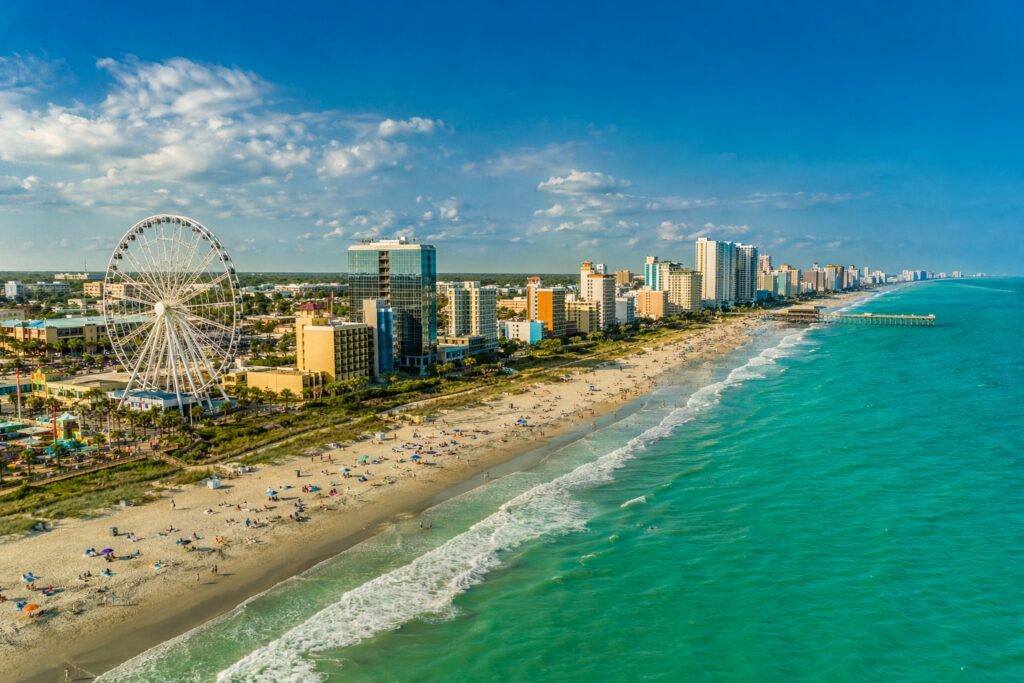
There is a particular kind of place that earns a permanent spot in the American imagination — not through a single moment or a marketing campaign, but through decades of delivering exactly what it promises. Myrtle Beach is one of those places. Drive down Ocean Boulevard on a summer evening, watch the SkyWheel turning slowly against a deepening sky, and listen to the Atlantic rolling in behind the restaurants and the laughter and the smell of sunscreen on warm pavement, and you will understand something immediately: this is a place that people return to. Not because it is the most glamorous destination on the East Coast. Because it feels like something. It feels like vacation, in the most elemental and uncomplicated sense of the word.

Aerial view of the Myrtle Beach Grand Strand coastline, South Carolina

That feeling did not happen by accident, and it did not happen overnight. The story of how Myrtle Beach went from a quiet Carolina town to one of the most visited destinations in the United States is a story worth knowing — especially if you are among the more than 20 million people who make the trip down U.S. 17 each year to see what all the fuss is about.

Before the Boom: A Quiet Stretch of Carolina Coastline

For most of its early history, what would become Myrtle Beach was barely accessible at all. The beaches of Horry County sat behind a wall of geography — rivers, marshland, and poor roads that kept the coastline isolated from the rest of South Carolina well into the late 1800s. It was timber, not tourism, that finally cracked the region open. The Burroughs and Collins Company, a timber and turpentine operation that owned vast stretches of beachfront land, built a railroad to the coast in 1900 to move its product to market. The railroad brought workers to the beach — and workers brought the realization that this sand and surf had potential far beyond lumber.

The town took its name from the wax myrtle trees that grew wild along the shore. By the 1920s it had a modest hotel, a handful of beachfront cottages, and a reputation among middle-class families from the Carolinas as a reliable summer getaway. The tourist season ran roughly from Easter to Labor Day. It was modest and regional and entirely unpretentious — qualities that, as it turned out, would prove to be among its greatest long-term assets.

The postwar decades brought steady but unspectacular growth. Hurricane Hazel swept through in 1954, demolishing much of the oceanfront property along the Grand Strand, but the destruction had an unintended consequence: it cleared the way for a first wave of low-rise hotels and modern development, triggering what would become the area’s first real tourism boom. By the time Myrtle Beach officially incorporated as a city in 1957 — with a permanent population that had just crossed 5,000 — the foundations were in place for something much larger.

The 1970s: When Everything Changed

Fifty years ago, Myrtle Beach was a destination that most Americans outside the Carolinas had still never heard of. That was about to change in a hurry. The 1970s were the decade when Myrtle Beach stopped being a regional secret and became a national name. New construction during that decade alone topped $75 million, and the city’s permanent population tripled. Families from across the East Coast began loading up station wagons and pointing them south, drawn by something that was becoming increasingly difficult to ignore: here was a place where you could have a full, satisfying, genuinely fun vacation without spending a fortune.

Developers recognized the momentum and moved quickly. High-rise oceanfront hotels began replacing the small motels and beach cottages that had defined the earlier skyline. Amusement parks, water slides, arcades, and shopping centers appeared in rapid succession, transforming what had been a laid-back beach town into a full-scale entertainment destination. The Myrtle Beach Convention Center had opened in 1970, a signal that the city was thinking beyond the summer vacation crowd. By the end of the decade, the tourist season — once bounded by Easter and Labor Day — had stretched to something approaching year-round.

The Formula That Made It Stick

A lot of beach towns have their moment in the sun. What separated Myrtle Beach from the destinations that peaked and faded was a deceptively simple combination: accessibility, affordability, and variety. Myrtle Beach is easy to get to from most of the Eastern Seaboard. It is easy to navigate once you arrive. And it has always offered enough variety — beach, golf, live music, water parks, seafood, arcades, outlet shopping, state park hiking — that different members of the same family can have entirely different vacations without ever leaving the Grand Strand.

That last point matters more than it might initially seem. A destination that works for a couple of college students, a family with young children, a pair of retired golfers, and a group of friends celebrating a birthday — and works for all of them simultaneously — is extraordinarily rare. Myrtle Beach has managed to be that destination for five decades running, and that breadth of appeal is the single most important reason it has outlasted so many competitors.

Golf Capital of the World

No single element of Myrtle Beach’s identity has done more to extend its reach into new markets than golf. The area’s golf boom began in the 1960s, when developers recognized that the Grand Strand’s climate, terrain, and flat coastal landscape made it nearly ideal for course construction. The creation of Myrtle Beach Golf Holiday in 1967 formalized the golf package as a distinct product, and the courses kept coming. By the 1980s, Myrtle Beach had earned the nickname Golf Capital of the World — more golf courses per square mile than any other destination on earth. At the peak, the region boasted over 120 courses and once recorded more rounds played annually than anywhere else in the world.

Today, the region has around 100 courses remaining, following some consolidation over the past two decades as real estate development claimed a number of layouts. But the golf identity has never faded. Players from beginners to seasoned low-handicappers continue to make the Grand Strand a primary destination, drawn by the combination of quality, variety, price, and the ability to play year-round in the mild South Carolina climate. For a significant portion of visitors — particularly those in the retiree and active adult demographic that has made Horry County one of the fastest-growing areas in the nation — golf is the primary reason for the trip.

Staying Relevant: The Boardwalk, the SkyWheel, and Beyond

One of the harder things for any destination to do is reinvent itself without losing what made people fall in love with it in the first place. Myrtle Beach has done this more successfully than most. The beach is still the star of the show — that same Grand Strand coastline delivers the same wide, flat, warm-water experience that pulled those first station wagons down the highway fifty years ago. The fundamentals have not changed because the fundamentals did not need to change.

But the supporting cast has evolved considerably. The Myrtle Beach Boardwalk, completed in 2010, revitalized the downtown oceanfront with a 1.2-mile stretch of open-air restaurants, shops, and walkway that connected the heart of the city to the water in a way it had not been connected before. The Carolina Opry, which opened in 1986, pioneered the live entertainment theater scene that eventually gave Myrtle Beach something resembling a miniature Branson, Missouri on the South Carolina coast. And the SkyWheel, rising nearly 200 feet above the boardwalk, added a landmark that is visible from both the beach and the boulevard — a gondola ride that doubles as one of the best sunset viewing platforms on the East Coast.

Broadway at the Beach arrived in the 1990s as a 350-acre entertainment and shopping complex built around a central lake, adding a destination anchor that gave visitors a reason to spend an entire day — and evening — off the sand. Ripley’s Aquarium followed, and the complex became one of the most-visited attractions in South Carolina. Each addition has built on what came before, layering new reasons to visit on top of the original reason that never stopped working.

More Than Just a Beach Trip

Step off the sand and the Grand Strand reveals itself as something considerably deeper than its postcard version suggests. Myrtle Beach State Park, just south of the main commercial strip, offers a version of the Carolina coast that feels genuinely removed from the boardwalk crowds — maritime forest trails, a fishing pier, a campground, and the kind of quiet that reminds you how wild this coastline was before the hotels arrived. It is a twenty-minute drive from the SkyWheel and feels like a different world entirely.

For families traveling with children, the mini-golf culture alone is worth the trip. Myrtle Beach has more elaborately themed miniature golf courses per square mile than perhaps anywhere else in the country — pirate ships, dinosaurs, volcanoes, waterfalls — and the tradition runs deep enough that many adults have photographs of themselves as children playing the same courses their own kids are navigating now. That kind of generational continuity is not something a destination manufactures. It is something earned, slowly, over fifty years of doing things right.

The live entertainment scene — dinner theaters, concert venues, variety shows — continues to bring visitors who are not primarily drawn by the ocean. The restaurant landscape has matured well beyond the all-you-can-eat seafood buffets that defined the area’s dining identity for decades, though those institutions still exist and still fill up every night in season. And the shopping, anchored by Broadway at the Beach and extended by Barefoot Landing in North Myrtle Beach, gives the retail-minded traveler as much room to roam as the coast gives the beach lover.

North Myrtle Beach: The Quieter, Deeper Side of the Grand Strand

About fifteen miles up the coast from downtown Myrtle Beach, North Myrtle Beach offers a different entry point into the Grand Strand experience — one that trades the high-rise density of the main strip for wider beaches, quieter neighborhoods, and a sense of place that feels more rooted in the area’s original character. It is a separate city with its own government and its own identity, and for many visitors it is the preferred base for exploring everything the Grand Strand has to offer.

The four communities of North Myrtle Beach each carry their own personality. Cherry Grove Beach is known for its fishing pier and unhurried pace. Ocean Drive is the birthplace of the shag — the official state dance of South Carolina — and carries the kind of boardwalk history that no amount of development can fully replicate. Crescent Beach sits in the relaxed center, and Windy Hill offers the peaceful southern end of the strip for those who want ocean views without the foot traffic. Visitors can choose from spacious oceanfront home rentals and well-positioned oceanfront condos — putting the Atlantic directly outside the door and everything the Grand Strand has built over the past fifty years just a short drive away.

Frequently Asked Questions

When did Myrtle Beach become a popular vacation destination?
+
Myrtle Beach had been drawing regional visitors since the early 1900s, but it was during the 1970s that the destination truly broke onto the national scene. New construction during that decade topped $75 million, the permanent population tripled, and the combination of new hotels, attractions, and entertainment options transformed the Grand Strand from a regional getaway into a nationally recognized vacation hub.
Why is Myrtle Beach called the Golf Capital of the World?
+
Myrtle Beach earned the nickname Golf Capital of the World because of its extraordinary concentration of golf courses — at peak, over 120 across the Grand Strand — and because it once recorded more rounds of golf played annually than any other destination in the world. The golf boom began in the 1960s and accelerated through the 1970s and 1980s, drawing players of every skill level to the area year-round.
What is the Grand Strand?
+
The Grand Strand is a 60-mile stretch of uninterrupted sandy Atlantic coastline running through Horry and Georgetown Counties in South Carolina, from the North Carolina border south toward Winyah Bay. Myrtle Beach sits at the center of the Grand Strand and is its most recognized city, though the stretch encompasses numerous distinct communities including North Myrtle Beach to the north and Pawleys Island and Murrells Inlet to the south.
How many people visit Myrtle Beach each year?
+
Myrtle Beach and the Grand Strand attract over 20 million visitors annually, making it one of the most visited destinations in the entire United States. The area draws families, golfers, retirees, couples, and travelers from across the East Coast and beyond, with international visitors increasingly making the trip from Canada, Germany, and the United Kingdom.
What is there to do in Myrtle Beach besides the beach?
+
Beyond the shoreline, Myrtle Beach offers over 100 golf courses, the Myrtle Beach Boardwalk and Promenade, the SkyWheel, Broadway at the Beach, Ripley’s Aquarium, live entertainment theaters, miniature golf, water parks, Myrtle Beach State Park, world-class dining, outlet shopping, Barefoot Landing in North Myrtle Beach, and a full calendar of year-round events and festivals.

Fifty years of earning a reputation is not something that happens by accident — and experiencing it firsthand is easier than you might think. Thomas Beach Vacations has oceanfront homes and condos across North Myrtle Beach ready for your next Grand Strand trip. Browse the full collection at northmyrtlebeachvacations.com or call (866) 249-2100 and let the team help you find exactly the right place on the coast.

Undertow Movie Filming in Myrtle Beach: Hollywood Comes to the Grand Strand

A Thriller Finds Its Stage on the Shore

The morning light off the Myrtle Beach coastline can fool you. It slides across the pier planks, catches the spray where the Atlantic breaks against the pilings, and makes everything look like a postcard. But for the past month, that same light has been doing double duty — illuminating something you do not see every spring along the Grand Strand. Film crews. Cameras mounted on rigs. Directors calling for quiet on a public beach where quiet almost never happens. The movie is called Undertow, and it has turned familiar stretches of sand and local landmarks into the backdrop of a Hollywood psychological thriller.

Director Adam Sigal brought the production to the Grand Strand after the script was originally slated to film in Ireland. The reason for the change was straightforward — South Carolina offered stronger financial incentives and, once the filmmakers scouted the coastline, the visual pull of this place did the rest. The South Carolina Film Commission confirmed that the creative team was so taken with what the Grand Strand offered that they rewrote the script to set the story here. That kind of pivot does not happen because of a tax break alone. It happens because a place looks right on camera and feels right in a story.

The production has been spotted at locations stretching from Garden City to North Myrtle Beach — surf shops, the boardwalk, a municipal aquatic center, even the police station. Beachgoers on spring break have walked into active film sets without realizing it. Local paddleboarders have been recruited for ocean scenes. The whole thing has had the feeling of a town discovering, in real time, that its everyday landscape is somebody else’s cinematic vision.

Grand Strand Filming Locations

What makes the Undertow production interesting from a local perspective is how widely the crew has spread across the region. This is not a case of a film company renting a single soundstage and calling it a day. Sigal and his team have used the entire Grand Strand as their set, and the result is a production deeply woven into the geography that visitors and residents know by heart.

Filming kicked off at Village Surf Shoppe in Garden City, a place that has been part of the beach culture down here for years. The historic surf shop closed its doors temporarily for interior and exterior scenes, and one of the film’s characters reportedly owns a surf shop in the story — a detail that fits Garden City’s vibe like a wetsuit in October. From there, the production moved north.

Pier 14 in Myrtle Beach served as another key location. Sitting directly over the Atlantic at 1306 North Ocean Boulevard, right along the Myrtle Beach Boardwalk, Pier 14 has been a Grand Strand landmark since the mid-1980s. The pier’s position — jutting out over the waves with an unobstructed ocean horizon — gives it the kind of dramatic framing that directors look for without having to build anything. Scenes involving a search-and-rescue sequence were filmed near the pier, and local paddleboarders were even asked to participate in the shoot.

Up in North Myrtle Beach, the North Myrtle Beach Aquatic and Fitness Center on Second Avenue South became the site for controlled ocean sequences. A significant portion of the film takes place on a yacht, and the aquatic center’s pools allowed the crew to stage underwater chase scenes and swimming sequences in a safe, repeatable environment. It is the kind of creative problem-solving that makes location shooting work — using a municipal pool to simulate open water, surrounded by the same coastal town where the outdoor beach scenes are happening a few blocks away.

The production also filmed along the beach near Riptydz Oceanfront Grille and Rooftop Bar, where what appeared to be a wedding scene drew a crowd of onlookers from the nearby Myrtle Beach Boardwalk. Additional shooting took place at the Myrtle Beach International Airport, local restaurants, the city’s Chamber of Commerce offices, and the police station — which was temporarily shut down to accommodate filming.

The Cast and Crew Behind Undertow

Adam Sigal is a writer, director, and producer with more than twenty years in the industry. His path to filmmaking took an unusual route — he worked as a private investigator in Los Angeles before turning to screenwriting, a background that likely informs the kind of tension and suspicion that drives a thriller like Undertow. His previous directorial credits include Chariot (2022), starring John Malkovich and Rosa Salazar, and Nandor Fodor and the Talking Mongoose (2023), which featured Simon Pegg, Minnie Driver, and Christopher Lloyd. Producer Joel Shapiro’s credits include Gunner (2024) and River Runs Red (2018).

The cast is headlined by Tania Raymonde, an actress whose face many viewers will recognize even if they cannot immediately place it. She played Alex Rousseau in the ABC phenomenon Lost, appeared as Cynthia Sanders on Fox’s Malcolm in the Middle, and starred alongside Billy Bob Thornton in the Amazon legal drama Goliath. Raymonde was spotted on set at Village Surf Shoppe in early March, and her involvement brought a visible level of industry credibility to the production. Additional cast and local extras have been involved throughout the shoot, though the full roster has not been publicly released.

The plot itself remains tightly guarded. What has been confirmed is that the story centers on a seaborne kidnapping — a woman is taken from the ocean, and the narrative unfolds from there. Sigal described a scenario involving a yacht, a pursuit through the water, and the kind of tension that builds when a character is trapped between the open sea and a threat that will not let go. The Myrtle Beach setting is not incidental to the story. It is the story. The coastline, the piers, the salt air — all of it feeds the atmosphere the film needs.

Why South Carolina Is Winning the Film Incentive Game

The reason Undertow ended up on the Grand Strand instead of the coast of Ireland comes down to money and momentum. South Carolina has built one of the more attractive film incentive packages in the Southeast, and productions are responding. The state’s Motion Picture Incentive program offers qualifying productions a cash rebate — not a tax credit that has to be brokered, but a direct check — of up to 25 percent on in-state crew wages and up to 30 percent on goods and services purchased from South Carolina suppliers. Productions need to spend at least one million dollars in the state to qualify for the main program.

That rebate structure is significant. Unlike states that offer tax credits requiring brokers and extended waiting periods, South Carolina reserves the estimated rebate funds upfront and cuts the check within 30 days of the final audit. For a production company managing cash flow across locations and schedules, that kind of certainty matters. The wage rebate is even assignable to a financial institution, meaning producers can use it to finance the production itself.

In 2025, South Carolina introduced the Local Filmmaker Incentive, a pilot program with two million dollars in annual funding aimed at smaller productions. This newer program lowered the spending threshold to $250,000, opening the door for independent filmmakers who previously could not hit the million-dollar mark. The requirement that at least one producer be a South Carolina native has helped ensure the program builds local industry talent rather than just importing it. Matt Storm of the South Carolina Film Commission has been instrumental in managing the state’s incentive program and guiding productions through the application process.

The state legislature is also considering Bill H.3832, which would increase the annual rebate cap from ten million dollars to thirty million dollars. If passed, the expanded cap would position South Carolina to compete even more aggressively with states like Georgia and Louisiana for major studio productions. The trajectory is clear — South Carolina is not just dipping a toe into the film industry. It is building infrastructure.

Film Tourism and the Grand Strand Economy

When a film crew sets up on a public beach and starts shooting, the first thing that happens is entirely predictable — people stop and watch. Spring breakers near Riptydz slowed their boardwalk strolls to a halt when they realized a movie was being made in front of them. Visitors from out of state tried to take photos before being told the set was closed. That kind of curiosity is the seed of something the tourism industry calls film-induced tourism, and the Grand Strand is positioned to benefit from it in ways that go well beyond the weeks of active production.

The economics are layered. During production, the film company spends money locally — hotels for the crew, meals at area restaurants, equipment rentals, location fees, and wages for local hires. That is the immediate impact. The longer-term value comes after the film is released, when audiences see the Grand Strand on screen and start thinking about visiting. The Myrtle Beach Boardwalk, the beaches of Cherry Grove Beach and Ocean Drive, the pier at sunset — these are not just film backdrops. They are destinations, and seeing them in a movie makes them feel both familiar and aspirational to potential visitors.

South Carolina state officials have noted that productions like Undertow generate both direct revenue and tourism interest that extends well beyond the production schedule. The South Carolina Film Commission actively works to attract directors and production companies for exactly this reason — every film shot here is, in effect, a feature-length advertisement for the state’s coastline, communities, and culture.

Myrtle Beach’s Growing Film Legacy

Undertow is not an isolated event. It is the latest chapter in a story that has been building across South Carolina for years. More than 200 feature films, television series, and TV movies have been shot in the state, and the South Carolina Film Commission has signaled its intention to increase that number. The Grand Strand in particular has become a recurring location choice for productions that need a coastal setting with accessible infrastructure, cooperative local government, and a visual palette that ranges from quiet tidal creeks to wide public beaches to neon-lit commercial strips.

The appeal for filmmakers is practical as much as it is aesthetic. The Grand Strand offers a concentrated range of environments within a short drive — the marshlands and surf culture of Garden City, the boardwalk energy of downtown Myrtle Beach, the quieter residential feel of Crescent Beach and Windy Hill in North Myrtle Beach. A production does not have to relocate to find a different look. It just drives fifteen minutes up or down the coast.

Dan Rogers, Senior Project Manager at the South Carolina Film Commission, has spoken publicly about the growing interest from filmmakers in the Myrtle Beach region. The fact that the Undertow production rewrote its script to move the setting from Ireland to Myrtle Beach says something about the confidence the creative community is placing in this coastline. It is one thing to film here because the incentives are good. It is another thing entirely to change your story because the place itself demanded it.

Visit the Filming Locations Yourself

One of the best parts about a movie filmed on the Grand Strand is that every location the crew used is a place you can visit on your next vacation. You do not need a backstage pass or a studio tour. You just need to show up.

Walk the Myrtle Beach Boardwalk and stop at Pier 14 for a seafood lunch over the Atlantic — the same pier where search-and-rescue scenes were filmed for Undertow. Head south to Garden City and browse Village Surf Shoppe, where the first scenes of the production were shot inside a real working surf shop that has been part of the local beach scene for decades. Drive up to North Myrtle Beach and explore the neighborhoods around the Aquatic and Fitness Center on Second Avenue South, where the controlled water sequences were staged.

And while you are in North Myrtle Beach, take some time to explore what the rest of the area has to offer beyond the film sets. Walk the wide, family-friendly sand at Cherry Grove Beach, where the marsh inlet meets the ocean and the fishing pier stretches out over the waves. Stroll through Ocean Drive, the birthplace of the Shag dance and the heart of North Myrtle Beach’s social scene. Settle into the quieter rhythm of Crescent Beach, or catch the sunset from Windy Hill, where the pace slows down and the ocean view widens. Whether you want a front-row seat to the waves from an oceanfront home or the convenience of an oceanfront condo, the Grand Strand has a rental that fits the trip you are planning.

When Undertow eventually hits screens, you will be able to watch it and say you have been to those places. You have walked that beach. You have eaten at that pier. That is the kind of connection a filmed-on-location movie gives you — and the Grand Strand has always been a place that rewards people who actually show up.

Frequently Asked Questions

What is the movie Undertow being filmed in Myrtle Beach about?
+
Undertow is a psychological thriller directed by Adam Sigal. The story centers on a seaborne kidnapping — a woman is abducted from the ocean and the tension builds from there. The script was originally set in Ireland but was rewritten to take place in Myrtle Beach after the filmmakers scouted the Grand Strand and were drawn to its coastal landscape. South Carolina’s competitive film production incentives also played a significant role in the decision to relocate the production.
Where is Undertow being filmed along the Grand Strand?
+
The production has filmed at multiple locations across the Grand Strand, including Village Surf Shoppe in Garden City, Pier 14 in Myrtle Beach, the North Myrtle Beach Aquatic and Fitness Center, the beach near Riptydz Oceanfront Grille and Rooftop Bar along the Myrtle Beach Boardwalk, the Myrtle Beach International Airport, area restaurants, the city Chamber of Commerce offices, and the police station.
Who stars in the movie Undertow filmed in Myrtle Beach?
+
The cast includes actress Tania Raymonde, known for her roles in the Amazon series Goliath, the ABC hit show Lost, and the Fox comedy Malcolm in the Middle. The film also features other professional actors along with local talent and extras recruited from the Grand Strand area. The full cast list has not been publicly released by the production team.
What film incentives does South Carolina offer to attract movie productions?
+
South Carolina offers qualifying productions a cash rebate of up to 25 percent on in-state crew wages and up to 30 percent on goods and services purchased from South Carolina suppliers. Productions must spend at least one million dollars in the state to qualify for the main rebate program. The state also introduced the Local Filmmaker Incentive in 2025, which allows smaller productions spending between $250,000 and $1 million to qualify for a 25 percent rebate. Additionally, qualified productions are exempt from state and local sales and use taxes on supplies.
When will the movie Undertow be released?
+
As of March 2026, no official release date has been announced for Undertow. The production team has kept many details under wraps, including the complete cast list and specific release timeline. Filming along the Grand Strand was scheduled to wrap by late March 2026, and the film will enter post-production after that. Check back for updates as more information becomes available.

Whether you are coming to walk the same beaches where Undertow was filmed, explore the Myrtle Beach Boardwalk, or simply settle into a week of ocean air and slow mornings, Thomas Beach Vacations can help you find the perfect place to stay in North Myrtle Beach. Browse oceanfront homes and oceanfront condos across Cherry Grove, Ocean Drive, Crescent Beach, and Windy Hill. Call us at (866) 249-2100 or visit northmyrtlebeachvacations.com to start planning your Grand Strand getaway.

Things to Do in Myrtle Beach: The Complete Visitor Guide

Myrtle Beach is one of the most popular vacation destinations on the East Coast, and for good reason. From oceanfront attractions and live entertainment to beautiful beaches and family activities, the area offers something for every type of traveler.

Located along the famous Grand Strand, Myrtle Beach blends lively attractions with scenic coastal experiences. Many visitors spend their days exploring the boardwalk, enjoying amusement parks, discovering live music, or relaxing on the beach.

This guide highlights some of the best things to do in Myrtle Beach and introduces nearby destinations worth exploring during your visit.

Explore the Myrtle Beach Boardwalk

Myrtle Beach Boardwalk

The Myrtle Beach Boardwalk & Promenade is one of the most iconic attractions in the area. Stretching along the oceanfront in downtown Myrtle Beach, the boardwalk is filled with restaurants, shops, arcades, and entertainment.

Visitors often spend hours walking along the ocean, stopping for ice cream, enjoying live performers, and watching the waves roll in.

Nearby gathering areas also host seasonal events and live entertainment throughout the year. One of the most popular spots for community events is Nance Plaza in downtown Myrtle Beach, where visitors can enjoy festivals, concerts, and special events.

Visit Family Kingdom Amusement Park

Family Kingdom Amusement Park is one of the few oceanfront amusement parks remaining in the United States. Located right beside the beach, it offers classic rides and family-friendly attractions.

The park features roller coasters, carnival rides, and the historic Swamp Fox wooden roller coaster. Across the street, visitors will also find the Splashes Oceanfront Water Park with water slides and splash zones.

Live Music and Nightlife

Myrtle Beach has a vibrant live music scene. Visitors can enjoy local bands, beach music, and concerts at venues across the area.

Popular entertainment spots include beachfront bars, music halls, and outdoor venues that host seasonal performances throughout the summer months.

Live entertainment is a long-standing tradition along the Grand Strand and adds a lively atmosphere to the evenings after a day at the beach.

Enjoy the Beaches of the Grand Strand

The coastline known as the Grand Strand stretches roughly 60 miles along South Carolina’s coast. These wide sandy beaches attract millions of visitors every year.

Many travelers enjoy spending their mornings walking along the shore, swimming, or simply relaxing under an umbrella while listening to the ocean waves.

While the central Myrtle Beach area is lively and energetic, visitors often explore quieter sections of the coastline located just a short drive away.

Explore Downtown Myrtle Beach

Downtown Myrtle Beach continues to grow as a destination for entertainment, dining, and community events.

Visitors can explore restaurants, entertainment venues, beach access points, and public gathering spaces. Throughout the year the area hosts festivals, concerts, and seasonal celebrations.

Public spaces like Nance Plaza have become important gathering areas where locals and visitors come together to enjoy the vibrant atmosphere of downtown Myrtle Beach.

Discover North Myrtle Beach

Just a short drive north, North Myrtle Beach offers a different pace of coastal life. Many visitors choose this area for its quieter beaches, family-friendly neighborhoods, and classic beach traditions.

North Myrtle Beach is known for wide beaches, fishing piers, waterfront restaurants, and the famous shag dancing culture along Ocean Drive.

Staying in North Myrtle Beach allows visitors to enjoy a peaceful coastal atmosphere while remaining close to all the attractions of Myrtle Beach.

Planning Your Myrtle Beach Vacation

Whether you are looking for lively attractions, oceanfront entertainment, or relaxing beach days, the Myrtle Beach area offers countless experiences.

Many travelers choose to stay just minutes away in North Myrtle Beach, where spacious vacation rentals and oceanfront condos provide the perfect place to relax after a day of exploring the Grand Strand.

Thomas Beach Vacations has been helping families plan memorable beach vacations for more than 60 years.

Call (866) 249-2100 or visit northmyrtlebeachvacations.com
to find the perfect North Myrtle Beach vacation rental for your next getaway.


Frequently Asked Questions About Myrtle Beach

What are the most popular things to do in Myrtle Beach?

Some of the most popular activities include visiting the Myrtle Beach Boardwalk, enjoying the rides at Family Kingdom Amusement Park, relaxing on the beaches of the Grand Strand, attending live music events, and exploring restaurants and entertainment in downtown Myrtle Beach.

Is Myrtle Beach good for family vacations?

Yes. Myrtle Beach is considered one of the best family vacation destinations on the East Coast. Families enjoy the beaches, amusement parks, mini golf courses, water parks, and many entertainment options designed for visitors of all ages.

What is the difference between Myrtle Beach and North Myrtle Beach?

Myrtle Beach is the central tourist area known for its busy boardwalk and entertainment districts. North Myrtle Beach is located a short drive north and offers a quieter coastal atmosphere with wide beaches, fishing piers, and family-friendly vacation communities.

What is the best time of year to visit Myrtle Beach?

Spring, summer, and early fall are the most popular times to visit Myrtle Beach. Warm weather, ocean activities, festivals, and live entertainment make these seasons ideal for beach vacations.

Where should families stay when visiting Myrtle Beach?

Many families choose to stay in North Myrtle Beach because it offers a quieter environment while still being close to Myrtle Beach attractions. Oceanfront condos and vacation homes provide comfortable accommodations for families visiting the Grand Strand.