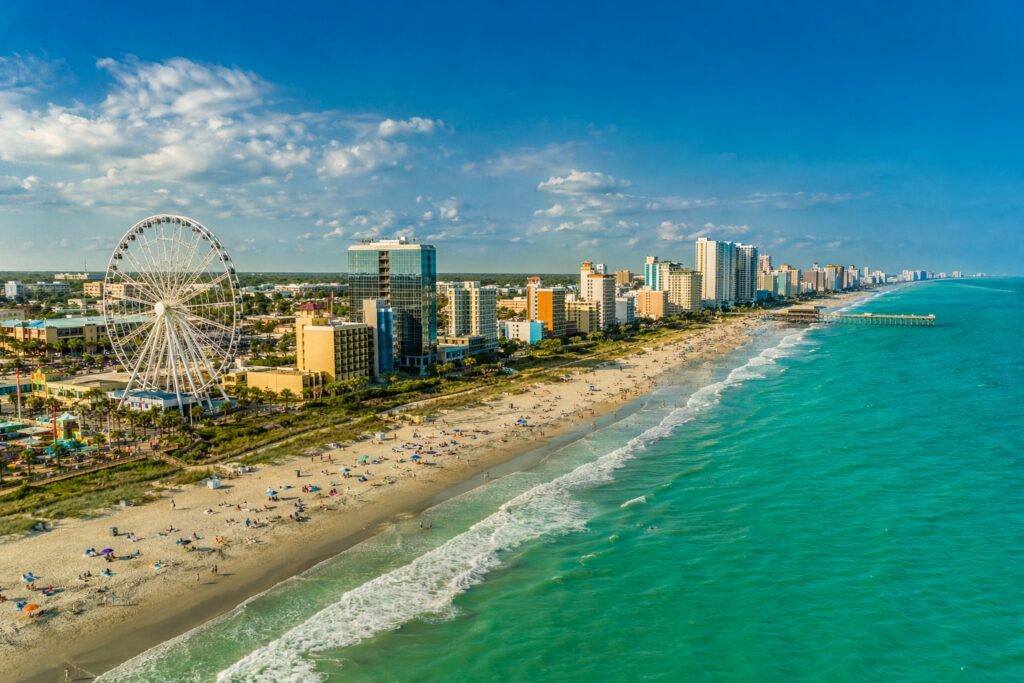
There is a particular kind of place that earns a permanent spot in the American imagination — not through a single moment or a marketing campaign, but through decades of delivering exactly what it promises. Myrtle Beach is one of those places. Drive down Ocean Boulevard on a summer evening, watch the SkyWheel turning slowly against a deepening sky, and listen to the Atlantic rolling in behind the restaurants and the laughter and the smell of sunscreen on warm pavement, and you will understand something immediately: this is a place that people return to. Not because it is the most glamorous destination on the East Coast. Because it feels like something. It feels like vacation, in the most elemental and uncomplicated sense of the word.
That feeling did not happen by accident, and it did not happen overnight. The story of how Myrtle Beach went from a quiet Carolina town to one of the most visited destinations in the United States is a story worth knowing — especially if you are among the more than 20 million people who make the trip down U.S. 17 each year to see what all the fuss is about.
Before the Boom: A Quiet Stretch of Carolina Coastline
For most of its early history, what would become Myrtle Beach was barely accessible at all. The beaches of Horry County sat behind a wall of geography — rivers, marshland, and poor roads that kept the coastline isolated from the rest of South Carolina well into the late 1800s. It was timber, not tourism, that finally cracked the region open. The Burroughs and Collins Company, a timber and turpentine operation that owned vast stretches of beachfront land, built a railroad to the coast in 1900 to move its product to market. The railroad brought workers to the beach — and workers brought the realization that this sand and surf had potential far beyond lumber.
The town took its name from the wax myrtle trees that grew wild along the shore. By the 1920s it had a modest hotel, a handful of beachfront cottages, and a reputation among middle-class families from the Carolinas as a reliable summer getaway. The tourist season ran roughly from Easter to Labor Day. It was modest and regional and entirely unpretentious — qualities that, as it turned out, would prove to be among its greatest long-term assets.
The postwar decades brought steady but unspectacular growth. Hurricane Hazel swept through in 1954, demolishing much of the oceanfront property along the Grand Strand, but the destruction had an unintended consequence: it cleared the way for a first wave of low-rise hotels and modern development, triggering what would become the area’s first real tourism boom. By the time Myrtle Beach officially incorporated as a city in 1957 — with a permanent population that had just crossed 5,000 — the foundations were in place for something much larger.
The 1970s: When Everything Changed
Fifty years ago, Myrtle Beach was a destination that most Americans outside the Carolinas had still never heard of. That was about to change in a hurry. The 1970s were the decade when Myrtle Beach stopped being a regional secret and became a national name. New construction during that decade alone topped $75 million, and the city’s permanent population tripled. Families from across the East Coast began loading up station wagons and pointing them south, drawn by something that was becoming increasingly difficult to ignore: here was a place where you could have a full, satisfying, genuinely fun vacation without spending a fortune.
Developers recognized the momentum and moved quickly. High-rise oceanfront hotels began replacing the small motels and beach cottages that had defined the earlier skyline. Amusement parks, water slides, arcades, and shopping centers appeared in rapid succession, transforming what had been a laid-back beach town into a full-scale entertainment destination. The Myrtle Beach Convention Center had opened in 1970, a signal that the city was thinking beyond the summer vacation crowd. By the end of the decade, the tourist season — once bounded by Easter and Labor Day — had stretched to something approaching year-round.
The Formula That Made It Stick
A lot of beach towns have their moment in the sun. What separated Myrtle Beach from the destinations that peaked and faded was a deceptively simple combination: accessibility, affordability, and variety. Myrtle Beach is easy to get to from most of the Eastern Seaboard. It is easy to navigate once you arrive. And it has always offered enough variety — beach, golf, live music, water parks, seafood, arcades, outlet shopping, state park hiking — that different members of the same family can have entirely different vacations without ever leaving the Grand Strand.
That last point matters more than it might initially seem. A destination that works for a couple of college students, a family with young children, a pair of retired golfers, and a group of friends celebrating a birthday — and works for all of them simultaneously — is extraordinarily rare. Myrtle Beach has managed to be that destination for five decades running, and that breadth of appeal is the single most important reason it has outlasted so many competitors.
Golf Capital of the World
No single element of Myrtle Beach’s identity has done more to extend its reach into new markets than golf. The area’s golf boom began in the 1960s, when developers recognized that the Grand Strand’s climate, terrain, and flat coastal landscape made it nearly ideal for course construction. The creation of Myrtle Beach Golf Holiday in 1967 formalized the golf package as a distinct product, and the courses kept coming. By the 1980s, Myrtle Beach had earned the nickname Golf Capital of the World — more golf courses per square mile than any other destination on earth. At the peak, the region boasted over 120 courses and once recorded more rounds played annually than anywhere else in the world.
Today, the region has around 100 courses remaining, following some consolidation over the past two decades as real estate development claimed a number of layouts. But the golf identity has never faded. Players from beginners to seasoned low-handicappers continue to make the Grand Strand a primary destination, drawn by the combination of quality, variety, price, and the ability to play year-round in the mild South Carolina climate. For a significant portion of visitors — particularly those in the retiree and active adult demographic that has made Horry County one of the fastest-growing areas in the nation — golf is the primary reason for the trip.
Staying Relevant: The Boardwalk, the SkyWheel, and Beyond
One of the harder things for any destination to do is reinvent itself without losing what made people fall in love with it in the first place. Myrtle Beach has done this more successfully than most. The beach is still the star of the show — that same Grand Strand coastline delivers the same wide, flat, warm-water experience that pulled those first station wagons down the highway fifty years ago. The fundamentals have not changed because the fundamentals did not need to change.
But the supporting cast has evolved considerably. The Myrtle Beach Boardwalk, completed in 2010, revitalized the downtown oceanfront with a 1.2-mile stretch of open-air restaurants, shops, and walkway that connected the heart of the city to the water in a way it had not been connected before. The Carolina Opry, which opened in 1986, pioneered the live entertainment theater scene that eventually gave Myrtle Beach something resembling a miniature Branson, Missouri on the South Carolina coast. And the SkyWheel, rising nearly 200 feet above the boardwalk, added a landmark that is visible from both the beach and the boulevard — a gondola ride that doubles as one of the best sunset viewing platforms on the East Coast.
Broadway at the Beach arrived in the 1990s as a 350-acre entertainment and shopping complex built around a central lake, adding a destination anchor that gave visitors a reason to spend an entire day — and evening — off the sand. Ripley’s Aquarium followed, and the complex became one of the most-visited attractions in South Carolina. Each addition has built on what came before, layering new reasons to visit on top of the original reason that never stopped working.
More Than Just a Beach Trip
Step off the sand and the Grand Strand reveals itself as something considerably deeper than its postcard version suggests. Myrtle Beach State Park, just south of the main commercial strip, offers a version of the Carolina coast that feels genuinely removed from the boardwalk crowds — maritime forest trails, a fishing pier, a campground, and the kind of quiet that reminds you how wild this coastline was before the hotels arrived. It is a twenty-minute drive from the SkyWheel and feels like a different world entirely.
For families traveling with children, the mini-golf culture alone is worth the trip. Myrtle Beach has more elaborately themed miniature golf courses per square mile than perhaps anywhere else in the country — pirate ships, dinosaurs, volcanoes, waterfalls — and the tradition runs deep enough that many adults have photographs of themselves as children playing the same courses their own kids are navigating now. That kind of generational continuity is not something a destination manufactures. It is something earned, slowly, over fifty years of doing things right.
The live entertainment scene — dinner theaters, concert venues, variety shows — continues to bring visitors who are not primarily drawn by the ocean. The restaurant landscape has matured well beyond the all-you-can-eat seafood buffets that defined the area’s dining identity for decades, though those institutions still exist and still fill up every night in season. And the shopping, anchored by Broadway at the Beach and extended by Barefoot Landing in North Myrtle Beach, gives the retail-minded traveler as much room to roam as the coast gives the beach lover.
North Myrtle Beach: The Quieter, Deeper Side of the Grand Strand
About fifteen miles up the coast from downtown Myrtle Beach, North Myrtle Beach offers a different entry point into the Grand Strand experience — one that trades the high-rise density of the main strip for wider beaches, quieter neighborhoods, and a sense of place that feels more rooted in the area’s original character. It is a separate city with its own government and its own identity, and for many visitors it is the preferred base for exploring everything the Grand Strand has to offer.
The four communities of North Myrtle Beach each carry their own personality. Cherry Grove Beach is known for its fishing pier and unhurried pace. Ocean Drive is the birthplace of the shag — the official state dance of South Carolina — and carries the kind of boardwalk history that no amount of development can fully replicate. Crescent Beach sits in the relaxed center, and Windy Hill offers the peaceful southern end of the strip for those who want ocean views without the foot traffic. Visitors can choose from spacious oceanfront home rentals and well-positioned oceanfront condos — putting the Atlantic directly outside the door and everything the Grand Strand has built over the past fifty years just a short drive away.
Frequently Asked Questions
When did Myrtle Beach become a popular vacation destination? +
Myrtle Beach had been drawing regional visitors since the early 1900s, but it was during the 1970s that the destination truly broke onto the national scene. New construction during that decade topped $75 million, the permanent population tripled, and the combination of new hotels, attractions, and entertainment options transformed the Grand Strand from a regional getaway into a nationally recognized vacation hub.
Why is Myrtle Beach called the Golf Capital of the World? +
Myrtle Beach earned the nickname Golf Capital of the World because of its extraordinary concentration of golf courses — at peak, over 120 across the Grand Strand — and because it once recorded more rounds of golf played annually than any other destination in the world. The golf boom began in the 1960s and accelerated through the 1970s and 1980s, drawing players of every skill level to the area year-round.
What is the Grand Strand? +
The Grand Strand is a 60-mile stretch of uninterrupted sandy Atlantic coastline running through Horry and Georgetown Counties in South Carolina, from the North Carolina border south toward Winyah Bay. Myrtle Beach sits at the center of the Grand Strand and is its most recognized city, though the stretch encompasses numerous distinct communities including North Myrtle Beach to the north and Pawleys Island and Murrells Inlet to the south.
How many people visit Myrtle Beach each year? +
Myrtle Beach and the Grand Strand attract over 20 million visitors annually, making it one of the most visited destinations in the entire United States. The area draws families, golfers, retirees, couples, and travelers from across the East Coast and beyond, with international visitors increasingly making the trip from Canada, Germany, and the United Kingdom.
What is there to do in Myrtle Beach besides the beach? +
Beyond the shoreline, Myrtle Beach offers over 100 golf courses, the Myrtle Beach Boardwalk and Promenade, the SkyWheel, Broadway at the Beach, Ripley’s Aquarium, live entertainment theaters, miniature golf, water parks, Myrtle Beach State Park, world-class dining, outlet shopping, Barefoot Landing in North Myrtle Beach, and a full calendar of year-round events and festivals.
Fifty years of earning a reputation is not something that happens by accident — and experiencing it firsthand is easier than you might think. Thomas Beach Vacations has oceanfront homes and condos across North Myrtle Beach ready for your next Grand Strand trip. Browse the full collection at northmyrtlebeachvacations.com or call (866) 249-2100 and let the team help you find exactly the right place on the coast.
When Strength Meets the Sea: World’s Strongest Man Returns to Myrtle Beach
Every spring, Myrtle Beach welcomes warm breezes, longer days, and the first true rhythm of vacation season. In 2026, however, something even more powerful is returning to the shoreline — an event that replaces the quiet sound of waves with the roar of the crowd and the unmistakable energy of world-class competition.
The World’s Strongest Man contest is coming back to Myrtle Beach from April 23 through April 26, bringing elite athletes from around the globe to the oceanfront at Burroughs & Chapin Pavilion Place. For four days, the beach will transform into a stage where strength, endurance, and determination take center stage against the backdrop of the Atlantic Ocean.
A Tradition of Strength Nearly Half a Century in the Making
For nearly fifty years, the World’s Strongest Man competition has captured the imagination of fans worldwide. What began as a test of raw power has evolved into a global sporting spectacle, blending athletic performance with showmanship and suspense.
Each year, competitors face a series of challenges designed to push them beyond their limits. These events are not simply about lifting heavy weights. They are about endurance, balance, and the ability to remain focused under pressure. From holding massive pillars in place during the Hercules Hold to launching heavy kegs high into the air, every moment demands both physical mastery and mental resilience.
The Atlas Stones remain one of the most anticipated challenges. Watching athletes lift and place enormous stone spheres onto towering platforms has become a signature moment of the competition, drawing cheers from spectators who line the viewing areas.
Bringing this legendary contest back to Myrtle Beach reflects the area’s growing reputation as a host for major international sporting events.
Four Days of Action Along the Oceanfront
The competition will unfold over four days, with qualifying rounds scheduled for Thursday and Friday. These early rounds often provide some of the most dramatic moments, as athletes battle for a place in the finals and every second counts.
By the weekend, the atmosphere reaches its peak. Saturday and Sunday will feature final events where the world’s strongest competitors face off in decisive challenges that determine the ultimate champion. The oceanfront setting adds a unique dimension to the experience. Spectators watch as athletes test their limits just steps from the shoreline, with sea breezes and sunshine creating a setting unlike any traditional arena.
Reserved general admission seating will be available around the center stage, allowing fans to experience the action up close. For visitors already planning a spring getaway, the event offers a rare chance to witness a global sporting competition without leaving the beach.
A Global Gathering of Elite Athletes
Each year, the World’s Strongest Man competition attracts competitors from across continents. Champions, rising contenders, and fan favorites all arrive with a shared goal: to prove they possess the greatest combination of strength and endurance in the world.
Defending champions and past winners have included athletes who have become icons in the sport. Their presence adds both prestige and excitement, as returning competitors attempt to defend their titles while newcomers strive to make their mark.
The diversity of participants reflects the global appeal of strongman competition. From Europe and North America to Africa and beyond, athletes bring different training styles and techniques, creating a contest that is as unpredictable as it is thrilling.
As the official roster and event schedule are announced closer to the competition, anticipation will continue to build across the strongman community and among local fans eager to witness the action firsthand.
More Than a Competition: An Experience for Visitors
Major events like the World’s Strongest Man competition do more than entertain. They bring a unique energy to the Grand Strand, drawing visitors who fill restaurants, shops, and attractions throughout the area. For local businesses and hospitality providers, the event represents both excitement and opportunity.
Visitors attending the competition often extend their stay to explore everything Myrtle Beach and North Myrtle Beach have to offer. Mornings might begin with a walk along the shore, afternoons spent watching world-class athletes compete, and evenings filled with dining, live music, or quiet moments by the ocean.
This blend of high-energy entertainment and relaxed coastal living is what makes the Grand Strand such a memorable destination.
Plan Your Strongest Spring Getaway
As April approaches, the return of the World’s Strongest Man competition offers yet another reason to plan a visit to the Myrtle Beach area. Few experiences combine the thrill of international competition with the beauty of an oceanfront setting quite like this one.
For those traveling to the Grand Strand, choosing the right place to stay can transform a simple trip into a truly memorable getaway. Thomas Beach Vacations offers oceanfront condos and spacious beach homes in North Myrtle Beach, providing the perfect home base for both relaxation and adventure.
Spend the day watching the world’s strongest athletes push their limits, then return to the comfort of a private balcony overlooking the Atlantic. Enjoy the balance of excitement and tranquility that defines a coastal escape.
Call (866) 249-2100 to reserve your North Myrtle Beach stay and experience a spring getaway where strength, sunshine, and seaside relaxation come together along the Carolina coast.
A Stronger Shoreline Ahead: How Beach Renourishment Protects the Grand Strand for Years to Come
There’s a certain rhythm to life along the Grand Strand—waves rolling in, tides shifting, footprints appearing and fading as quickly as summer memories. But every so often, the coastline needs more than time and tide to heal. That’s where the 2025–2026 Beach Renourishment Project steps in, bringing renewed strength to the shoreline that so many families treasure year after year.
What’s happening now across North Myrtle Beach, Myrtle Beach, Surfside, and Garden City isn’t just another construction effort. It’s a long-term investment in storm protection, tourism, wildlife, and the natural beauty that draws millions of visitors to the Grand Strand.
Below is everything vacationers—and locals—should know, told in a clear, friendly way that captures the story behind the work.
A Coastline Shaped by Storms
Hurricanes Ian (2022) and Debby (2024) carved noticeable erosion into the beaches of Horry County. While storms are a natural part of coastal life, they can strip away sand faster than nature can rebuild on its own. The result? Narrower beaches, weakened dunes, and higher risks during future storm seasons.
Beach renourishment steps in as a restorative force, replacing lost sand and reshaping the shoreline so it can continue protecting homes, communities, and wildlife. The last large-scale renourishment across the Grand Strand happened in 2019, making this year’s work both timely and necessary.
The Grand Plan: How Renourishment Works
Renourishment is a surprisingly complex process—part science, part engineering, part choreography.
Pumping Sand from Offshore
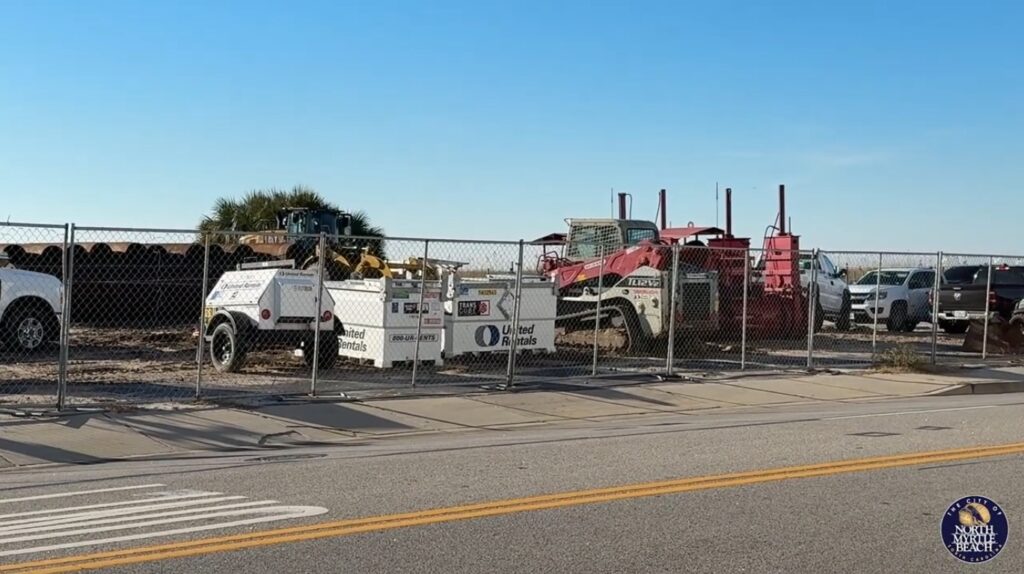
Miles from the coastline, a dredge collects sand from permitted offshore sites. This sand is carried through underwater pipes to pump stations onshore, where a mixture of sand and water flows onto the beach. From there, crews shape the sand into a new, healthy beachfront.
A Moving Work Zone
Only a 1,000-foot section of the beach is closed at a time, typically for just 2–3 days. The crews work around the clock, and as soon as one zone is complete, they move farther down the shoreline. Everywhere else, the beach stays open.
For families staying in North Myrtle Beach, Cherry Grove is the first section to be worked on, beginning December 15, 2026. Myrtle Beach follows in February, then Surfside and Garden City starting in April.
Two Million Cubic Yards of Sand
That’s roughly the equivalent of 200,000 dump trucks—enough to restore 26 miles of shoreline. The project is funded entirely at the federal level, with $72 million dedicated to protecting life, property, infrastructure, and tourism.
Protecting Wildlife While Rebuilding the Beach
The Grand Strand is home to sea turtles, shorebirds, and other marine life that depend on a healthy coastline.
Renourishment includes strict environmental safeguards, such as:
Daily monitoring for sea turtles and birds
Relocation of nests when necessary
Stopping work immediately if wildlife enters the active zone
Gentle shaping of sand to preserve natural contours
It’s a rare blend of engineering and environmental stewardship—reshaping the shore without losing sight of the life it supports.
What Visitors Can Expect
Even with large machinery and movement along the coastline, vacationers can still enjoy their time at the beach.
Short-Term Closures Only
Closed areas are well marked and small in size. The rest of the shoreline remains open, and many guests find the renourishment work fascinating to watch from a safe distance.
Safe Access Points
Barriers, designated crossovers, and signage help guests navigate around pipelines and equipment. The process is designed with safety and minimal disruption in mind.
Unexpected Beach Treasures
Fresh sand often uncovers seashells, sea glass, and even shark teeth that haven’t been exposed in years. Many beachcombers describe renourishment seasons as some of the most rewarding for discovery.
Why This Matters for the Future
When the waves settle and the equipment moves on, what remains is a stronger, wider beach—better able to withstand storms, support marine habitat, and welcome families each season.
Renourishment doesn’t just prepare the shoreline for tomorrow; it preserves the Grand Strand experience we know today. From sunrise strolls to sandcastle traditions, these moments endure because the coastline is cared for.
Where to Find Reliable Updates and Helpful Resources
Even though renourishment moves quickly along the shore, it’s natural for visitors—and locals—to want the latest details. Fortunately, several trusted organizations update the public in real time, making it easy to stay informed as the project progresses.
Visit Myrtle Beach – Community Resource Page
This page offers a clear overview of the renourishment effort, along with visitor-friendly explanations about what to expect during different project phases. It’s one of the best places for families to get quick, easy-to-understand updates about beach access. Resource:https://www.visitmyrtlebeach.com/things-to-do/beaches/beach-renourishment
U.S. Army Corps of Engineers – Official Project Information
One of the most useful tools is the real-time tracking map, showing exactly where crews are working along the coastline each day. Whether planning a morning walk or checking which section of the beach will be widened next, this map offers a simple, visual way to stay up to date. Resource: https://experience.arcgis.com/experience/266cbf20d5f84dec969d1e943cdbf618/page/Myrtle?org=cesac
Together, these resources offer a complete picture—practical for visitors, helpful for locals, and reassuring for anyone eager to understand how the Grand Strand’s shoreline is being restored with care and expertise.
Plan Your Beach Vacation with Confidence
At Thomas Beach Vacations, we stay closely informed on renourishment progress and guide our guests with real-time updates, local insight, and information that helps them plan with ease. The beach remains open, the ocean still sparkles, and the Grand Strand continues to be one of the most welcoming destinations on the East Coast.
If you’re planning a getaway—or returning to a place you love—our team is here to help you choose the right rental and stay informed along the way. Reach us anytime at 843-273-3003 or explore our homes and condos at www.northmyrtlebeachvacations.com.