



Table of Contents
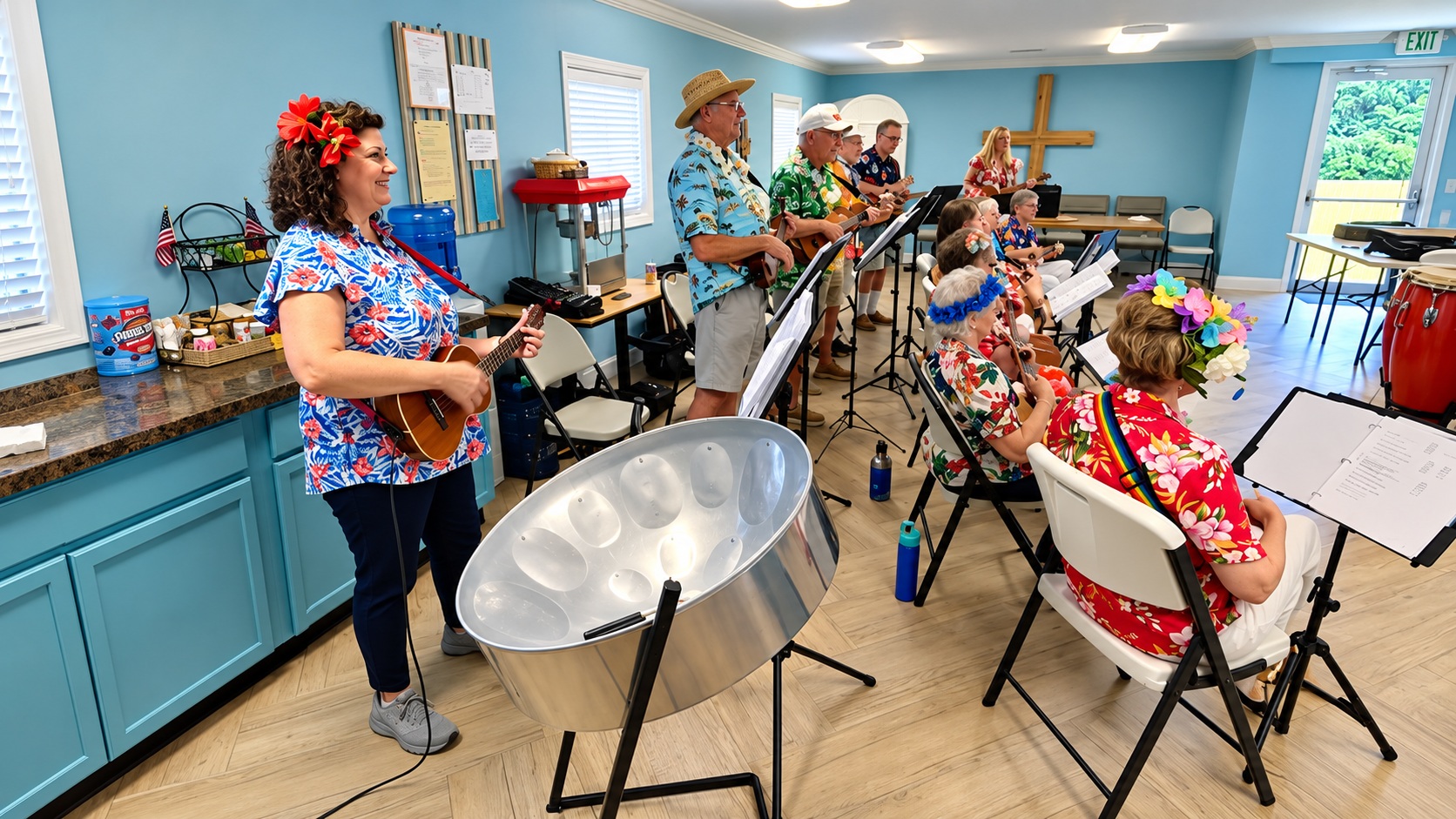
Twenty-five ukuleles do not sound the way one ukulele sounds. One is a toy on a porch, a four-string plink that makes people smile and then forget it. Twenty-five, strummed together on the downbeat by a room full of retirees who found the instrument late and fell hard, is something closer to a tide coming in. It fills the space. It has a bottom to it. And when the songs are the ones everybody in the room grew up with, Buffalo Springfield and Peter, Paul and Mary and the Beatles, the audience tends to sing along before they have decided to.
That is the sound of Ukes by the Sea, a Grand Strand ukulele ensemble that has been quietly growing for about three years and that caught the attention of regional television this fall. A Gray Media feature from the Aging Untold series, carried most recently by Live 5 News in Charleston, introduced the group to viewers across the Carolinas: a director with a lifetime in music, a roster that mixes seasoned players with people who picked up their first instrument in retirement, and a songbook that runs from 1960s rock through folk and contemporary tunes with a few African-influenced pieces mixed in. For anyone planning a slower, off-season visit to the beach, it is a reminder that the music here does not stop when the summer bands pack up.
This article is about the group, the man who leads it, and why the ukulele, of all instruments, has found such a natural home on this stretch of South Carolina coast. It also covers where live music lives along the Grand Strand in the quieter months and how to build a trip around it, because the people who book a condo on the oceanfront in November are usually the ones who want exactly this kind of afternoon.
Twenty-Five Ukuleles and One Very Happy Sound
Ukes by the Sea is, by the count given in the feature, a twenty-five-member ensemble that performs around the Myrtle Beach community. The group formed roughly three years ago, which puts its beginnings in the stretch after the pandemic when a lot of people along the coast were looking for a reason to gather in a room and do something with their hands. The repertoire leans on the music its members know by heart: rock and folk from the sixties and seventies, contemporary songs, and, according to the director, some pieces with African roots that give the group a wider palette than the standard campfire set.
The feature’s reporter, Loren Korn, framed the group around a simple observation from its director, Tom Woodle: it is very hard to play a ukulele and frown at the same time. He called the instrument’s sound a happy one, and he described the group’s purpose in plainly spiritual terms, as a way of sharing the love of Jesus through cheerful music. That faith dimension is not incidental. Woodle served as a senior rector at The Well by the Sea, a Grand Strand church, and the ensemble grew out of the same community-minded instinct that runs through a lot of volunteer music on this coast, from the shag clubs on Main Street to the church choirs that fill the Alabama Theatre at Christmas.
What the feature did not include, and what we could not independently confirm, is a public rehearsal schedule, a regular performance venue, or a published way to join. The group appears to operate through word of mouth and community connections rather than a website or a ticketed calendar. If that changes, we will update this article; until then, treat Ukes by the Sea as something you might happen upon at a church event, a community fair, or a senior-center afternoon rather than something you can buy a ticket for in advance.
The Director Who Started at Four
Tom Woodle’s music resume reads like a Carolina life in miniature. By his own account in the feature, he started playing at age four, was performing on live radio by six, and was playing in bands by eleven. He went on to perform with The Reedy Creek Band, a group that reached a top-100 chart in Nashville, and later taught at Coastal Carolina University in Conway, the same campus whose students help run the city’s Halloween BOOnanza every October. His years as senior rector at The Well by the Sea came after that, and the ukulele ensemble came after that still, which makes it, in a sense, the third or fourth act of a career that never stopped making noise.
The thread running through all of it is accessibility. A man who has played professionally for sixty years could have chosen any instrument to build a community around. He chose the one that a seventy-year-old with no musical background can learn to strum through a three-chord song in an afternoon. That choice says something about the group’s priorities, and it explains why a roster of twenty-five includes people who, two years ago, had never held an instrument.
Why the Ukulele Fits This Coast
The ukulele came to the American mainland from Hawaii in the early twentieth century and has had three distinct waves of popularity since: the 1920s, the 1950s, and the one we are in now, which started around the time YouTube made it easy to learn a chord shape from a stranger. The instrument’s recent surge has been driven in large part by adults over fifty, and the reasons are practical. A ukulele is small enough to carry in a tote bag. It is inexpensive. Its nylon strings are gentle on fingers that have arthritis or simply have never built calluses. And its four strings, tuned so that an open strum already sounds like a chord, mean that a beginner gets a musical result in the first ten minutes rather than the first ten weeks.
Along the Grand Strand, where a large share of the year-round population is retired and where the seasonal rhythm leaves long quiet stretches between October and March, those qualities matter. The region already has an outsized live-music culture for its size. The shag clubs on Ocean Drive have kept beach music alive since the 1950s, the Carolina Beach Music Awards return to the Alabama Theatre every November, and venues from the House of Blues at Barefoot Landing to the small stages at Little River’s waterfront restaurants book bands nearly every night of the year. A ukulele ensemble slots into that landscape without friction. It is portable, it is cheerful, and it sounds right next to salt water.
Most of Them Had Never Played a Note
The member the feature spent the most time with was Kristen Toben, who plays ukulele and steel drum with the group. Her account tracks with what music teachers hear from adult beginners everywhere: she described music as something that lifted her spirits and reminded her how much she had always loved it. She also made a point about the ensemble as a whole that is worth dwelling on. Most of the members, she said, had never played an instrument until roughly two years earlier, and she was proud of how far they had come. Twenty-five people who could not read a chord chart in 2024 are now performing arrangements of songs with real harmonic movement in front of audiences, and doing it in time with one another.
That is the part of the story that travels. Visitors who come to North Myrtle Beach in the off-season tend to be older, tend to stay longer, and tend to be looking for exactly this sort of thing: a reason to be in a room with other people, a skill to pick up, a community to drop into for a week or a month. The group is not, as far as we can tell, a drop-in class for visitors. But its existence points to a larger truth about the north end in winter, which is that the social calendar does not empty out, it just moves indoors and gets a little more personal.
Ukes by the Sea at a Glance
| Detail | What the feature reported |
|---|---|
| Group name | Ukes by the Sea |
| Director | Tom Woodle, former CCU instructor and senior rector at The Well by the Sea |
| Members | About 25, mixing experienced musicians and beginners |
| Age of the group | Roughly three years |
| Repertoire | 1960s and 1970s rock, folk, contemporary songs, some African-influenced music |
| Where they play | Community events around the Myrtle Beach area; no public schedule published |
| Coverage | Gray Media / Aging Untold feature by Loren Korn, carried by Live 5 News, October 22, 2026 |
Where Live Music Lives on the Grand Strand
If Ukes by the Sea is the hidden end of the Grand Strand’s music scene, the visible end is easy to find, and a fall or winter visit is the best time to see it without the summer crowds. On the north end, the shag clubs along Main Street in Ocean Drive, Fat Harold’s and Duck’s and the OD Arcade among them, run beach music and live bands year-round, and the dance floors are more forgiving to a beginner in January than they are during SOS week. The House of Blues at Barefoot Landing in Windy Hill books national touring acts through the winter, and the Alabama Theatre next door hosts the Carolina Beach Music Awards on November 8 this year before rolling into its holiday show.
Up the road in Little River, the waterfront restaurants along Mineola Avenue, Hurricane Juel’s and Mako’s and the Pilot House, keep live music on their decks well past Halloween, and the view across the Intracoastal is better when the light goes early. Down in Murrells Inlet, the MarshWalk’s eight restaurants share a boardwalk and a steady rotation of acoustic players, and the Thursday-through-Sunday music calendar there runs through the holidays. For the full picture, our guide to things to do in Myrtle Beach at night covers the venues in more depth, and the complete guide to things to do in Myrtle Beach sets the music in the context of everything else.
Bringing Your Own Ukulele to the Beach
A surprising number of our winter guests travel with an instrument, and the ukulele is the one that fits in the overhead bin. A few practical notes from people who do it. Salt air and the humidity swings between a heated condo and a cool balcony are hard on wood, so a laminate-body instrument travels better than a solid-top one, and a cheap digital hygrometer in the case is worth the five dollars. Nylon strings go flat in the cold, so tune after you have been outside for a few minutes rather than before. And the best place to play is not the beach itself, where the wind carries the sound away, but the covered porch of a beach house in Cherry Grove, where the channel behind the house gives you an audience of pelicans and the occasional neighbor who wanders over to listen.
For guests who want to learn rather than just play, the Grand Strand has music stores in Myrtle Beach and Murrells Inlet that sell starter ukuleles and offer lessons, and the Horry County library branches run occasional adult music programs in the off-season. On a rainy day, our indoor guide to North Myrtle Beach has the rest.
A Slower Week in North Myrtle Beach
The kind of visitor who reads a story about a retiree ukulele ensemble and thinks, that sounds like my week, is usually the kind of visitor the north end was built for. Late fall and winter here are quiet in the right way. The beach is empty enough to walk for an hour without passing anyone, the restaurants seat you immediately, and the rates on oceanfront homes and condos drop to a fraction of July. Guests who stay a month or more, and many do, find that the community opens up to them: the church suppers, the library programs, the Tuesday-night music at the shag club where the regulars will teach you the basic step if you ask.
Crescent Beach and Windy Hill are the easiest sections for a long winter stay, with the oceanfront condos clustered close to the grocery stores on Highway 17 and a short drive from Barefoot Landing. Cherry Grove’s oceanfront homes suit families and groups who want a porch and a yard, and Ocean Drive puts you within walking distance of Main Street and its music. For families traveling with children, our guide to the best kid-friendly things to do in North Myrtle Beach fills the daytime hours, and the concierge page gathers everything else.
Plan a Slower Season on the North End
Thomas Beach Vacations has been placing families in North Myrtle Beach oceanfront homes and condos since 1962, and our winter and monthly rates are among the best values on the coast. Bring the ukulele.
Frequently Asked Questions
The best thing about a place with a music scene this deep is that some of it never makes the tourism brochures, and you only find it by being here long enough to hear about it. Ukes by the Sea is that kind of thing. Thomas Beach Vacations has been helping people stay long enough since 1962, with oceanfront homes and condos across all four sections of North Myrtle Beach and some of the best monthly rates on the coast once the season turns. Browse availability at northmyrtlebeachvacations.com or call (843) 273-3001, and if you hear twenty-five ukuleles somewhere on the north end this winter, stop and listen.
Source: “Ukulele group brings island vibes to popular South Carolina vacation area,” by Loren Korn for Gray Media’s Aging Untold series, published by Live 5 News (WCSC) on October 22, 2026. Details about the group’s membership, repertoire, and leadership are as reported in that feature; the group has no published performance schedule, and visitors should not expect ticketed events.