




The Road That Built America — And Still Runs Through North Myrtle Beach
Table of Contents
- A Road Hiding in Plain Sight
- Origins: From Native Trail to the King’s Road
- Building the Road Through the Grand Strand
- The Boundary House: Where the Revolution Arrived in South Carolina
- Washington Plans the Southern Tour
- April 27, 1791: The President Crosses Into South Carolina
- The Night at the Vereen Plantation
- April 28: Onto the Long Beach of the Ocean
- Windy Hill: A Name Born From That Morning
- Washington Continues South: Pawleys, Hampton Plantation, and the Washington Oak
- The Road Today: Where You Can Walk It
- Frequently Asked Questions
You have almost certainly driven it. If you have ever turned off the interstate and headed toward the beach on U.S. 17, if you have ever sat at a traffic light on Kings Highway in Myrtle Beach watching the procession of summer afternoon traffic inch south, if you have ever navigated the strip from Ocean Drive down through Crescent Beach and Windy Hill — you have been traveling the King’s Highway. You just did not know it.
This is Article 2 of the Thomas Beach Vacations America 250 series, and it follows one of the most consequential roads in American history from its origins as a Native American coastal footpath all the way to a specific two-day stretch in April 1791, when the first president of the United States rode it through what is now North Myrtle Beach and recorded every detail in his diary. The King’s Highway carried the first postal riders between the colonies. It moved British troops and revolutionary militia. It delivered the news of the first shots fired at Lexington — the news that started the American Revolution — to a house in Little River before anyone in Charleston had heard a word of it. And then, twelve years after independence, it brought George Washington himself to this coastline, where the open beach between Little River and Pawleys Island did what it has always done to hats and expectations: it refused to cooperate.
The road is still here. So is the story.
A Road Hiding in Plain Sight
Most roads accumulate history quietly. They do not announce it. A road that has been traveled for three hundred years looks, on a Tuesday afternoon in June, exactly like any other road — asphalt and traffic signals and the occasional green sign telling you what town is ahead and how many miles. The King’s Highway is that kind of road. Its history is embedded in the pavement beneath the rental cars and delivery trucks, in the straight-line logic of a corridor that Europeans formalized from trails that Indigenous people had already been walking for centuries before them. You do not feel it. You drive it.
But knowing the history changes the drive. When you cross from North Carolina into South Carolina on U.S. 17 just north of Little River, you are crossing the same line that George Washington crossed on horseback on April 27, 1791. The intersection at Heather Lakes Drive, a half-mile or so south of the state line on the left side of U.S. 17, is where Horry County has placed a historical marker describing the Boundary House — a colonial-era public house where, in May 1775, the first dispatch reporting the Battle of Lexington arrived in South Carolina, carried by a rider on the King’s Highway. The news of the Revolution came to this spot before it reached Charleston.
Most people drive past the marker without slowing down. That seems like a loss worth correcting.
Origins: From Native Trail to the King’s Road
The King’s Highway did not spring into existence by royal decree. It grew from something much older — a network of footpaths and trade routes used by the Indigenous peoples of the Atlantic coastal plain for generations before any European arrived to name or number them. The Waccamaw, the Catawba, the Winyah, the Tuscarora, the Lenape — each nation maintained trails connecting hunting grounds, fishing sites, and trade partners along the coast. When European colonists arrived and began moving between settlements, they did what travelers have always done: they followed the paths that were already there.
By the mid-seventeenth century, English settlers from Virginia were pushing south and English settlers from Carolina were pushing north, and a continuous road connecting the two was clearly needed for commerce, communication, and defense. Around 1660, King Charles II issued the orders that set formal road construction in motion. What followed was not a single coordinated project but a patchwork of colonial governments each building their section toward the others, over decades. The whole effort took the better part of a century. The South Carolina section — the stretch that crosses through Horry and Georgetown counties, crossing the North Carolina line just above Little River — was built between 1739 and 1750, making it one of the last sections completed. By the early 1750s, for the first time, a traveler could ride an uninterrupted road from Boston to Charleston, roughly 1,300 miles, without having to find a boat or bushwhack through forest.
It was, even by contemporary accounts, not a pleasant road. Travelers who rode the section between Wilmington and Charleston described it as among the most tedious and disagreeable stretches of road on the continent. The coastal plain offered mile after mile of pine barren and swamp. The rivers and swashes had to be forded or ferried, and the timing of both was hostage to the tides. Sandy soil grabbed at wagon wheels. The bridges that existed were poorly maintained, and the ones that did not exist required travellers to wade or swim. George Washington, a man who had crossed the Delaware River in a blizzard with an army at his back, would later record his particular frustration with the Grand Strand swashes. Even the first president had to wait for the tide.
Building the Road Through the Grand Strand
The Grand Strand section of the King’s Highway presented particular engineering challenges. The barrier island geography of the northern Grand Strand — shallow swashes that flooded at high tide, soft sand that gave no footing for horses, and the broad exposure of the open beach strand between river crossings — meant that the road here was less a built road than a managed corridor. Travelers relied on local knowledge as much as on any formal road surface. The swash crossings in particular demanded both precise timing and a guide who understood the tidal rhythms.
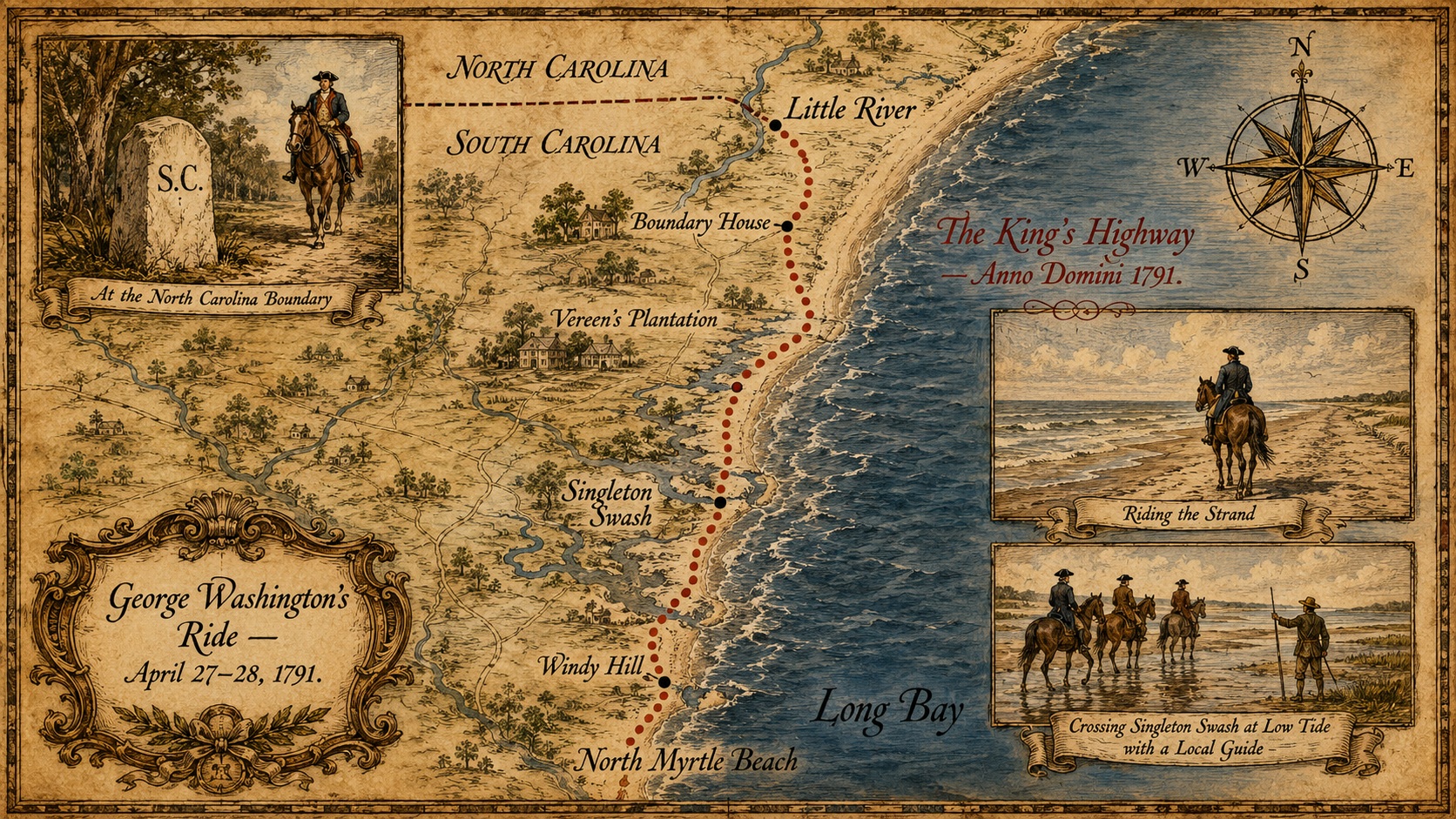
The road ran inland from the coast in many stretches — cutting through pine barrens behind the barrier islands — but in the northern Grand Strand, where the geography permitted, travelers sometimes rode the beach strand itself, using the hard-packed wet sand at the tideline as the road surface. This is exactly what Washington would do in 1791: cross the swash at what is now Singleton Swash near North Myrtle Beach, ride south along the open beach for sixteen miles, and then cut inland again to reach the settlements around Pawleys Island and Georgetown. The beach was the road. The tide was the traffic signal. The local guide was the GPS.
The families who settled along this stretch of the King’s Highway became, in effect, the infrastructure of the route. They ran the public houses where travelers ate and slept. They maintained the ferries across the larger rivers. They served as guides across the swashes. The Gause family operated a tavern near the North Carolina line beginning around 1740 — the same family whose house Washington would breakfast at on the morning of April 27, 1791. The Vereen family farmed and fished the land just south of Singleton Swash, and Jeremiah Vereen became the region’s acknowledged expert on tidal crossings. When the first president of the United States needed to cross that swash, Vereen was the man he asked.
The Boundary House: Where the Revolution Arrived in South Carolina
Before the King’s Highway carried Washington south in peace, it carried revolution north in alarm. On April 19, 1775 — the morning the first shots of the American Revolution were fired at Lexington and Concord, Massachusetts — a postal rider was already preparing to carry the dispatch south along the King’s Highway. The news moved fast by the standards of the era, but the era’s standards were measured in days and weeks, not hours. By May 9, 1775, the dispatch had traveled roughly a thousand miles south and arrived at the Boundary House, a colonial-era private residence and public house sitting directly on the South Carolina–North Carolina line near Little River.
The man who received it was Isaac Marion — the eldest brother of Francis Marion, who would within five years become the most famous guerrilla commander in the American Revolution and earn the name the Swamp Fox. Isaac read the dispatch and immediately forwarded it to the Committee of Safety in Little River. From Little River it moved south to Georgetown, and from Georgetown to Charleston. The news of the first shots of the Revolution traveled to South Carolina along the King’s Highway, and its first stop on South Carolina soil was this small public house in Little River. The British themselves had built the road that carried the news of their own undoing to the southernmost reaches of their American colonies.
Walter Hill, director of the Horry County Museum in Conway and a historian who has studied the King’s Highway in depth, has put it plainly: the King’s Road is the thoroughfare that delivered the news of Lexington and Concord to South Carolina, and it arrived first at the Boundary House in Little River. A historical marker erected by Horry County in 2005 — placed on the left side of U.S. 17 at the Heather Lakes Drive intersection — commemorates this. It is easy to miss at highway speed. It is worth stopping for.
Washington Plans the Southern Tour
By the spring of 1791, George Washington was two years into his first term as president of a republic that was still, in practical terms, an experiment. The Constitution had been ratified. The new federal government had been assembled. But the question of whether ordinary citizens from Virginia to Georgia actually trusted this new government — felt it was their government, felt its authority as legitimate rather than merely theoretical — was still very much open. Washington understood this the way a general understands terrain. He had been thinking about a tour of the southern states since at least October 1789, when John Jay told him such a visit would be expected.
He set out from Philadelphia on March 21, 1791, traveling in a white chariot painted with the four seasons on its doors and the Washington coat of arms on its panels, drawn by four brown horses. Outriders in bright red-and-white livery accompanied the procession. Major William Jackson served as his aide. A valet de chambre, two footmen, a coachman, and a postilion rounded out the party. Four saddle horses traveled with them, including Prescott, Washington’s tall white charger, in case the president wished to ride rather than be driven. The whole procession was unmistakable and deliberately so — this was not a quiet tour of inspection but a public statement of presidential presence in every region the new republic claimed as its own.
Washington’s route took him south from Philadelphia through Virginia and the Carolinas, targeting every significant town along the eastern seaboard before turning inland for the return journey through Georgia, South Carolina, and North Carolina. He kept his diary throughout — the same meticulous diary he had maintained for decades, recording distances, road conditions, the names of houses where he slept, the names of the men and women who received him, and the quality of the terrain through which he passed. His diary entries from April 27 and 28, 1791, are the primary documentary record of what happened when the first president of the United States crossed onto the Grand Strand.
April 27, 1791: The President Crosses Into South Carolina
That morning Washington breakfasted at the home of William Gause, near Ocean Isle Beach in Brunswick County, North Carolina — about ten miles from the state line. The Gause family had operated a tavern for travelers on the King’s Highway since around 1740, and Washington’s breakfast there was both a practical necessity and a political gesture: stopping at the homes of prominent local families was how the tour worked, how Washington pressed the flesh of the republic’s emerging gentry class and assured them that Philadelphia knew their names.
In his diary, Washington recorded the day with his characteristic precision. He crossed the boundary line between North and South Carolina, he wrote, at about half past twelve o’clock — roughly ten miles from Gause’s. Two miles further he dined at a private house belonging to a man named Cochran, a Revolutionary War veteran who lived near Little River. And then, he wrote, he lodged at Mr. Vareen’s — fourteen miles more and about two miles short of the long bay. Vareen’s plantation sat near the intersection of what is now U.S. 17 and Lake Arrowhead Road, just south of Singleton Swash. Washington noted that he was entertained there very kindly, without being able to make compensation. Jeremiah Vereen refused to take the president’s money. It is the kind of detail that makes a diary entry human.
The Night at the Vereen Plantation
The Vereen family were among the earliest European settlers of the northern Grand Strand. Their land sat in the geography that most challenged travelers on the King’s Highway: the stretch of tidal swashes, barrier islands, and open beach that made the road here less a road than a series of judgment calls about wind, tide, and sand. Jeremiah Vereen — scholars debate whether Washington’s host was Jeremiah Sr. or his son Jeremiah Jr. — was the acknowledged expert on those crossings. He knew Singleton Swash the way a harbor pilot knows a channel: by feel, by experience, and by the kind of local knowledge that cannot be acquired from a map.
Washington’s party spent the night at the Vereen plantation. It was not a grand accommodation — the president had been disappointed throughout his journey that the distances between public houses in the Carolinas forced him repeatedly into private homes, where he felt the burden of being an unexpected houseguest on families who could not possibly have prepared for a presidential visit. But Vereen, whose home sat at the gateway to the most difficult stretch of the Grand Strand route, was accustomed to travelers. And in the morning, he did what he had done for countless others who needed to cross the swash: he guided them.
April 28: Onto the Long Beach of the Ocean
Washington’s diary entry for April 28, 1791 is, by his own spare standards, almost lyrical. He wrote that Mr. Vareen piloted them across the swash — which at high water is impassable and at times, by the shifting of the sands, is dangerous — on the long beach of the ocean. And it being at a proper time of the tide, they passed along it with ease and celerity to the place of quitting it, which is estimated sixteen miles.
Sixteen miles along the hard-packed Atlantic beach, with the surf breaking to the east and the open sky overhead. The swash crossing was at what we now call Singleton Swash, near the Dunes Golf and Beach Club. The sixteen miles of beach ran south through what is now the heart of North Myrtle Beach and into the northern end of Myrtle Beach, before Washington’s party turned inland toward the home of George Pawley — whose family name the island and the community of Pawleys Island still carry today. The diary records that they had dinner there and fed their horses, and then rode ten more miles to the home of a Doctor Flagg, where they spent the night. Thirty-three miles from Vereen’s in a day that began with a tidal crossing at dawn.
The beach Washington rode is the same beach that visitors walk today between Cherry Grove and the southern end of Windy Hill. The Atlantic has moved somewhat — barrier beaches migrate over centuries — but the essential character of the place, the exposure and the width and the way the wind comes off the ocean with nothing to slow it, has not changed. Washington’s carriage and horses would have been moving along a beach that looks, in its fundamentals, very much like the beach a visitor sees from an oceanfront rental balcony today.
Windy Hill: A Name Born From That Morning
Here the history shades into tradition — and tradition, on the Grand Strand, is worth taking seriously even when it cannot be pinned to a diary entry. Local accounts, preserved in Horry County historical records and in the institutional memory of the communities that would eventually become North Myrtle Beach, hold that the area known as Windy Hill got its name in connection with Washington’s 1791 visit. The exposed coastal dunes and open beach of this particular stretch of the strand were memorably windy, and Washington’s passage gave the community its occasion to name what the wind already made plain.
The precise version of the story varies depending on who is telling it. Some accounts say Washington’s hat blew off repeatedly as his party crossed the open dune line; others say he remarked on the wind while crossing an exposed rise. The North Myrtle Beach High School’s own institutional history notes honestly that the hat story is “one myth about his time here.” What is not myth is Washington’s documented presence, his documented route along the beach strand through this area, and the documented windiness of the site — all of which the local community threaded together into a name that stuck through two centuries and three incorporations, all the way to the 1968 merger that made Windy Hill one of the four original communities of North Myrtle Beach.
Whether you favor the hat version or the dune version, the underlying fact is the same: a name that appears today on vacation rental listings and real estate signs and road signs up and down the Windy Hill beachfront traces its origins to a blustery April morning in 1791 when the first president of the United States rode sixteen miles along this shore and the wind off the Atlantic made him know exactly where he was.
Washington Continues South: Pawleys, Hampton Plantation, and the Washington Oak
After leaving the beach strand and dining at George Pawley’s house, Washington continued south toward Georgetown, which he reached on April 30. He spent the night in Georgetown and then, on the morning of May 1, traveled south to Hampton Plantation near McClellanville — a working rice plantation owned by the Horry family, whose name you will recognize from the county that surrounds Myrtle Beach. Hampton Plantation was where Washington had what may be the most remembered moment of his entire Grand Strand passage.
He was received there for breakfast by Eliza Lucas Pinckney — the pioneering agricultural scientist who had introduced indigo cultivation to South Carolina decades earlier and who was, at this point in her life, in her seventies and one of the most celebrated women in the state. Her daughter Harriott Horry received him alongside her. At some point during the visit, Washington was asked about a large live oak tree growing in front of the plantation house. The tree was old, perhaps too close to the house, and the family was considering removing it. Washington looked at the tree. He said, according to the account that has been passed down through multiple sources, let the tree stand. The tree stood. It stands today — now estimated to be somewhere around 270 years old, a living oak on the grounds of Hampton Plantation State Historic Site, still called the Washington Oak. Hampton Plantation is open to visitors and is about an hour’s drive south of North Myrtle Beach oceanfront homes.
The Road Today: Where You Can Walk It
The King’s Highway did not disappear. It evolved. U.S. Highway 17 — the road that enters South Carolina just north of Little River and runs south through the Grand Strand all the way to Georgetown and beyond — is its direct descendant. The SC Encyclopedia calls U.S. 17 “the linear descendant of the King’s Highway.” In some stretches, modern U.S. 17 follows the exact colonial path. In others, the roads diverge — developers, hurricanes, and infrastructure projects have moved things around over three centuries. Kings Highway was not paved until 1940. For its first two centuries, it was the same sandy, rutted, tide-dependent track that Washington described as among the more challenging roads he had encountered in a lifetime of riding difficult terrain.
The best place in the Grand Strand to walk a preserved section of the original roadbed is the Vereen Memorial Historical Gardens in Little River, at 2250 SC-179. The gardens preserve a stretch of the old path within about fifty feet of the current U.S. 17 — you can stand on the original roadbed and watch modern traffic pass fifty feet away. It is open daily and free. The walking trails wind through old-growth coastal forest where enormous live oaks and longleaf pines shade a path that postal riders, militia troops, British soldiers, enslaved people, merchants, and at least one president traveled before the United States had a Supreme Court. It is one of the most historically significant and least-visited public spaces on the entire Grand Strand.
| Site | Location | King’s Highway connection |
|---|---|---|
| Vereen Memorial Historical Gardens | 2250 SC-179, Little River | Original roadbed preserved and walkable. Washington slept nearby on April 27, 1791. Open daily, free. |
| Boundary House Historical Marker | U.S. 17 at Heather Lakes Drive, Little River | Site where news of Lexington and Concord first arrived in SC on May 9, 1775. Marker erected by Horry County 2005. |
| Singleton Swash / Dunes Area | Near Dunes Golf and Beach Club, N. Myrtle Beach | The tidal crossing Washington’s party made on April 28, guided by Jeremiah Vereen. Start of the 16-mile beach ride. |
| Horry County Museum | 428 Main St, Conway | Washington’s Southern Tour and the King’s Highway documented in exhibits. 2026 Revolution exhibit. Free admission. |
| Hampton Plantation State Historic Site | McClellanville (~1 hr south) | Washington breakfasted here May 1, 1791. Said “Let the tree stand” — the Washington Oak is still alive on the grounds. |
| Georgetown Historic District | Front Street, Georgetown | Washington arrived April 30, 1791. Colonial streetscape largely intact. Rice Museum, Kaminski House, Maritime Museum. |
Frequently Asked Questions
Stay Where Washington Rode
The beach Washington described as “the long beach of the ocean” runs past the front door of every oceanfront rental Thomas Beach Vacations offers on the Grand Strand. From the Ocean Drive beachfront to the Windy Hill shoreline — where the first president rode and the wind that named the place still comes straight off the Atlantic — you are steps from one of the most historically layered beaches in America. Browse our oceanfront homes and oceanfront condos at northmyrtlebeachvacations.com, or call (843) 273-3001.
This is Article 2 of the Thomas Beach Vacations America 250 & the Grand Strand series. Read the series hub for the full nine-article overview, or continue with Article 1: Pirates, Planters, and the Birth of the Grand Strand. Historical facts verified against Washington’s published diary entries (The Diaries of George Washington, University Press of Virginia, 1979), the South Carolina Encyclopedia entries for King’s Highway, Highway 17, and North Myrtle Beach, the Horry County Historical Society’s Boundary House marker documentation, and Grand Strand Magazine’s feature on the Kings Road. Thomas Beach Vacations is a locally owned vacation rental company serving North Myrtle Beach, South Carolina. Note: This article replaces the earlier TBV article on the King’s Highway published in 2023; that URL now redirects here.