If the beach looked bigger on your last visit, you weren’t imagining it. Crews finished rebuilding eight miles of North Myrtle Beach shoreline in January 2026, part of a much larger project along the Grand Strand. Here’s what changed, why the sand underfoot might feel unfamiliar, and what all of it means for the way you spend a day out there.
There’s a question that comes up at check-in more often than you might expect, and it almost always comes from someone who has been renting the same week on the same stretch of sand for fifteen or twenty years. Is the beach bigger than it used to be? It’s a fair thing to wonder about, because memory has a habit of shrinking the places we love and then handing them back to us smaller than we left them. In this case, though, the answer is yes. Between the fall of 2025 and the last day of January 2026, crews rebuilt roughly eight miles of North Myrtle Beach shoreline, and if you were here before that work and have come back since, the difference you think you see is real.
What Actually Happened Out There
The work finished on January 31, 2026, and by the time the last of the equipment rolled off the sand, about 675,000 cubic yards of it had been pumped ashore and graded into place along those eight miles. North Myrtle Beach was only one piece of a much bigger undertaking: a 28-mile, $72 million project that reached from the north end of the Grand Strand down through Garden City and moved 2.15 million cubic yards of sand in total. If you want the engineering and the funding in detail, our full report on the renourishment lays it out.
Standing on the result, the thing you notice is width, plain and simple. The dry beach at mid-tide runs deeper than it did, which shows up in two ways over the course of a day. At high tide, when the old profile used to squeeze everyone up toward the dune line in the busy access areas, there is now noticeably more room to spread out. At low tide, the walk down to the water is longer than it used to be, which some people love and others grumble about while hauling a cooler.
Why the Sand Might Feel Unfamiliar
Renourishment sand doesn’t come from somewhere else on the beach. It’s dredged from borrow areas offshore and pumped in, and offshore sand tends to be a little coarser than what it replaces, with more shell mixed through it. Guests who know a particular stretch well often pick up on this before they notice anything else. It can feel firmer underfoot, a bit less like powder, and there may be more broken shell than you remember when you’re walking barefoot at the waterline.
This sorts itself out, and faster than most people assume. Waves are relentless graders, and over the course of a season or two they winnow the finer material toward the surface and push the heavier shell into bands and pockets. A beach that felt shelly the first summer after placement generally doesn’t feel that way by the second or third. The same goes for color: freshly dredged material can look darker in patches when it arrives, and it lightens as it dries out and weathers.
The Dunes Are Doing Real Work
A renourishment project doesn’t just lay down a flat apron of sand. It rebuilds the dune ridge behind the beach as well, and those new dunes are usually planted with sea oats and then fenced off while the root systems take hold. If you see orange or wooden sand fencing on your walk, that’s what it’s for.
It’s worth understanding why that fencing matters, because it looks like an inconvenience and isn’t. The vegetation is what anchors the sand when a storm comes through. Roots hold the dune together, and a dune that holds together is the last line between the ocean and everything behind it. Foot traffic through a young planting undoes months of growth in a single afternoon, which is why every beach access in North Myrtle Beach has a marked walkover and why it’s worth the extra thirty seconds to use one.
One practical note while you’re out there: sea oats are protected under South Carolina law. They’re beautiful in that late-afternoon light and they photograph wonderfully, but picking them carries a fine.
Why Anyone Builds a Beach on Purpose
It helps to think of the beach as infrastructure that happens to also be a wonderful place to spend a Tuesday. The berm and dune are engineered to a specific width and height, and the whole design rests on a simple idea: when a storm arrives, the waves should spend their energy tearing through sand rather than reaching the roads, the utilities and the buildings behind the dune line.
Which means the sand is supposed to disappear. That catches people off guard, and it’s the part most worth knowing. Losing a good deal of the beach in a bad storm isn’t the project failing. It’s the project doing precisely what it was built to do, and it’s why renourishment is understood as a cycle rather than a one-time fix.
Hurricane Ian in 2022 and Hurricane Debby in 2024 each took their turn, and between them they drew the profile down far enough to trigger federal emergency repair. That’s the erosion the 2026 work put back.
What It Means for an Ordinary Beach Day
Mostly it means elbow room. A wider beach shows up most obviously on a July afternoon at high tide, when the old profile used to get genuinely tight around the busier accesses and you found yourself setting up closer to strangers than anyone particularly wanted.
The tradeoff is the carry. If your setup involves chairs, an umbrella, a cooler and a couple of boogie boards, the extra distance from the boardwalk to the water is real, and a beach cart has gone from a nice-to-have to something you’ll be glad you brought.
There’s one small bonus worth watching for. Freshly graded beaches sometimes hold shallow runnels and tidal pools where water collects as the tide drops. They warm up fast in the sun, they’re only a few inches deep, and small children find them completely irresistible.
Which Stretches Were Covered
The January 2026 placement ran across the North Myrtle Beach segments, which takes in Cherry Grove Beach, Ocean Drive, Crescent Beach and Windy Hill.
Further south, the work carried on through the year. Myrtle Beach was renourished between May and early July, and the Surfside Beach and Garden City stretches wrapped up on August 15, 2026. So if your week takes you down the coast for a day, those beaches are freshly widened too.
Every segment is finished. There is no equipment on the sand anywhere along the Grand Strand, and nothing about the work should affect your plans beyond giving you more beach to put a chair on. If you’re still deciding where to stay, our oceanfront homes and oceanfront condos put you directly on it.
Frequently Asked Questions
Is there still construction on the beach?
No. The North Myrtle Beach segment finished on January 31, 2026, and the last stretch of the wider Grand Strand project, at Surfside Beach and Garden City, was completed on August 15, 2026. There is no equipment on the sand.
Why does the sand look and feel different?
Renourishment sand is dredged from offshore, and it tends to be coarser and carry more shell than the sand it replaces. Wave action sorts it out over a season or two, and freshly placed sand also lightens in color as it dries and weathers.
Is the wider beach permanent?
No, and it isn’t meant to be. The berm is designed to erode as it absorbs storm energy, which is exactly how it protects what sits behind it. Renourishment is a recurring cycle rather than a permanent fix.
Can I walk on the dunes?
Please don’t. Use the marked walkovers and beach accesses instead. Dune vegetation is what holds the sand in place during a storm, and sea oats are protected under South Carolina law, so picking them carries a fine.
How much sand was added in North Myrtle Beach?
About 675,000 cubic yards, spread along roughly eight miles of shoreline.
Did local taxpayers pay for it?
No. The $72 million project was fully federally funded as emergency repair following Hurricanes Ian and Debby, so the usual local cost-share requirement didn’t apply.
Sources: U.S. Army Corps of Engineers, Charleston District, via DVIDS and army.mil, September 17, 2026, for sand volumes, segment completion dates, project cost and funding. South Carolina sea oat protection and dune access guidance from state coastal management rules.
North Myrtle Beach Begins Preparations for Upcoming Beach Renourishment Project
🌅 A Shoreline Worth Protecting
For generations, the beaches of North Myrtle Beach have been more than a vacation destination—they’ve been a place where families gather, wildlife thrives, and visitors find peace in the steady rhythm of the waves. Every sunrise, every sandcastle, and every footprint left in the sand tells part of a shared story that stretches across generations.
Now, that shoreline is entering a new chapter of care. The City of North Myrtle Beach, working closely with the U.S. Army Corps of Engineers Charleston District, is preparing for a major Beach Renourishment Project that will strengthen and restore the coastline in the months ahead.
The project is currently in its mobilization and planning phase, with engineers, environmental experts, and local officials finalizing logistics before work begins in late 2025. This isn’t a response to crisis—it’s a forward-looking effort, grounded in science and stewardship, to protect the city’s most treasured natural asset for future generations.
By investing now, North Myrtle Beach ensures that its iconic shoreline remains wide, walkable, and welcoming—for residents, visitors, and the wildlife that call it home.
🏗️ The Grand Strand Beach Renourishment Project
In December 2024, the U.S. Army Corps of Engineers Charleston District awarded a $72 million contract to Great Lakes Dredge and Dock Company, one of the most experienced coastal engineering firms in the country. Their mission? To restore the beaches along 26 miles of the Grand Strand coastline, including North Myrtle Beach, Myrtle Beach, Surfside Beach, and Garden City.
This project will move roughly two million cubic yards of sand—the equivalent of 200,000 dump trucks—from offshore sources back onto the beaches. That’s enough to rebuild dunes, strengthen the coastline, and create a wide, resilient buffer against storms and erosion.
The renourishment is 100% federally funded, meaning no local tax dollars are used. It’s a remarkable partnership between federal engineers and local leadership, ensuring that one of South Carolina’s most beloved destinations continues to thrive.
📅 Project Timeline and Construction Details
Work officially begins with mobilization in October 2025 in North Myrtle Beach. Crews will start here, move south into Myrtle Beach in February 2026, and conclude in Garden City and Surfside Beach by mid-summer 2026.
Each week, teams will work in 1,000-foot sections—restoring, reshaping, and reinforcing the dunes as they move along. No section will be under construction for more than a few days at a time, minimizing disruptions for visitors and residents.
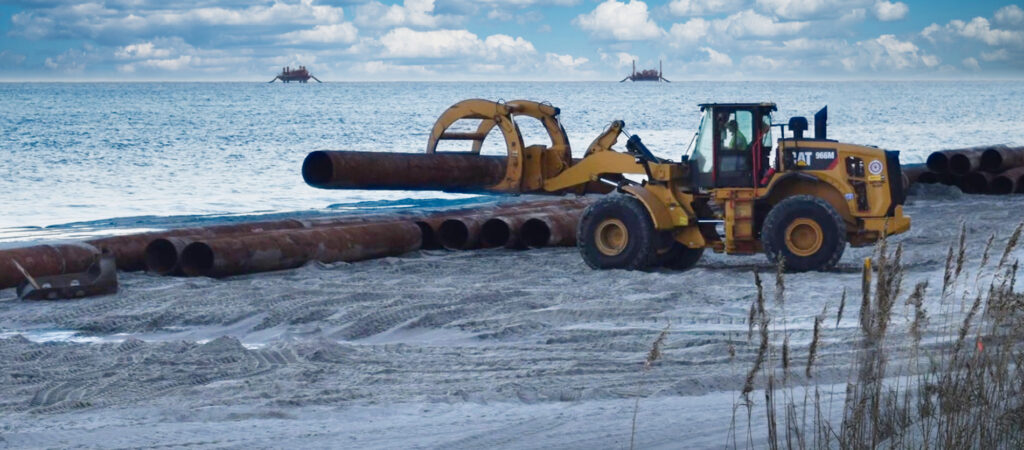
The timeline is carefully designed to avoid peak hurricane season and to stay on schedule, weather permitting. Crews will operate 24 hours a day, seven days a week, using specialized dredging and pumping equipment to move sand from the sea floor onto the beach.
Visitors may notice equipment, pipelines, and temporary fencing in active work zones, along with some noise from back-up alarms or lights during nighttime operations. But rest assured: the City and the Corps are taking every step to ensure public safety and convenience.
🐢 Protecting Nature and Wildlife
One of the most impressive aspects of this project is how it balances engineering precision with environmental care. Before any sand is moved, environmental specialists from the Corps and Horry County conduct daily monitoring of sea turtles, shorebirds, and marine life.
If a sea turtle nest is discovered in a construction area, it’s gently relocated by trained biologists. Hatchlings are monitored until they safely reach the ocean. Work halts immediately if turtles or protected wildlife are present.
Migratory shorebirds also receive daily observation, ensuring nesting sites remain undisturbed. This delicate balance between preservation and progress is central to the project’s mission: restoring the beach while safeguarding the creatures who call it home.
🚧 Public Safety and Beach Access
While the project involves heavy machinery and constant motion, safety remains the top priority.
Only active construction zones—about 1,000 feet at a time—will be temporarily closed to the public. Adjacent sections of the beach will remain open, and visitors can easily access the shore using the next available access point.
Signage, fencing, and city staff will clearly mark closed areas, and updates will be posted regularly online. The City encourages all beachgoers to stay alert, follow posted guidance, and respect safety barriers.
Most importantly, visitors can rest easy knowing that the majority of North Myrtle Beach’s shoreline will remain open throughout the process.

🤝 A Partnership for the Future
This renourishment effort highlights a long-standing partnership between local government, federal agencies, and private contractors. The U.S. Army Corps of Engineers Charleston District manages the project’s funding and execution, while the City of North Myrtle Beach ensures coordination, communication, and public engagement.
Together, they are ensuring the project runs efficiently, protecting not only the beach itself but also homes, businesses, and public infrastructure behind the dunes.
This partnership has proven its worth. During previous storms—like Hurricane Ian (2022) and Hurricane Debby (2024)—the dunes and prior renourishment efforts helped reduce storm surge and protect property. The system worked exactly as designed, proving that investment in shoreline protection pays real dividends in community safety.
🌴 Why Beach Renourishment Matters
Beach renourishment is about much more than aesthetics. It’s a coastal defense system and an economic safeguard rolled into one.
Healthy beaches provide:
- Storm surge protection: Dunes absorb the force of waves and prevent flooding.
- Wildlife habitat: Sea turtles, shorebirds, and coastal plants depend on wide, stable beaches to survive.
- Tourism stability: A strong, scenic shoreline attracts millions of visitors annually, fueling the local economy.
- Community identity: The beach defines North Myrtle Beach—it’s a shared resource, a cultural anchor, and a source of pride.
When the project wraps in mid-summer 2026, the beach will be wider, safer, and ready for another generation of beachgoers to enjoy.
📍 Tracking Progress and Staying Informed
Transparency is key to keeping the community connected to the project.
The City of North Myrtle Beach has launched an interactive Beach Renourishment Tracker showing live progress, work locations, and completion maps:
👉 North Myrtle Beach Tracker
The U.S. Army Corps of Engineers Charleston District also provides updates on their online project tracker and through their social media channels on Facebook, Instagram, and X at @CharlestonCorps.
Residents and visitors can follow along daily to see which sections of beach are active and when they’ll reopen.
🏖️ Plan Your Visit with Thomas Beach Vacations
The best news? North Myrtle Beach remains open, beautiful, and welcoming.
The renourishment work is just one more example of how this community protects what makes it special. And there’s no better time to experience that care firsthand. Whether you’re visiting this winter to catch a holiday show, walking the quiet shoreline in spring, or planning your summer escape, you’ll see the results of this stewardship in every grain of sand.
At Thomas Beach Vacations, we’re proud to be part of this story—helping families and friends experience the very best of North Myrtle Beach, year after year.
🌴 Explore our properties at NorthMyrtleBeachVacations.com or call (866) 249-2100 to plan your stay.
The beach is being renewed, restored, and made ready for you.